Amazon.com reviews are rigged

Amazon.com user reviews are a critical factor in increasing the sales for the giant retailer. The number of times, I have heard my wife say that she selected a particular product because of great user reviews, is far too high to count. These reviews can have significant credibility issues, though…In their great scholarly paper – Six degrees of reputation: The use and abuse of online review and recommendation systems – Shay David and Trevor Pinch point to some of the follies of user-generated reviews at Amazon.com:

Evidently, in many areas of cultural production user reviews are mushrooming as an alternative to traditional expert reviews. If there was any doubt, it has long ago been established that reviews and recommender systems play a determining role in consumer purchasing (an early review is available in Resnick and Varian, 1997) and recent qualitative research adds weight to the claim that these review systems have causal and positive effects on sales; to nobody’s surprise, books with more and better reviews are shown to sell better (Chevalier and Mayzlin, 2004). With people in the culture industries increasingly realizing this truism, many of the reviews are thus positively biased and it becomes very hard to distinguish the ‘objective’ quality of the reviews. In addition, due to the large variance in the quality of the reviews, and the varied agendas of the reviewers, user input too often becomes untrustworthy leaving the consumers with little ability to gauge an item’s actual quality. Do we live in a cultural Lake Wobegon where “all the books are above average?” (to paraphrase Keillor, 1985) Is there a way to review the reviewers, to guard the guards? As will be discussed in details below, emerging systems like the one employed on sites like Amazon.com (2005) suggest that there are ways to try to solve this bias problem by offering a tiered reputation management system which offers a set of checks and balances. But these new options also bring with them new problems as the participants adjust to what is at stake in this new economy of reputation.

They offer examples with links to amazon.com reviews:

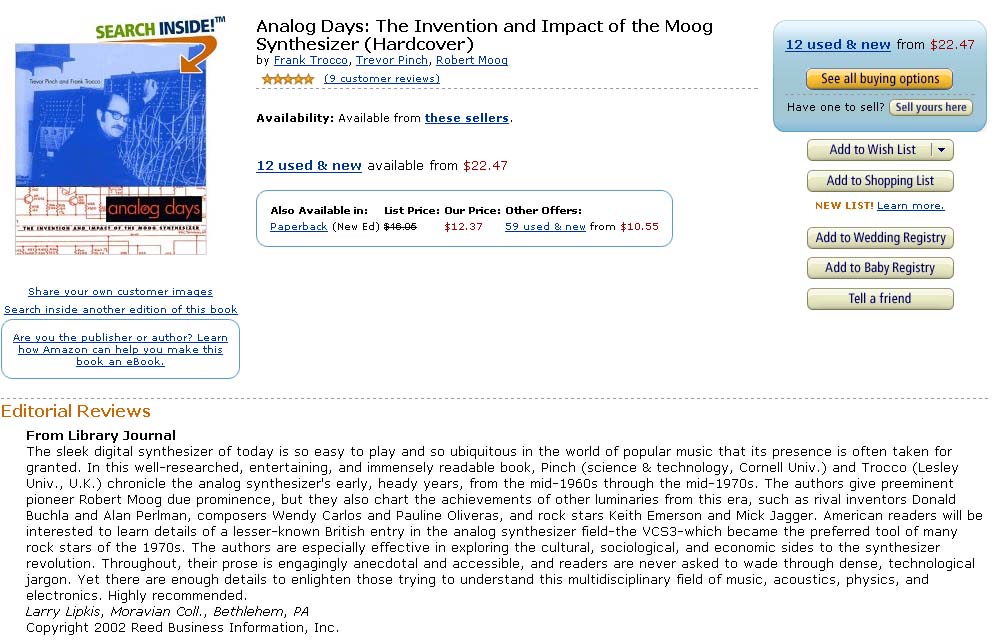
This instance concerned one of Pinch’s own books Analog Days: The Invention and Impact of the Moog Synthesizer (Pinch and Trocco, 2002). This book that chronicles the invention and early days of the electronic music synthesizer was well received by reviewers both offline and online, and the Amazon.com editors quote a review from the Library Journal that reads as follows:

… In this well–researched, entertaining, and immensely readable book, Pinch (science & technology, Cornell Univ.) and Trocco (Lesley Univ., U.K. [sic]) chronicle the synthesizer’s early, heady years, from the mid–1960s through the mid–1970s … . Throughout, their prose is engagingly anecdotal and accessible, and readers are never asked to wade through dense, technological jargon. Yet there are enough details to enlighten those trying to understand this multidisciplinary field of music, acoustics, physics, and electronics. Highly recommended. [link]

original review

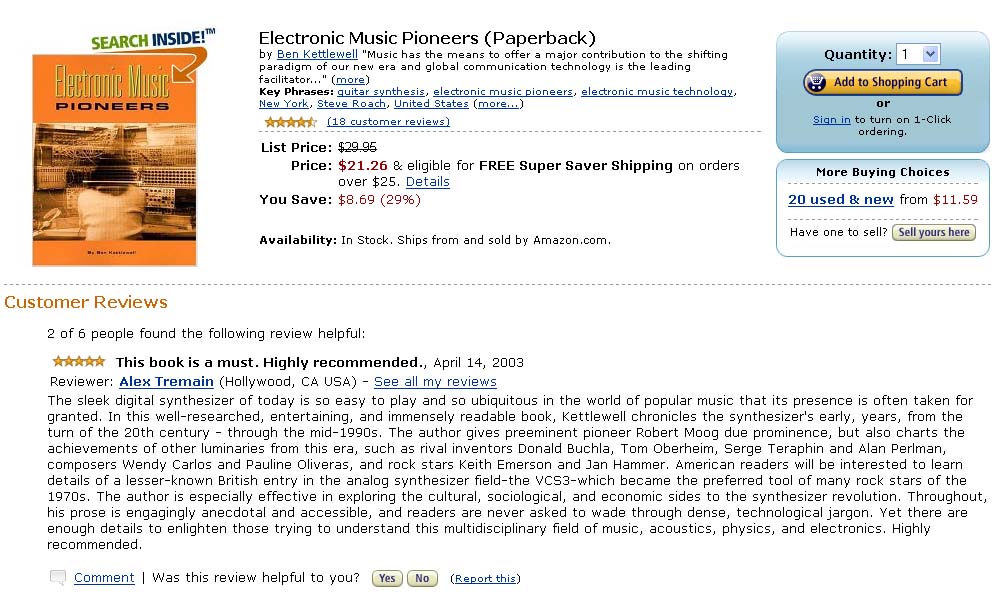
A similar (but distinctly different) book that had appeared earlier — Electronic Music Pioneers by Ben Kettlewell (Vallejo, Calif.: ProMusic Press, 2002) — received the following user review on Amazon.com on 15 April 2003:

This book is a must. Highly recommended., April 15, 2003 / Alex Tremain (Hollywood, CA USA)

… In this well–researched, entertaining, and immensely readable book, Kettlewell chronicles the synthesizer’s early, years, from the turn of the 20th century — through the mid–1990s … . Throughout, his prose is engagingly anecdotal and accessible, and readers are never asked to wade through dense, technological jargon. Yet there are enough details to enlighten those trying to understand this multidisciplinary field of music, acoustics, physics, and electronics. Highly recommended. [link]

Copied review

The ‘similarity’, of course, is striking. The second review is simply a verbatim copy of the first one, replacing only the name of the authors and the period the book covers.

In another case a user reviewed several Tom Hanks/Meg Ryan movies. The user posted the same review for the movies Sleepless in Seattle and You’ve Got Mail. He found that each of those films was “a film about human relations, hope and second chances, but most importantly about trust, love, and inner strength.” [link link]

copied review

rev4

As we know, especially with the demands for producing one blockbuster after another, Hollywood movies are sometimes strikingly similar, and yet posting the same review for two different films suggests that the reviewer is interested less in accurate representation of the movie’s content or qualities and more in the sort of reputation and identity that he or she can build as someone who posts numerous reviews.
The authors point perverse incentives for different actors to game the review mechanisms:

  • Self-plagiarize in order to write reviews quickly and to build up reviewer reputation (see examples with links above)
  • Write unusually positive reviews to butter the publisher and the author in hope of landing a job as a full-time reviewer
  • People with vested financial interest in the success of a product, take advantage of the cloak of anonymity and try to game the system by having family members etc. create positive reviews for their product and negative reviews for competing products
  • Write reviews to see your name associated with a popular product. This can work as an ego boost for adolescents or even some adults
  • Write reviews to promote other web sites or substitute products (example)

The authors find the problems mentioned above, based on their very limited analysis (due to the limitations of Amazon.com APIs), to effect about 1% of the reviews. I suspect, though, that a thorough analysis will reveal a significantly higher level of problem reviews.

So what can be done to deal with these issues? I believe that any system – both online and offline – has limitations that can be exploited by bad actors for personal benefit. Anybody remember the Armstrong Williams fiasco as an example of problems with offline systems? Still, as long as these systems are transparent and user expectations of how the systems work are properly managed, such systems can be valuable. Some of the specific things Amazon.com can do are:

  • Provide more statistics about various issues with its user generated product reviews so as to properly set user expectations. They should point to all the various kinds of problems so that users take all the reviews on their site, with a pinch of salt. This, of course will be hard because doing this might reduce their revenue and potentially their influence, but in the long term pay off in terms of higher customer satisfaction.
  • Be more receptive to user complaints and create a mechanism to penalize the people who try and game the system. At present they seem to be taking a completely hands off approach to policing the user reviews and as a result customers end up paying a price.
  • Build up a more sophisticated notion of reputation which is based on reputation of users in other communities. Such a notion should include more elements then just the number of reviews a person has entered
  • Build up a more sophisticated meta-moderation system like the one built by Slashdot.

This is not a simple problem but one Amazon.com should tackle to maintain long-term trust relationship with their users.

What is reputation?

There has been a lot of discussion about how to define and operationalize reputation for on-line communities. Bob Blakley in his beautifully written post – On the Absurdity of Owning One’s Identity – defines reputation as follows:

Your reputation is my story about you. You can’t own this by definition; as soon as you own it, it’s no longer my story about you; it instantly becomes an autobiography instead of a reputation.

James Kobielus has a different take on what reputation is:

Reputation isn’t an attribute of our identity, and it isn’t a story, really. It’s simply an assurance, confidence, or comfort level in which others regard our identity. It’s a vague, qualitative, holistic, often semi-conscious impression, calculated somewhere in the reptilian mind that has descended to us down through the ages. Quoting myself again:

“Relying parties—-the ultimate policy decision and enforcement points in any interaction—-need many levels of assurance if they’re going to do business with us. They gather assertions and data from many IdM “authorities” (authentication authorities, attribute authorities, etc.) before rendering their evaluations and opening their kimonos. They—-the relying parties—-make reputation evaluations based on information fed in from trusted authorities, from their own experiences with us, from whatever reputation-relevant data they can google across the vast field of received opinion and public record.”
Reputation is a computed halo—positive or negative–around our socially contextualized identities.

Reputation is a score computed by relying parties in order to determine whether or not to authorize the reputed party to access resources such as jobs, communities, romantic encounters, time of day, etc.
Reputation is an assurance that someone is worth our while.

This is an interesting take although it almost seems like James is defining the process of generating and evaluating trust based on reputation rather then reputation itself. Phil Windley et al in the paper “A Framework for Building Reputation Systems” have a multi-faceted definition of reputation

Reputation is one of the factors upon which trust is based. The is much confusion between trust and reputation. We consider reputation a building block for trust. We are not concerned in this paper with what other factors go into trust, how trust is built, or how trust is exchanged.

Reputation is someone else’s story about me. I can’t control what you say about me although I may be able to affect the factors you based your story on. Every person should be able to have their own story about me.

Reputation is based on identity. Reputation, as someone else’s story, isn’t part of your identity, but is based on an identity or set of identities.

Reputation exists in the context of community. Any given context will have specific factors for what is important in determining reputation. This is different than saying “communities have a reputation about someone.” Communities do not have beliefs, only people have beliefs including beliefs about what others believe.

Reputation is a currency. While you can’t change reputation directly, reputation can be used as a resource. For example, Paul Resnick et. al. has shown the value of a positive eBay reputation [Res00a].

Reputation is narrative. Put another way, reputation varies with time. Reputation is dynamic because the factors that affect it are always changing. Reputation may require weaving together plot lines from different contexts.

Reputation is based on claims (verified or not), transactions, ratings, and endorsements.. How these factors are used in determining reputation is up to each individual. Individuals may use various evidence in making claims or proposing a certain rating or endorsement. The penalty for making false claims or giving false endorsements varies from context to context.

Reputation is multi-level. A reputation isn’t just based on facts, but is also based on other’s beliefs about the target of the reputation. These beliefs are signaled to others in various ways depending on the context.

Multiple people holding the same opinion increases the weight of that opinion. Reputation systems should have some way of weighting scores. As a related issue, repeat behavior is another way of weighting reputation.

Most of these points make a lot of sense…Reputation is really a key ingredient for establishing trust…and trust really is grease to the wheels of commerce and social interactions. Reputation is more then sum total of a person’s transactions on sites like eBay, it is really more of a person’s interactions in various communities.

One of the other characteristics of reputation, which is not captured in any of the definitions, is that reputation can be transferred. E.g. if a high reputation person recommends a particular person, it improves the reputation of the recommended. It’s almost like the recommended person can bask in reflected glory of the high reputation recommender. We should know, as we are in the process of approaching a number of people for help with our startup. In this process, one of the key things we think about is, what is the best way to approach and get introduced to the target, such that we maximize our potential for success. It will be interesting to see on-line reputation systems account for this critical characteristic of reputation.

On-line Vs Real world communities

Yesterday, I went to the Silicon Valley Indian Professional’s association (SIPA) annual conference in Santa Clara.

SIPA ANNUAL EVENT 2006

It was a great event…well organized…great speakers, especially Mr. Azim Premji (CEO of Wipro) had a very refreshingly thoughtful presentation…large number of quality attendents (they were sold out)…Overall making for a very enjoyable event. My kudos to the SIPA team…I am going to keep my annual membership with them.

At the event, I was stuck by the number of motivated volunteers hustling about and making sure that everything was working as planned. Also most of the participants seemed to be engaged and interacting with other participants. This was in the stark contrast of the on-line communities where the participation levels are rather dismal. Some of reasons for this participation inequality has to do with the higher threshold for participation for real world event. In case of SIPA event, you had to pay about ~$50 for registering then wake up early (I got up at 7:00 AM which is kinda early for a Saturday), dress up and drive over to the event. These thresholds ensured that only the highly motivated participants were at the event.

Another factor driving higher level of participation was that most people were looking to meet interesting new people and exchange cards. I personally handed out close to 25 business cards and collected about the same number. In on-line virtual communities, there is no way to tell who is an interesting person as there typically don’t have a name tag with their professional credentials…Despite that, if you still manage to find somebody interesting, there is no way to exchange business cards with them as both parties are not sure each other’s credentials.

I believe this significantly limits the level of participation in on-line communities.

What do you think?

New Audience Metric

Robert Scoble has an interesting post on the need of measuring the engagement level of the users of a web site. He talks about the difference in user engagement between the Register and Digg:

Well, I’ve compared notes with several bloggers and journalists and when the Register links to us we get almost no traffic. But they claim to have millions of readers. So, if millions of people are hanging out there but no one is willing to click a link, that means their audience has low engagement. The Register is among the lowest that I can see.

Compare that to Digg. How many people hang out there every day? Maybe a million, but probably less. Yet if you get linked to from Digg you’ll see 30,000 to 60,000 people show up. And these people don’t just read. They get involved. I can tell when Digg links to me cause the comments for that post go up too.

One of the factors in determining the engagement level is whether the community is a read-only community (web 1.0 site) like the Register, USA Today or a participatory community (web 2.0 site) like Digg. I would expect the participatory communities like Digg to have a whole lot more engagement compared to a read-only community.

The existing web metrics of unique users and page views should be able to handle this difference though. In the Scoble example all you will need to look at are the number of page views per user over a week’s time and you will get a good idea of the engagement level of each of the user. The other existing metric that can be useful here is to see the distribution of the top pages. On Digg, my guess will be that their top pages graph is a lot steeper compared to a diffused graph at the Register, indicating the common interest of the people coming to Digg (mostly cutting edge web 2.0 tech folks) compared to the Register (more IT folks).

The situation becomes complex when you start looking deeper at the page views themselves as a good metric. In the article “Pageviews are obsolete“, Evan Williams points out the problems with pageviews:

But it’s this pageviews part that I think needs to be more seriously questioned. (This is not an argument that Blogger is as popular as MySpace—it’s not.) Pageview counts are as suseptible as hit counts to site design decisions that have nothing to do with actual usage. As Mike Davidson brilliantly analyzed in April, part of the reason MySpace drives such an amazing number of pageviews is because their site design is so terrible.

As Mike writes: “Here’s a sobering thought: If the operators of MySpace cleaned up the site and followed modern interface and web application principles tomorrow, here’s what the graph would look like:”

Mike assumes a certain amount of Ajax would be involved in this more-modern MySpace interface, which is part of the reason for the pageview drop. And, as the Kiko guys wrote in their eBay posting, their pageview numbers were misleading because the site was built with Ajax. (Note: It’s really easy to track Ajax actions in Google Analytics for your own edification.)

But Ajax is only part of the reason pageviews are obsolete. Another one is RSS. About half the readers of this blog do so via RSS. I can know how many subscribers I have to my feed, thanks to Feedburner. And I can know how many times my feed is downloaded, if I wanted to dig into my server logs. But I don’t get to count pageviews for every view in Google Reader or Bloglines or LiveJournal or anywhere else I’m syndicated.

Another reason: Widgets. The web is becoming increasingly widgetized—little bits of functionality from one site are displayed on many others. The purveyors of a widget can track how many times their javascript of flash file is loaded elsewhere—but what does that mean? If you get a widget loaded in a sidebar of a blog without anyone paying attention to it, that’s not worth anything. But if you’re YouTube, and someone’s watching a whole video and perhaps even an ad you’re getting paid for, that’s something else entirely. But is it a pageview?

One answer to the issue of measuring the customer is provided by folks at AttentionTrust. See my previous post of the subject. Still, though, the issue of how do you know who is coming to your site and what are they doing remains a critical unanswered question. What is needed is a global and user controlled way of share public identity of a user. Using the data for individual users we will have a better chance of handing this issue.

Engagement Marketing

New York Times had an article, a few days back, on the problems with the traditional brand campaigns and the emerging field of “engagement” marketing. Check it out here (might be restricted content after today).

Marketers of all sorts are now being urged to give up the steering wheel to a new breed of consumers who want more control over the ways products are peddled to them. Exhortations to bring consumers into the tent dominated the agenda of the 96th annual conference of the Association of National Advertisers, which took place here Thursday through yesterday. The nearly 1,000 people who attended the conference — a record for the trade group — heard one speaker after another describe a need to replace decades worth of top-down marketing tactics with bottom-up, grass-roots approaches.

“Consumers are beginning in a very real sense to own our brands and participate in their creation,” he said. “We need to learn to begin to let go” and embrace trends like commercials created by consumers and online communities built around favorite products.

For example, Yahoo Music asked fans of the singer Shakira to contribute video clips of them performing her song “Hips Don’t Lie,” and the submissions were culled to produce a fans’ version of her music video.

It’s a good idea to engage your customers in building your brand. The issue though is “how”. Companies are still trying to figure out how to get engagement marketing to work for them. Just having customers send pictures of products, (that is what Acura is doing in its latest Ad in Newsweek)  is not enough. Companies need to get to the underlying story of who the users and how the product is an important part of their life, to have a better chance of relating to other users.

As noted in the previous post, with the 90-9-1% rule for Intent community participation, spending a whole lot of money to engage a small minority of users who are likely to work with a company, is really not likely to provide a good return on investment. Instead, what is needed is to generate brand messages, with community participation, that can be effective with a majority of the population. For this, companies need to get users to tell their story, with a good placement for the product, such that the story is interesting and potent as a brand message. But with the substrate of anonymity on the Internet this is really hard to do without expensive and explicit customer engagement?

youTube was a huge success of engagement marketing but it had the advantage in the area because their product was the platform for telling such stories but for other brand owners it’s a difficult challenge.

Participation Inequality on the Web

Jacob Nielsen, in his usual stellar style, has published an excellent article, on participation inequality in Internet communities:

User participation often more or less follows a 90-9-1 rule:

  • 90% of users are lurkers (i.e., read or observe, but don’t contribute).
  • 9% of users contribute from time to time, but other priorities dominate their time.
  • 1% of users participate a lot and account for most contributions: it can seem as if they don’t have lives because they often post just minutes after whatever event they’re commenting on occurs.


There are about 1.1 billion Internet users, yet only 55 million users (5%) have weblogs according to Technorati. Worse, there are only 1.6 million postings per day; because some people post multiple times per day, only 0.1% of users post daily.

Here is a shameless plug for our older post of the size of blogosphere (Jacob Nielsen’s numbers match pretty well with our numbers).

Some of the participation inequality is driven by inherent human nature. As a result even physical communities display lop-sided participation characteristics. Internet, though, I think exacerbates this problem. Following are some of the reasons:

  • People are inherently selfish. Contributing to a community does not come naturally to most people unless there is a reward associated with contributing. The mechanisms for providing reward for participation are largely missing from the web at this point in time.
  • The default substrate for interactions on the Internet is anonymity. It takes an extra effort to get them to drop the cloak of anonymity and express their opinions. This happens only when they feel really-strongly about the topic of discussion.
  • Bad UI design that discourages users from participating. One of the most annoying issues here is requiring users to register before they can leave a comment.
  • Read-only web interactions used to be the norm for most web 1.0 interactions. We are just starting to focus on the community participation and user generated content etc. and I suspect over time these statistics will change for lesser inequality.

Jacob Nielsen focuses on the effects of participation inequality on the web:

  • Customer feedback. If your company looks to Web postings for customer feedback on its products and services, you’re getting an unrepresentative sample.
  • Reviews. Similarly, if you’re a consumer trying to find out which restaurant to patronize or what books to buy, online reviews represent only a tiny minority of the people who have experiences with those products and services.
  • Politics. If a party nominates a candidate supported by the “netroots,” it will almost certainly lose because such candidates’ positions will be too extreme to appeal to mainstream voters. Postings on political blogs come from less than 0.1% of voters, most of whom are hardcore leftists (for Democrats) or rightists (for Republicans).
  • Search. Search engine results pages (SERP) are mainly sorted based on how many other sites link to each destination. When 0.1% of users do most of the linking, we risk having search relevance get ever more out of whack with what’s useful for the remaining 99.9% of users. Search engines need to rely more on behavioral data gathered across samples that better represent users, which is why they are building Internet access services.
  • Signal-to-noise ratio. Discussion groups drown in flames and low-quality postings, making it hard to identify the gems. Many users stop reading comments because they don’t have time to wade through the swamp of postings from people with little to say.

He also goes into what can be done to address the situation somewhat:

  • Make it easier to contribute. The lower the overhead, the more people will jump through the hoop. For example, Netflix lets users rate movies by clicking a star rating, which is much easier than writing a natural-language review.
  • Make participation a side effect. Even better, let users participate with zero effort by making their contributions a side effect of something else they’re doing. For example, Amazon’s “people who bought this book, bought these other books” recommendations are a side effect of people buying books. You don’t have to do anything special to have your book preferences entered into the system. Will Hill coined the term read wear for this type of effect: the simple activity of reading (or using) something will “wear” it down and thus leave its marks — just like a cookbook will automatically fall open to the recipe you prepare the most.
  • Edit, don’t create. Let users build their contributions by modifying existing templates rather than creating complete entities from scratch. Editing a template is more enticing and has a gentler learning curve than facing the horror of a blank page. In avatar-based systems like Second Life, for example, most users modify standard-issue avatars rather than create their own.
  • Reward — but don’t over-reward — participants. Rewarding people for contributing will help motivate users who have lives outside the Internet, and thus will broaden your participant base. Although money is always good, you can also give contributors preferential treatment (such as discounts or advance notice of new stuff), or even just put gold stars on their profiles. But don’t give too much to the most active participants, or you’ll simply encourage them to dominate the system even more.
  • Promote quality contributors. If you display all contributions equally, then people who post only when they have something important to say will be drowned out by the torrent of material from the hyperactive 1%. Instead, give extra prominence to good contributions and to contributions from people who’ve proven their value, as indicated by their reputation ranking.

I couldn’t agree with him more…Providing the right incentives to participants is the key to cracking this tough nut.

Jigsaw Data

Interesting article in the SF Chronicle about Jigsaw Data, a company with an unusual social network for buying and selling business contacts:

Here’s how Jigsaw works: You can pay a subscription of $25 per month to access the database or you can enter 25 contacts per month. Members get two contacts back for each one they enter. All information is entered anonymously.

It seems like they are expecting strong growth:

Since it started operations on Jan. 1, 2004, Jigsaw has amassed a database of 3 million contacts at 150,000 companies, and the company expects that to grow to 5 million by year’s end. Only 131 of its 105,000 members sell points, Fowler said. “Almost all trade data to get data.”

It just seems like the wrong way to build a social network. Getting your contact added to Jigsaw feels like a breach of trust…A typical way your contact can get into Jigsaw is – you send a communication to a professional contact, who in turn, sells your information to Jigsaw (similar to somebody selling your information to a spammer). Sure you can opt out if you like, but I would rather have an explicit opt-in mechanism.

Anyone, even nonmembers, can go to the site to see if they’re listed. If they are, they can set parameters for how they wish to be contacted. A person could even say: “Never contact me.” Fowler’s own guidelines tell people never to call his mobile phone, keep e-mails short and not pitch wealth management or other financial services.

I guess the basic assumption that Jigsaw is making is that all professionals, just because they are employed, are going to want to be contacted by other professionals. I personally can see the value of sharing my contact information with people in the same field. But I can imagine other people who will object. Also who is going to make sure that information is not misused? What is there to prevent Jigsaw from becoming a super data base for spammers?

There is also a valid question about the quality of the data, raised by Bob Blakley in his post on the subject along with his new business card (:-)):

BTW, check out if you are in Jigsaw here.

Social networks and the profit motive

The Blog Herald had an interesting review called Diggs for sale in organized fashion

User/Submitter is a new service that connects publishers with diggers. Have a story? Then hand over the cash and User/Submitters’ dig users will digg it for you – and you might even end up on the frontpage of Digg. That’s serious stuff, The Blog Herald knows that.

Publishers get to pay $20 and an additional $1 per dig, and digg users can get paid $0.50 for every 5 stories they digg. It seems real enough but I don’t really know, we’ll find out soon I’d reckon since the blogosphere tends to flush out the frauds.

Similarly there was another startup called PayPerPost profiled at TechCrunch.

The service is a marketplace for advertisers to pay bloggers to write about products for a fee. Commenters to our original post were polarized into those violently for and those againt the product. The key area of controversy is the fact that advertisers can mandate that posts be positive on the product, and disclosure of payment is optional for the blogger (screen shot at end of post shows sample available writing opportunities).

The main issue here is how can we incorporate the profit motive in the social networks? If a social network becomes useful enough, somebody will try to make money from it. Take comment spam as an example…No sooner did the blogs gain some popularity, spammers were creating splogs and comment spam to make money from them. So what can be done about it?

I think the answer is not a whole lot can be done to completely eliminate people from trying to make money from social networks. The issue is that in physical communities, in all interactions, users have to identify themselves. In online communities, it’s easier for users to participate without the constraint of location or without even identifying themselves. The communities pay for this ease of use and participation in terms of enabling various profit driven actors. There are still a few simple things that can be done with the design of the communities to be more effective in handling profit driven participants:

  • Community oriented monitoring of content
  • Incentivize positive participation
  • Penalize negative participation

This is not going to eliminate the profit motive from the social networks but it will help communities be more effective dealing with the issue. Slashdot did all these things and as a result is a whole lot more spam-proof than Digg. Also as expected, Slashdot pays a price for its sophisticated community design, in terms of more sophisticated user interaction model that reduces ease of use.

User Owned Product Preferences

Interesting piece from Kim Cameron and Dave Winer of the scripting news

Doc talks about a Vendor Management Systems, to balance the other side’s Customer Management Systems. I, of course, like. A prototype for this is a movie review system where I own and control my data. Today, I rate movies on Netflix and Yahoo, but I can’t get them to share the data with each other, so they make recommendations without info the other one has. If I had a place where I kept my movie ratings and gave each of them a pointer to it, they could read it and I would control the data. It would be very easy to set up, the technology is no trick at all. The hard part is getting enough users to do it this way to gain critical mass. This is also the idea behind Edgeio and Marc Canter’s People Aggregator. Open systems, users own the data, silos smell of sulfur.

The user’s ownership of her or her own data sounds like a great idea. It will work great for a number of interactions, where the services provided by the vendors are commoditized and the users preferences are well established. E.g. travel preferences (E.g what kind of seat you prefer (Aisle), what airlines etc.), on-line shopping for clothes, shoes (sizes, colors, cuts), movie rentals, computer upgrades etc. This would lead to user advertised needs rather then suppliers generated demand…

Doc Searls frames the problem:

We need to serve market (not marketing) relationships that arise from decisions customers have already made to buy something. They have money in hand, and the intention to book a hotel, rent a car, buy a basketball backboard. Whatever they want, marketing’s job is done. Sales needs to show up now. But how? That’s the question. And the answers that work can’t come from the sell side. We need new means to the buyer’s ends, coming from the buyer’s side.
What I want is for vendors in an open and free market (not a proprietary silo like eBay or Amazon or Travelocity or some other intermediator with a walled garden) to respond to the intentions (or gestures, or expressions, or whatever) of the customer. On customers’ terms. I want to turn the tables on the lame customer management systems every big vendor has, and which have no idea how to relate. Especially to humans who would rather not be “managed”, thank you.
To be fair, until now the full burden of customer relationship management fell on vendors. They had no choice about being lame, because they had to relate to everybody, and to limit the variables involved. I want to change that, from the customer’s side, with a Vendor Management System under the customer’s control that is so richly useful, and capable, that vendors have no choice but to relate to it — on customer terms that will prove mutually beneficial out the wazoo.

Doc’s model sounds great for fulfilling demand for simple products, but how do businesses make money in such an environment? Typically businesses want to create product/service differentiations so that they can charge a premium. How will complex products, where multiple trade-offs are involved, be sold? And how did the demand get created in the first place? My guess would be that some business invested money for creating the demand. Would they have invested the money if they did not expect to be able to recoup that investment via higher margins and premium pricing for their unique features? And without the marketing arguments for new products that can improve people’s lives, would we have the Internet or even the telephone?

Yahoo! Single Sign On APIs Release

Yahoo! has just released a new set of APIs for enabling SSO on the web. TechCrunch has a good review.

There are two pieces to BBAuth. The first is a single sign on tool to authenticate the user. The second piece is a set of APIs to get into specific Yahoo services and interact with user data. For example, the Yahoo Photos API allows other applications to, among other things, upload photos, tag photos, and modify titles and descriptions. Yahoo is also opening up Yahoo Mail through BBAuth.

I am not sure what data the 3rd party apps will be able to access from Yahoo!? E.g. will the 3rd party apps be able to access information related to Yahoo! Shopping? Will they be able to access user address information? What kind of systems will be put in place to validate the 3rd party application providers to ensure that the user information is not misused?

This move makes a lot of sense for Yahoo! as they get to be the central repository of all user information and to participate in a whole lot of transactions unrelated to their properties. I am not sure, though, that it makes sense for 3rd party apps or users. Typically users and 3rd party application providers are reluctant to have an intermediary, that does not add any direct value, in the middle of a transaction. There have been a few initiatives like this in the past – Microsoft Passport and Six part’s TypeKey to name a few. Such SSO initiative did not do very well in the past…let’s see how Yahoo!’s move fares?