Compete.com: first Attention based metric

You are all probably familiar with my previous posts (New audience metric, AttentionTrust) about the need for better metric to measure the engagement level of users at a particular web-site. The issue with the current metric of page-views can be best understood by comparing it with TV surfing. Consider a user Ms. X, with a remote, who surfs to a particular channel say FOX and immediately switches over to NBC where she watches a full hour of Apprentice. With page-views, which only measures the number of times a particular page loads or channel is accessed in our example, both NBC and FOX will get equal equal credit for the user. Clearly though, NBC had a better opportunity to engage the user and will likely be a more effective advertising medium for somebody looking to reach the Ms. X.

This inequality in the way the page views are measured is further exacerbated by the difference in which web sites can vary in information density per page. The use of technology like AJAX can enable web-sites to pack a whole lot of dynamic information in just one page. Check out the Noisely…I love this web-site design and the whole application is just one page (except for informational pages like FAQ etc.). All this means that we need a better way to measure the user engagement in order to better evaluate the effectiveness of web-sites.

istock_000002281507xsmall.jpg

Last week Compete.com, a web measurement company, announced the first metric to measure of this important data. From the compete.com blog:

Today we announce that you can use Compete.com to measure a site’s Attention. Attention fuses engagement (measured by time) and traffic (measured by unique visitors) into a single, more complete picture of a web site’s value.

Why is Attention Important?

  • A site’s influence can be under/over stated by traditional metrics.
  • There are only 24 hours in a day – our time is finite. Where we spend our time is where we find the most value.

Notice in the chart above how runescape.com only ranks 436th in unique visitors, yet based on Attention is the 15th most prominent site on the web. If we relied solely on traditional metrics we would overlook the real value and prominence of Runescape.

This is fantastic…I hope more companies follow suite and we can finally focus on truly important metric rather then the arbitrary page views.

If you want to follow this story further check out RWW coverage.

Bad behavior in the blogosphere

Great piece in the SF chronicle today by Dan Fost about the recent firestorm related to vitriolic comments against Kathy Sierra (BTW she is great and I love her blog).

The threats against Kathy Sierra, an author who promotes the notion of emphasizing the needs of the user in Web site design, have sparked a Webwide debate on the nature of online discourse.

The incident and its aftermath have drawn back the curtain on a computer culture in which the more outrageous the comment, the more attention it gets. It’s a world that many women in particular see as still dominated by men and where personal attacks often are defended on grounds of free speech.

In addition, many of the newest tools of the Internet are coming into play. Blogs and online communities were supposed to herald an era in which “the wisdom of crowds” guided online behavior to a higher plane. Instead, instances of mob rule appear to be leading the discussion into the sewer.

Some observers believe the incident eventually could serve as a warning to Web communities to increase accountability and stamp out the vitriol that characterizes much of online conversation.

“We need to say this is not acceptable behavior,” said Tim O’Reilly, CEO of Sebastopol’s O’Reilly Media, which publishes Sierra’s books and runs the ETech conference where Sierra was scheduled to speak this week. “If you start making offensive comments, they will be deleted from a blog. Don’t give people that platform.”

This is a sad state of affairs and not completely unexpected either…As one of the commenters quipped in one of the older posts:

Normal Person + Anonymity + Audience = Total Idiot

The other issue here is really, accountability…Unlike in human communities, on the Internet, its easy to avoid facing repercussions of making nasty and unhelpful comments. We really need a system across social media that addresses the issue of accountability by providing the right incentives to all users for participating positively. Such a system will ensure that the users get rewarded for positive contributions and are held accountable for disrupting community discourse.

A powerful argument about what lack of accountability does to good people is provided by Philip Zimbardo, in his interesting book called the Lucifer Effect. Through a number of experiments, Philip demonstrates how if you put good people in accountability free lawlessness, they become fairly evil. Anybody remember Abu Ghirab? (I haven’t read it yet but heard from a number of sources that this is an interesting and powerful book).

What do you think?

Who Owns Your Image on the Internet?

Recently heard aprogram on NPR, called the talk of the nation, about people who have had to deal with internet stardom/notoriety because of starring in a popular YouTube videos.

Its an interesting program that highlights what happens when users really don’t control their own images/reputations (see also this previous article) and how Internet with its ease of communication can really amplify this effect. I guess we are really living in a global community and Internet is really redefining the meaning of viral spread of ideas.

What do you think?

Nasty Discourse or Incentives

Fascinating article on MSNBC.com today, related to the decline in public discourse because of the web.

istock_000002848658xsmall.jpg

When a California woman recently gave birth to a healthy baby just two days after learning she was pregnant, the sudden change to her life was challenging enough. What April Branum definitely didn’t need was a deluge of nasty Internet comments.

Postings on message boards made cracks about Branum’s weight (about 400 pounds — one reason she says didn’t realize sooner she was pregnant). They also analyzed her housekeeping ability, based on a photo of her home. And they called her names. “A pig is a pig,” one person wrote. Another suggested that she “go on the show ’The Biggest Loser.”’

“The thing that bothered me most was, people assumed because I am overweight, I’m going to be a bad mom,” Branum says. “And that is not one little bit true.”
It was yet another example of how the Internet — and the anonymity it affords — has given a public stage to people’s basest thoughts, ones that in earlier eras likely never would have traveled past the watercooler, the kitchen table or the next barstool.

The main issue here really is not the decline in public discourse but rather without the proper incentives, people can be nasty. Unlike in real-life communities, where there is a price to be paid for venting and being negative, on the web, which allows participation without geographical limitations, people have no incentive to curb their desire to be nasty. This leads to comments like the ones experienced by the mother in the snippet above. What we need is a better way to provide right incentives and to filter out the commenters that are not adding value to the community. What do you think?

How to build a $50M online company?

Updated revision is also available at RWW

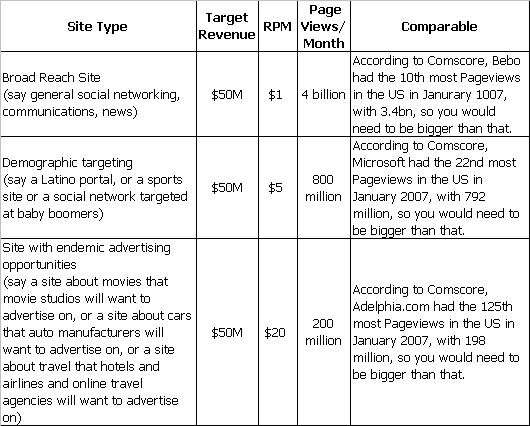
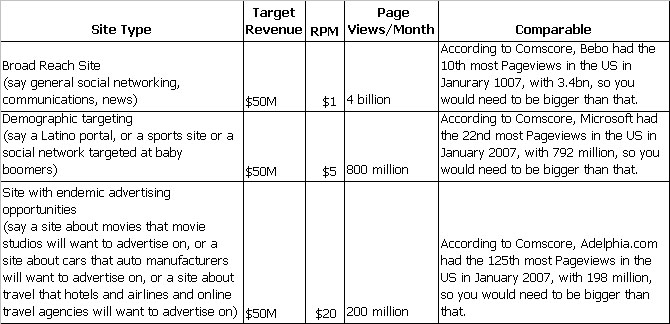
Interesting post over the weekend by Dan Mitchell at the NYT. He took the cue from Jeremy Liew of Lightspeed, who pointed out a few weeks ago the scale a business has to achieve to get $50M in revenue. I have summarized the scenarios from Jeremy’s post in the table below:
jliew2.jpg

(RPM – Revenue per thousand impressions, including CPM, CPC, and CPA models)

Scott Karp of Publishing 2.0 has an interesting take on Jeremy’s piece:

Jeremy’s analysis is correct, on one level, but it also exposes a deep flaw in the way online media is currently valued and sold to advertisers.

At that rate, you could reach 1 million people for $1,000. Now, granted most thousand page views are generated by less than a thousand people (in many cases far less). And granted we’re talking about untarget advertising. A highly targeted site can earn a revenue per thousand pages of, say, $20. But still, $20 is a pretty good deal to reach as many as a thousand people with your advertising. And if you assume that $20 is from multiple ad sources on each page, then each source is paying less than $20 to reach a highly targeted audience of up to a thousand people.

Compared to other media, online publishers are pretty much giving it away. Because the reality is that EVERY page view is in viewed by someone who has some value to some advertiser. The problem is when you DON’T KNOW who your users are. This is the problem with all the focus (particularly in Web 2.0 circles) on total traffic numbers — 10 million uniques is great, but not so much if you don’t know who these people are.

I think Scott is onto something here…Google shows ads based on keyword. These keywords provides valuable context for targeting ads. But still Google doesn’t really understand the user. Let’s look at an example…Two users – one interested in football another in politics – each search for “defense strategy” will be shown same products/offers from Google. Instead, by understanding user’s interests, a system should clearly be able to do a lot better and more optimal targeting. (It looks like Google is trying to personalize the results now – see this piece from RWW about Google Search).

So by understanding the users and context a whole let better, a system will be able to generate ads that reach the level of relevancy and thereby value approaching mainstream media. Which of course would mean that businesses with a lot fewer users or page views (page views is really the wrong to look at these things) but a good understanding of those users would become viable…and all of us will be better off for it.

Some of the systems that are being developed to address this issue are based on attention data and Google personalization. I think the market could use a bit more innovation in this area.

Microsoft Vs Open Source Community

There was a great piece on CNet news.com about Higgins project waiting Microsoft’s approval for creating a Windows CardSpace’s open-source equivalent:

Higgins awaits Microsoft’s blessing

An open-source rival to a Microsoft identity tool has been in limbo for months, awaiting the software giant’s go-ahead on certain patent-related issues.

Developers working on the Higgins project want to create a tool equivalent to Microsoft’s Windows CardSpace, but fear the software giant’s legal wrath if they don’t receive permission on certain features. Although parts of the project continue to move forward, proponents say it may not reach its full potential without Microsoft’s help.

While CardSpace is available on Windows, one goal of the Higgins project is to cover other operating systems. Higgins wants to offer an open-source alternative that works on Windows and on alternatives such as Linux and Mac OS X. The application would work similarly to CardSpace.

“We don’t intend to duplicate CardSpace, but a user should be able to sit down in front of the open-source implementation and feel comfortable and understand how things work, like Firefox versus Internet Explorer,” said Dale Olds, who holds the title of distinguished engineer at Novell, drawing a parallel to Web-browsing software.

Also, Higgins developers want to include the capability to take identity information from Linux systems or Macs and use it with CardSpace, and vice versa, Olds said.

“This is the equivalent of the user’s wallet. You want to be able to take your cards and use them in whatever system. How to do that has now been fully documented, but we need that included under the open-specification promise,” Olds said. Without Microsof’s acquiescence, import and export will only be possible between Higgins systems, he said.

I really like Microsoft Cardspace (see our review here) …Microsoft has done a lot of new groundbreaking work here. The issue with the Higgins project is that its gonna provide a card management client based on the Java based Eclipse platform. This would ensure that the product works for Linux and Mac and any other client that supports Java including Windows. This makes it tricky for Microsoft, as by giving up the patent rights, they will be essentially creating an open-source competitor for one of the key technologies in Vista. Not only will Higgins based CardSpace product take away one of the major selling points of Vista, it might even provide a web client implementation, which challenges the raison d’etre for an expensive desktop OS like Windows. On the other hand, an open source implementation of CardSpace functionality might generate a lot of free buzz and user education for a fairly new and unknown CardSpace functionality.

Overall, I can see the reasons for Microsoft’s reluctance in granting a license to Higgins. This is a complex decision…I won’t even be surprised if Microsoft rejected the request altogether, although I do think the right course of action would be to work with Higgins and try and advance this crucial technology together with open-source community.

Improving Online Communities

An online community, or for that matter any community, is built upon shared experiences of its participants. In the real world, people in a community typically interact with each other by gathering at same physical location, at the same time. In online communities, it is easy for users to interact with each other without any geographical or temporal limitations. But in return for the benefits that Internet (or even telephone to a lesser degree) provides in terms of ease of communication, it takes away from the richness, texture and context of the conversation. As such a number of startups are trying to address the problem with online communities and restore richness, texture and context to online communities. (Richard calls this market segment, meta social networking).

Who reads my blog

MyBlogLog started off with the agenda to provide blog analytics. They launched MyBlogLog Communities mid last year, to enable readers of blogs to join and share their experiences with other like-minded group of readers. The idea was that if readers like same content, they probably have plenty else in common. They built a platform where readers could trade messages with other readers and see what other sites they visit.

Power of Images

They hit the jackpot with the reader rolls that provided a picture to connect readers and writer of blogs. By just providing a static visual cue in the form of a picture, MyBlogLog provided an important visual context for online community conversations. The result, their usage took off and is not at over 50K users…In the meantime, they also got acquired by Yahoo! for a $10M.

Where there are visitors there is spam

With all the success came a number of people looking use MyBlogLog for financial gains. From R-Rated avatars to people pretending to be somebody else to other commercial avatars like Mr. Online Pharmacy, there has been a glut of stories related to how people are trying to game MyBlogLog and given their history, MyBlogLog has understandably been having a hard time coping.

Competition

In addition to all the spammers, there is new competition on the horizon for MyBlogLog. OthersOnline and Explode are two emerging players. These players have interesting new twists to the functionality provided by MyBlogLog. Let’s take a quick look at each:

Explode

Explode provides the same analytics capability as MyBlogLog but in addition to Analytics, it also allows users to build a network for friends who can be readers or writers of blogs. Bloggers can then display a friends widget on their blogs. This widget provides valuable context on the readers of the blog and the bloggers circle of friends. Another capability Explode provides is a comment wall for each user, where friends and other users can post comments. This also provides valuable context on each of the user.

OthersOnline

OthersOnline has an interesting twist on the idea of providing context. They allow people to register their profile along with their website. As part of the registration process, OthersOnline asks users to categorize their website and themselves via keywords. Now using these keywords, OthersOnline shows profile information, along with presence and email, of users via a browser plug-in (a widget is in the works as well). The idea is to make it easy for people to locate other like minded individuals or websites in the course of browsing.

Conclusion

While these companies are breaking new ground in making online conversations more useful, there is still a long way to do before we have achieved a good enough quality of online interactions. Good things, a lot of companies are working on it.

Google: Click Fraud at 0.02%

Interesting post on inside Adwords blog about the extent of click fraud. The upshot is that Google is claiming that they are only seeing 0.02% of all clicks as being invalid clicks but initially recorded by Google as valid clicks. Here is the interesting bit:

Our Click Quality team investigates every inquiry we receive from advertisers who believe they may have been affected by undetected click fraud. Many of these cases are misunderstandings, but in most cases where malicious activity is found, the clicks have already been filtered out (and not charged for) by our real-time filters. Because of the broad operation of our proactive detection, the relatively rare cases we find of advertisers being affected by undetected click fraud constitute less than 0.02% of all clicks.

Put another way, for every ten thousand clicks on Google AdWords ads, fewer than two are reactively detected cases of possible click fraud. This proportion has stayed within this range every quarter since we launched AdWords, even as the issue of click fraud has received more widespread media attention. In the cases of reactively detected invalid clicks, a refund or credit is provided to the advertiser, and we utilize the discovery as a feedback mechanism to improve our proactive detection systems.

They explain it with a diagram as follows:

The interesting question though is how many of these clicks are invalid that even the Google Click Quality Team is not able to detect? I just don’t know its possible with filtering or with humans to detect all kinds of click fraud scenarios. The is especially troublesome because Google does not allow its advertisers to control where there ads will be shown. This makes it really hard for customers and Google to detect the fraud based on more controllable set of conditions thereby making it a more manageable problem. Apparently some advertisers are getting frustrated with Google and switch to one of their upcoming competitors, profiled recently by NYT:

Google and Yahoo have been fighting it out over which company will dominate the online advertising business, with Google maintaining the upper hand so far.

But in the competition for contextual text ads — those small sponsored links that run adjacent to related articles online — both companies are facing a challenge from a tiny but growing adversary named Quigo Technologies, a New York-based ad service that bills itself as an alternative to the giants.

In the last year and a half, a trickle of large media sites like ESPN.com, FoxNews.com and Cox Newspapers’ 17 sites have stopped using Google and Yahoo and instead signed up with Quigo.

What Quigo offers is transparency and control in what can often be an opaque business: advertisers pay Yahoo and Google for contextual ad placement on a wide variety of Web pages, but get little say over where those ads run or even a list of sites where they do appear.

Quigo, by contrast, gives advertisers not only the list of specific sites where their ads have appeared but also the opportunity to buy only on specific Web sites or particular pages on those sites. It also allows media company sites like ESPN.com and FoxNews.com a chance to manage their own relationships with advertisers.

Although Quigo remains a small competitor, with less than 10 percent of the contextual ad business, its growing success has apparently persuaded Google, which is accustomed to calling the shots in all aspects of its business, that it has to change the way it sells the sponsored link ads in the future.

Quigo still has a long way to go, but its nice to see some of the advertisers and web-sites getting a little bit more say in their ad placements. This can only lead to good things for the overall online ad market.