Some silly Friday fun:

Interesting post in NYT this week (It seems NYT is focusing more on Technology of late…Anybody else noticed that?) about how Microsoft is trying to get customers for search by creating direct financial incentives:

(Picture from NYT)
SIX months ago, Microsoft stood in front of the world and rather bravely stated the question on everyone else’s mind: Why on earth does the world need another search engine?
…
It cast the competition — read: Google — as eggheads whose “complicated mathematical equations” retrieve all too many results, which overwhelm the average user.
…
But Microsoft deserves credit for trying to compete on the basis of the intrinsic quality of the search experience. The tag line for this campaign was: “Algorithm. Meet Humanity.”
This by itself is pretty funny…Microsoft competing by innovating in the area of usability (after following Apple for so long)…But it gets more interesting:
In that matchup, algorithm wins. Google had a 50 percent share of searches in the United States in October 2006, while Yahoo had 24 percent, and Microsoft, 9 percent, according to Nielsen/NetRatings. The most recent data, for February of this year, show that Microsoft had climbed a bit, to a 9.6 percent share, but that Google had jumped much farther ahead, to 56 percent. (Yahoo’s executives had something to ponder, too: its share slipped by three points.)
Watching your principal competitor widen its lead with organic growth, unaided by advertising, makes you receptive to trying something else — anything else. Microsoft has decided that the search business needs a sort of “frequent flier” rewards program to attract and hold on to users: Microsoft Service Credits for Web Search.
John Battelle broke the story last month on his Searchblog. Adam Sohn, director of global sales and marketing for Windows Live, confirmed that Microsoft would pay large companies $2 to $10 a user annually — the more searches, the larger the bounty earned — in credits that can be used for Microsoft products and training services.
…
Microsoft is seeking 30 companies, each with at least 5,000 PCs, who are willing to sign up and install on employees’ computers a small program — a “browser helper object” — that will count the number of searches performed with Microsoft Live Search.
With this approach Microsoft is trying to get traction for its search products by leveraging their power center in the enterprises. It makes sense, sort of…although the devil really is in the details as pointed out by Prof. Lederman:
Mara Lederman, an assistant professor of strategic management at the University of Toronto who has closely studied the airlines’ programs, said one feature that has been essential to their popularity among business travelers is that customers earn the rewards but do not pay for the product — their employers do.
“If the fare for your preferred airline is $100 more, you don’t care because you don’t pay,” she said. “You just want the points because you want to take the family to Hawaii.”
Airlines have benefited from another feature: frequent-flier awards are more alluring than they deserve to be. The frequent-flier programs give away only empty seats, which is why the actual cost of the rewards is exceedingly cheap. (That’s also why it’s hard to redeem your miles for any flight that doesn’t leave at 5:30 a.m. on a Tuesday.) “Microsoft does not seem to understand this,” Professor Lederman said.
In the case of search, who pays isn’t an issue because the price is zero. But under Microsoft’s program, Professor Lederman said, “there’s no reward going directly to the individual carrying out the search.” She predicted that employers would have to take an active role, offering monetary incentives or applying administrative pressure, in order to obtain the desired outcome of full participation of the work force.
Even if the enterprises shared the financial bounty with the end-users, to provide them with the incentives to use Microsoft search, this kind of money can have a corrupting influence. I remember working at a large company that decided to pay employees for taking certain online training courses. Very soon, a few smart engineers developed a tool to take the tests associated with each course and soon people were finishing 30 courses in a day…Needless to say the financial incentives were gone in a quarter.
Another thing corporations might be able to do is to lock out other search engine like ones from Google and Yahoo! or even make MSN search the default. This might force more employees to use MSN search but on the flip side, such measures might make employees unhappy. Also the corporation might incur additional costs in terms of productivity loss with a brand new search engine.
Overall, my personal opinion is that the way the plan is setup, its unlikely to work. Let’s wait and see.
A new report from Microsoft (didn’t know they did these kinds of interesting reports) and UC Davis outlines the ways in which web spammers are operationally organized (NYT had a review on the report as well). Its an interesting albeit a somewhat dense read…I have summarized the main points from the report in the pictures below:
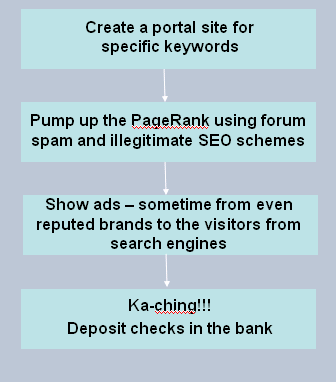
This chart talks about the basic structure of the scam…But the chart below (taken from the report) brings out some astonishing things about how well organized it all is. More then 80% of all these click-thrus are funneled through two of IP ranges apparently owned by the domain owners. Another surprising thing about it the appearance of a number of familiar brands like Shopping.com, Looksmart, Orbitz etc. at different stages of the money chain. Also the report points to BlogSpot and a few other popular web hosts which are very popular with the spammers…Apparently 75% of the BlogSpots that show up in the search results are because of the spammers. This is a serious issue which Google should do something about (makes you kinda scratch your head as to why Google doesn’t do anything about it, could it be the AdSense money they get???)
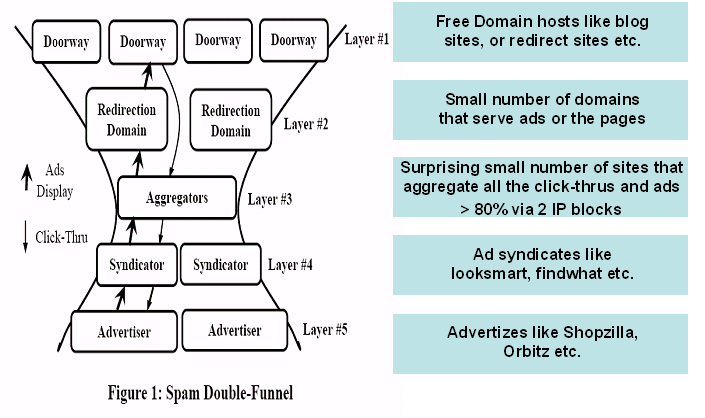
The fact that the whole thing is so organized means that it should be easy to go after for search companies…Doing this will rid the Internet of a lot of crappy content and thereby improve the browsing experience and CPMs for everybody else.

( Yi-Min Wang of Microsoft – Pic via NYT)
See some of screenshots related to the analysis in the report here.
Via the Progress Bar:
To be honest, I didn’t think I would be that impressed by the winners of the first YouTube Video Awards. Boy was I wrong. Smosh, Free Hugs and Kiwi were great shorts that I’d never seen before.
Great piece in the SF chronicle today by Dan Fost about the recent firestorm related to vitriolic comments against Kathy Sierra (BTW she is great and I love her blog).

The threats against Kathy Sierra, an author who promotes the notion of emphasizing the needs of the user in Web site design, have sparked a Webwide debate on the nature of online discourse.
The incident and its aftermath have drawn back the curtain on a computer culture in which the more outrageous the comment, the more attention it gets. It’s a world that many women in particular see as still dominated by men and where personal attacks often are defended on grounds of free speech.
In addition, many of the newest tools of the Internet are coming into play. Blogs and online communities were supposed to herald an era in which “the wisdom of crowds” guided online behavior to a higher plane. Instead, instances of mob rule appear to be leading the discussion into the sewer.
Some observers believe the incident eventually could serve as a warning to Web communities to increase accountability and stamp out the vitriol that characterizes much of online conversation.
“We need to say this is not acceptable behavior,” said Tim O’Reilly, CEO of Sebastopol’s O’Reilly Media, which publishes Sierra’s books and runs the ETech conference where Sierra was scheduled to speak this week. “If you start making offensive comments, they will be deleted from a blog. Don’t give people that platform.”
This is a sad state of affairs and not completely unexpected either…As one of the commenters quipped in one of the older posts:
Normal Person + Anonymity + Audience = Total Idiot
The other issue here is really, accountability…Unlike in human communities, on the Internet, its easy to avoid facing repercussions of making nasty and unhelpful comments. We really need a system across social media that addresses the issue of accountability by providing the right incentives to all users for participating positively. Such a system will ensure that the users get rewarded for positive contributions and are held accountable for disrupting community discourse.
A powerful argument about what lack of accountability does to good people is provided by Philip Zimbardo, in his interesting book called the Lucifer Effect. Through a number of experiments, Philip demonstrates how if you put good people in accountability free lawlessness, they become fairly evil. Anybody remember Abu Ghirab? (I haven’t read it yet but heard from a number of sources that this is an interesting and powerful book).

What do you think?
Recently heard aprogram on NPR, called the talk of the nation, about people who have had to deal with internet stardom/notoriety because of starring in a popular YouTube videos.

Its an interesting program that highlights what happens when users really don’t control their own images/reputations (see also this previous article) and how Internet with its ease of communication can really amplify this effect. I guess we are really living in a global community and Internet is really redefining the meaning of viral spread of ideas.
What do you think?
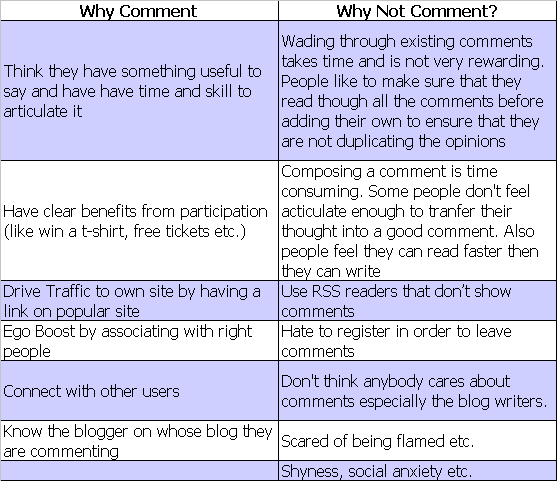
Fascinating survey post at the Freakonomics blog (Thanks Indus for pointing it out) asking users why do or why don’t they comment. (I love these guys not just because of the book or because they write intelligent/insightful stuff but also because Prof. Levitt is from my alma mater). The post generated 114 responses…Now these responses can be extrapolated to other social media as well where the participation more or less follows the same 90-9-1 kinda pattern observed on blogs. I waded through these responses and summarized them in the table below:
Some of the sample comments from the article are listed below:
# Matt W
First is the fixed cost.. it just took me 3 minutes to register with WordPress and thats a long time for the internet age.
Second, usually, on a high traffic blog like this, commenters have usually taken most points of view in an hour or so.
But mostly, its just like in school where theres a class of 30 people but the same 5 or 6 are the only ones that raise their hand.
# From Deckard
I REALLY WANT OTHER PEOPLE TO READ MY BLOG AS WELL AND GET THE STATS UP – also I WANT TO LOOK IMPORTANT AND ASSOCIATE MYSELF WITH SOMEONE AS GREAT AS (INSERT NAME HERE)
Being a bit of a marketing whore with a new business to promote
Many bloggers comment to get comments. Many also comment to connect with people. The undying need to be loved is strong with the blogging community.
# akbal
I rarely comment on blogs because (1) written communication is a skill I have not practiced since high school (often my comments are misunderstood), (2) Ive learned that people usually ignore or attack what they dont already believe (this makes my comments seem futile), and (3) I have things I would rather be doing (it usually takes 30 minutes or more to write even a semi-coherent response to a blog.
Shyness definitely plays into my reasons.
# sbw
Commenters needed to be parsed into distinct categories. Some comment to learn to nail an idea to a page so others will refine it. Some comment to convince. Some comment for community.
Still others comment to overpower ideas with cheap rhetoric.
# jonathank
I comment on two types of blogs: people I know and where I believe the author reads the comments and might actually be looking for ideas and different takes.
I have, on rare occasion, joined in to reinforce others comments. It is fruitless to argue with people in comments – or mostly anywhere on the internet – but sometimes it can be enjoyable (and, in a rare case, even constructive) to agree with other commenters
# RobertSeattle
I actually tend to avoid blogs that dont allow comments. Not allowing for comments means the blogger really doesnt care about what their readers think. I prefer some kind of login system though because I am a firm believer in the formula:
Normal Person + Anonymity + Audience = Total Idiot
# sasha
1. I (like many readers, I suspect) read your blog through an RSS feed. So commenting involves clicking on the link to your actual site, remembering my wordpress username (which usually takes a trip to my email account where its saved), and then remembering the password Ive chosen.
2. After a while, regular commenters start to form a community. It starts to feel intrusive to insert yourself.
3. The time it takes me to formulate a comment Im happy with posting is usually not worth what Ill get out of actually posting it. Im usually picky about being concise, grammatically correct, and having fully formed ideas, so a comment can take me upwards of 30 minutes to put together. And then the comment will usually be ignored anyway.# kentavos
Why I comment:
1. I feel passionately about the topic or I have unique insight.
2. Im in the mood and I have time.
3. I might win a t-shirt.
Why I dont comment:
1. My point of view is already represented.
2. Too many comments, Id just be lost in the sea of comments.
3. Too many passionate views, no one would really listen.
4. I dont have the time to deliver a concise and well thought out comment.
# mungojelly
Right after spending a while writing a detailed comment, I always have a nagging feeling that Ive wasted my time. If I have something important to say, why am I saying it way down at the bottom of a pile of messages, where no one will read it? If I dont have anything important to say, why am I spending time typing at all??
Heres a paradox, though: In principle I believe comments are very important, and Im offended when theyre disabled, even though I still think theyre usually a waste of space in particular. Theres some sense to that attitude, and heres my attempt to explain it: The difference between having comments and not having comments is whether you are projecting an open space or a closed space. Allowing for comments even if in practice theyre spam & junk & metooism is saying I am participating in a conversation, not a monologue; this is a two-way street.
Earlier today I saw something that was interesting but smelled like bullshit, so I glanced at the comments: Naturally the first comment was someone cutting through the bullshit & giving the real facts. Thats part of whats so nice about the internet.
5 insights for the bloggers are:
Finally a haiku from the comments section of Freakonomics blog to remind you how wonderful and creative commenters can be:
# egretman
The question is not why we comment
Thats seems all too evident
Rather I want to know why you blog
Is it for the comments that you will log?
Are you a comment hog?
Do you take them home and cherish them
Read them as if each were a gem
If so then you are one sick dude
Especially if you read them in the nude
Well thats all I have to say
Heres hoping that Ive made your day.
Fascinating article on MSNBC.com today, related to the decline in public discourse because of the web.

When a California woman recently gave birth to a healthy baby just two days after learning she was pregnant, the sudden change to her life was challenging enough. What April Branum definitely didn’t need was a deluge of nasty Internet comments.
Postings on message boards made cracks about Branum’s weight (about 400 pounds — one reason she says didn’t realize sooner she was pregnant). They also analyzed her housekeeping ability, based on a photo of her home. And they called her names. “A pig is a pig,” one person wrote. Another suggested that she “go on the show ’The Biggest Loser.”’
“The thing that bothered me most was, people assumed because I am overweight, I’m going to be a bad mom,” Branum says. “And that is not one little bit true.”
It was yet another example of how the Internet — and the anonymity it affords — has given a public stage to people’s basest thoughts, ones that in earlier eras likely never would have traveled past the watercooler, the kitchen table or the next barstool.
The main issue here really is not the decline in public discourse but rather without the proper incentives, people can be nasty. Unlike in real-life communities, where there is a price to be paid for venting and being negative, on the web, which allows participation without geographical limitations, people have no incentive to curb their desire to be nasty. This leads to comments like the ones experienced by the mother in the snippet above. What we need is a better way to provide right incentives and to filter out the commenters that are not adding value to the community. What do you think?
Updated revision is also available at RWW
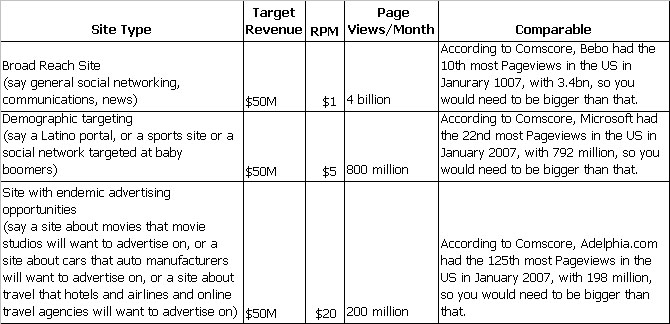
Interesting post over the weekend by Dan Mitchell at the NYT. He took the cue from Jeremy Liew of Lightspeed, who pointed out a few weeks ago the scale a business has to achieve to get $50M in revenue. I have summarized the scenarios from Jeremy’s post in the table below:
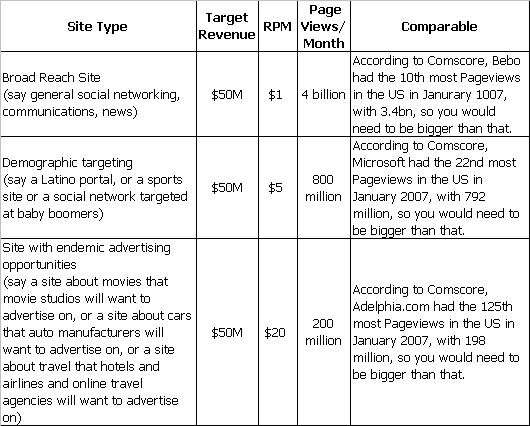
(RPM – Revenue per thousand impressions, including CPM, CPC, and CPA models)
Scott Karp of Publishing 2.0 has an interesting take on Jeremy’s piece:
Jeremy’s analysis is correct, on one level, but it also exposes a deep flaw in the way online media is currently valued and sold to advertisers.
…
At that rate, you could reach 1 million people for $1,000. Now, granted most thousand page views are generated by less than a thousand people (in many cases far less). And granted we’re talking about untarget advertising. A highly targeted site can earn a revenue per thousand pages of, say, $20. But still, $20 is a pretty good deal to reach as many as a thousand people with your advertising. And if you assume that $20 is from multiple ad sources on each page, then each source is paying less than $20 to reach a highly targeted audience of up to a thousand people.
Compared to other media, online publishers are pretty much giving it away. Because the reality is that EVERY page view is in viewed by someone who has some value to some advertiser. The problem is when you DON’T KNOW who your users are. This is the problem with all the focus (particularly in Web 2.0 circles) on total traffic numbers — 10 million uniques is great, but not so much if you don’t know who these people are.
I think Scott is onto something here…Google shows ads based on keyword. These keywords provides valuable context for targeting ads. But still Google doesn’t really understand the user. Let’s look at an example…Two users – one interested in football another in politics – each search for “defense strategy” will be shown same products/offers from Google. Instead, by understanding user’s interests, a system should clearly be able to do a lot better and more optimal targeting. (It looks like Google is trying to personalize the results now – see this piece from RWW about Google Search).
So by understanding the users and context a whole let better, a system will be able to generate ads that reach the level of relevancy and thereby value approaching mainstream media. Which of course would mean that businesses with a lot fewer users or page views (page views is really the wrong to look at these things) but a good understanding of those users would become viable…and all of us will be better off for it.
Some of the systems that are being developed to address this issue are based on attention data and Google personalization. I think the market could use a bit more innovation in this area.
There an interesting argument going on in the blogosphere. Its captured nicely in the exchange between Tony Huang (deep Jive Interest) and Jason Calacanis:

Blogging is damn hard work, and harder still when you have kids to feed and are working lousy hours at work — and you don’t have the connections, notoriety or credentials to fuel your blogs success.
And let’s not discount it. When you have the ability to meet people most people don’t; when you have the inside track before most people do; and when you are actually *creating* news as most of us *can’t*, that’s what really separates “A-listers” from the rest of us.
I’ve come a long way in blogging, but I’m not blind to the fact that the vast majority of bloggers — even those who bring something new, refreshing, and regular to the table — may find barriers to blogging success in spite of hard work or their talent. I’d like to believe in the democracy of blogging, but the fact is that there are certain advantages that some bloggers have that others don’t. Not having them doesn’t mean you can’t be an A-lister, but I have yet to find one that didn’t have any.
I agree with Tony to a large extent although I am not sure blogging being hard etc. has anything to do with A-List bloggers trying to keep other blue collar bloggers down. Jason’s take on the A-List controversy:
What a joke… a couple of years ago Scoble, Jarvis, and I were the blue collar bloggers! We were hustling trying to get our vocies heard and a couple of years later–after blogging daily/hourly–the supposed “A List” got some traction and attention.
Here is a tip: THEY EARNED IT!!! They busted their butts for years blogging in an intelligent way. They were not given their seats at the table–they took them!
There is no “A List” — it’s a myth.
I think the basic issue really is that blogging is hard, and its getting harder to build the traffic with the proliferation of blogs. I guess it was easier when there were far fewer blogs. I this is just a manifestation of a lot of people feeling frustrated with the difficulty of blogging and building traffic. The other question is that do the A-List bloggers owe anything to the community in terms of helping deserving bloggers get more traffic? I am just not sure if the popular bloggers really owe anybody anything although it would be nice if they were more helpful and behave less as prima donnas.
But really, how could an A-list blogger help drive consistent traffic to another up and coming blog? Sure they could link to a particular blog to share the page-rank juice, do a hat-tip to another blog or even have guest writers…but if A-List bloggers did it consistently would it really work? Wouldn’t people start ignoring some of these links and guest writers? Given that some of the A-List bloggers are really busy, would having a guest writer on a blog even mean that the A-List blogger supports the writers views or even finds them interesting? I am just not sure that give the technology landscape right now, its possible for any blogger to really prop-up another outside and independent blog in a consistent fashion.
What do you think? Am I onto something or just high on something :-)?
 KarmaWeb