Human Herd

Fascinating article in the NYT today (I am again quoting NYT…It seems they have really gotten their act together of late in the high-tech/network world space). The article talks about the theory of “Cumulative Advantage” or the “rich get richer” effect. In summary the theory suggests that our preferences/decisions are very much effected by what other people are doing. So if a technology or a singer or a movie is liked by our peers we are more likely to try it and like it. We provided another example of this phenomenon (without naming the theory) in a prior post related to behavior of users at Digg where we observed that a fake article got a number of Diggs just because a user paid of a few Diggs to get initial momentum.

istock_000002199222xsmall.jpg

Conventional marketing wisdom holds that predicting success in cultural markets is mostly a matter of anticipating the preferences of the millions of individual people who participate in them. From this common-sense observation, it follows that if the experts could only figure out what it was about, say, the music, songwriting and packaging of Norah Jones that appealed to so many fans, they ought to be able to replicate it at will. And indeed that’s pretty much what they try to do. That they fail so frequently implies either that they aren’t studying their own successes carefully enough or that they are not paying sufficiently close attention to the changing preferences of their audience.

The common-sense view, however, makes a big assumption: that when people make decisions about what they like, they do so independently of one another. But people almost never make decisions independently — in part because the world abounds with so many choices that we have little hope of ever finding what we want on our own; in part because we are never really sure what we want anyway; and in part because what we often want is not so much to experience the “best” of everything as it is to experience the same things as other people and thereby also experience the benefits of sharing.

The authors set out to test out the theory with an interesting experiment:

Because it’s not possible in the real world to test theories about events that never happened, most of what we know about cumulative advantage has been worked out using mathematical models and computer simulations — an approach that is often criticized for glossing over the richness of real human behavior. Fortunately, the explosive growth of the Internet has made it possible to study human activity in a controlled manner for thousands or even millions of people at the same time. Recently, my collaborators, Matthew Salganik and Peter Dodds, and I conducted just such a Web-based experiment. In our study, published last year in Science, more than 14,000 participants registered at our Web site, Music Lab (www.musiclab.columbia.edu), and were asked to listen to, rate and, if they chose, download songs by bands they had never heard of. Some of the participants saw only the names of the songs and bands, while others also saw how many times the songs had been downloaded by previous participants. This second group — in what we called the “social influence” condition — was further split into eight parallel “worlds” such that participants could see the prior downloads of people only in their own world. We didn’t manipulate any of these rankings — all the artists in all the worlds started out identically, with zero downloads — but because the different worlds were kept separate, they subsequently evolved independently of one another.

This setup let us test the possibility of prediction in two very direct ways. First, if people know what they like regardless of what they think other people like, the most successful songs should draw about the same amount of the total market share in both the independent and social-influence conditions — that is, hits shouldn’t be any bigger just because the people downloading them know what other people downloaded. And second, the very same songs — the “best” ones — should become hits in all social-influence worlds.

What we found, however, was exactly the opposite. In all the social-influence worlds, the most popular songs were much more popular (and the least popular songs were less popular) than in the independent condition. At the same time, however, the particular songs that became hits were different in different worlds, just as cumulative-advantage theory would predict. Introducing social influence into human decision making, in other words, didn’t just make the hits bigger; it also made them more unpredictable.

Where does this leave us with the rational choice and perfect market theory? Do you think people are more rational when it comes to money? What about making investments? How should VCs or any investor for that matter, evaluate a new consumer technology or a mass market product? This is powerful stuff.

Web Attack – What to do?

Great article in BusinessWeek how Internet and Social media (despite the occasional nastiness) is making business become more accountable:

istock_000001744024xsmall.jpg

Home Depot’s (HD ) CEO goes into an emergency huddle with his crisis management team after 14,000 bilious customers storm an MSN (MSFT ) comment room.

The venom of crowds isn’t new. Ancient Rome was smothered in graffiti. But today the mad scrawls of everyday punters can coalesce into a sprawling, menacing mob, with its own international distribution system, zero barriers to entry, and the ability to ransack brands and reputations. No question, legitimate criticism about companies should get out. The wrinkle now is how often the threats, increasingly posted anonymously, turn savage. Even some A-list bloggers are wondering if the cranks are too often prevailing over cooler heads.

Most companies are wholly unprepared to deal with the new nastiness that’s erupting online. That’s worrisome as the Web moves closer to being the prime advertising medium—and reputational conduit—of our time. “The CEOs of the largest 50 companies in the world are practically hiding under their desks in terror about Internet rumors,” says top crisis manager Eric Dezenhall, author of the upcoming book Damage Control. “Millions of dollars in labor are being spent discussing whether or not you should respond on the Web.”

In the beginning, the idea of this new conversation seemed so benign. Radical transparency: the new public-relations nirvana! Companies, employees, and customers engage in a Webified dialectic. Executives gain insight into product development, consumer needs, and strategic opportunities. All the back-and-forth empowers consumers, who previously were relegated to shouting at call-center minions. Venom can be a great leading indicator.

Trashing brands online can also be high theater. Rats cruising around a Greenwich Village KFC/Taco Bell (YUM ) on YouTube (GOOG ). MySpacers (NWS ) busting their employers’ chops. Faux ads bashing the Chevy (GM ) Tahoe as a gas-guzzling, global-warming monster. Millions of people watch this stuff—then join in and pile on. Is it any wonder companies lose control of the conversation?

When the Web turns against them, executives are faced with the problem of how to manage the blowback. They have two choices: ignore the smaller furies and hope they won’t metastasize, or respond outright to the attacks. It’s rarely a good idea to lob bombs at the fire-starters. Preemption, engagement, and diplomacy are saner tools.

…But what happens when the uproar grows so noisy that the mainstream media is bound to pick it up? That’s exactly the position new Home Depot CEO Francis S. Blake found himself in last month. MSN Money columnist Scott Burns accused Home Depot of being a “consistent abuser” of customers’ time. Within hours, servers were caving under the weight of 10,000 angry e-mails and 4,000 posts, which took the company to task for pretty much everything. It was the biggest response in MSN Money’s history. Blake’s predecessor, Robert L. Nardelli, the guy who famously didn’t allow comments at the company’s annual meeting, simply would have ignored the mob. But Blake knew the controversy could quickly mushroom.

The only way over it, he decided, was through it. So Blake penned a heartfelt and repentant online letter to all Home Depot customers, essentially copping to the company’s less-than-stellar service. He promised to increase staffing and begged for the chance to make good. He created a site to deal specifically with service. He thanked Scott Burns.

In crisis-management circles, the gamble was viewed as a win. Blake actually generated rare applause on an unofficial Home Depot employee site called the Orange Blood Bank, where workers are more likely to post riffs knocking the company. (“You can’t do it, and we’ll never help.”)

I think this is a good thing for all parties, if you take longer view of things…This makes people more accountable and that is always a good thing.

Buying customers – can it work?

Interesting post in NYT this week (It seems NYT is focusing more on Technology of late…Anybody else noticed that?) about how Microsoft is trying to get customers for search by creating direct financial incentives:

(Picture from NYT)

SIX months ago, Microsoft stood in front of the world and rather bravely stated the question on everyone else’s mind: Why on earth does the world need another search engine?

It cast the competition — read: Google — as eggheads whose “complicated mathematical equations” retrieve all too many results, which overwhelm the average user.

But Microsoft deserves credit for trying to compete on the basis of the intrinsic quality of the search experience. The tag line for this campaign was: “Algorithm. Meet Humanity.”

This by itself is pretty funny…Microsoft competing by innovating in the area of usability (after following Apple for so long)…But it gets more interesting:

In that matchup, algorithm wins. Google had a 50 percent share of searches in the United States in October 2006, while Yahoo had 24 percent, and Microsoft, 9 percent, according to Nielsen/NetRatings. The most recent data, for February of this year, show that Microsoft had climbed a bit, to a 9.6 percent share, but that Google had jumped much farther ahead, to 56 percent. (Yahoo’s executives had something to ponder, too: its share slipped by three points.)

Watching your principal competitor widen its lead with organic growth, unaided by advertising, makes you receptive to trying something else — anything else. Microsoft has decided that the search business needs a sort of “frequent flier” rewards program to attract and hold on to users: Microsoft Service Credits for Web Search.

John Battelle broke the story last month on his Searchblog. Adam Sohn, director of global sales and marketing for Windows Live, confirmed that Microsoft would pay large companies $2 to $10 a user annually — the more searches, the larger the bounty earned — in credits that can be used for Microsoft products and training services.

Microsoft is seeking 30 companies, each with at least 5,000 PCs, who are willing to sign up and install on employees’ computers a small program — a “browser helper object” — that will count the number of searches performed with Microsoft Live Search.

With this approach Microsoft is trying to get traction for its search products by leveraging their power center in the enterprises. It makes sense, sort of…although the devil really is in the details as pointed out by Prof. Lederman:

Mara Lederman, an assistant professor of strategic management at the University of Toronto who has closely studied the airlines’ programs, said one feature that has been essential to their popularity among business travelers is that customers earn the rewards but do not pay for the product — their employers do.

“If the fare for your preferred airline is $100 more, you don’t care because you don’t pay,” she said. “You just want the points because you want to take the family to Hawaii.”

Airlines have benefited from another feature: frequent-flier awards are more alluring than they deserve to be. The frequent-flier programs give away only empty seats, which is why the actual cost of the rewards is exceedingly cheap. (That’s also why it’s hard to redeem your miles for any flight that doesn’t leave at 5:30 a.m. on a Tuesday.) “Microsoft does not seem to understand this,” Professor Lederman said.

In the case of search, who pays isn’t an issue because the price is zero. But under Microsoft’s program, Professor Lederman said, “there’s no reward going directly to the individual carrying out the search.” She predicted that employers would have to take an active role, offering monetary incentives or applying administrative pressure, in order to obtain the desired outcome of full participation of the work force.

Even if the enterprises shared the financial bounty with the end-users, to provide them with the incentives to use Microsoft search, this kind of money can have a corrupting influence. I remember working at a large company that decided to pay employees for taking certain online training courses. Very soon, a few smart engineers developed a tool to take the tests associated with each course and soon people were finishing 30 courses in a day…Needless to say the financial incentives were gone in a quarter.

Another thing corporations might be able to do is to lock out other search engine like ones from Google and Yahoo! or even make MSN search the default. This might force more employees to use MSN search but on the flip side, such measures might make employees unhappy. Also the corporation might incur additional costs in terms of productivity loss with a brand new search engine.

Overall, my personal opinion is that the way the plan is setup, its unlikely to work. Let’s wait and see.

Bad behavior in the blogosphere

Great piece in the SF chronicle today by Dan Fost about the recent firestorm related to vitriolic comments against Kathy Sierra (BTW she is great and I love her blog).

The threats against Kathy Sierra, an author who promotes the notion of emphasizing the needs of the user in Web site design, have sparked a Webwide debate on the nature of online discourse.

The incident and its aftermath have drawn back the curtain on a computer culture in which the more outrageous the comment, the more attention it gets. It’s a world that many women in particular see as still dominated by men and where personal attacks often are defended on grounds of free speech.

In addition, many of the newest tools of the Internet are coming into play. Blogs and online communities were supposed to herald an era in which “the wisdom of crowds” guided online behavior to a higher plane. Instead, instances of mob rule appear to be leading the discussion into the sewer.

Some observers believe the incident eventually could serve as a warning to Web communities to increase accountability and stamp out the vitriol that characterizes much of online conversation.

“We need to say this is not acceptable behavior,” said Tim O’Reilly, CEO of Sebastopol’s O’Reilly Media, which publishes Sierra’s books and runs the ETech conference where Sierra was scheduled to speak this week. “If you start making offensive comments, they will be deleted from a blog. Don’t give people that platform.”

This is a sad state of affairs and not completely unexpected either…As one of the commenters quipped in one of the older posts:

Normal Person + Anonymity + Audience = Total Idiot

The other issue here is really, accountability…Unlike in human communities, on the Internet, its easy to avoid facing repercussions of making nasty and unhelpful comments. We really need a system across social media that addresses the issue of accountability by providing the right incentives to all users for participating positively. Such a system will ensure that the users get rewarded for positive contributions and are held accountable for disrupting community discourse.

A powerful argument about what lack of accountability does to good people is provided by Philip Zimbardo, in his interesting book called the Lucifer Effect. Through a number of experiments, Philip demonstrates how if you put good people in accountability free lawlessness, they become fairly evil. Anybody remember Abu Ghirab? (I haven’t read it yet but heard from a number of sources that this is an interesting and powerful book).

What do you think?

5 ways to get more comments on your blog

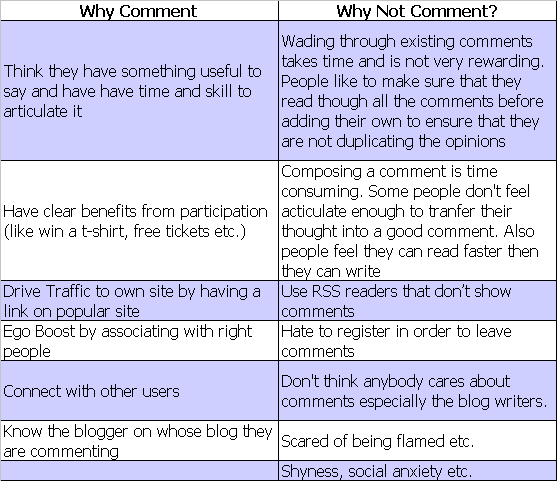
Fascinating survey post at the Freakonomics blog (Thanks Indus for pointing it out) asking users why do or why don’t they comment. (I love these guys not just because of the book or because they write intelligent/insightful stuff but also because Prof. Levitt is from my alma mater). The post generated 114 responses…Now these responses can be extrapolated to other social media as well where the participation more or less follows the same 90-9-1 kinda pattern observed on blogs. I waded through these responses and summarized them in the table below:

comment.PNG

Some of the sample comments from the article are listed below:

# Matt W

First is the fixed cost.. it just took me 3 minutes to register with WordPress and thats a long time for the internet age.

Second, usually, on a high traffic blog like this, commenters have usually taken most points of view in an hour or so.

But mostly, its just like in school where theres a class of 30 people but the same 5 or 6 are the only ones that raise their hand.

# From Deckard

I REALLY WANT OTHER PEOPLE TO READ MY BLOG AS WELL AND GET THE STATS UP – also I WANT TO LOOK IMPORTANT AND ASSOCIATE MYSELF WITH SOMEONE AS GREAT AS (INSERT NAME HERE)

Being a bit of a marketing whore with a new business to promote

# furiousball

Many bloggers comment to get comments. Many also comment to connect with people. The undying need to be loved is strong with the blogging community.

# akbal

I rarely comment on blogs because (1) written communication is a skill I have not practiced since high school (often my comments are misunderstood), (2) Ive learned that people usually ignore or attack what they dont already believe (this makes my comments seem futile), and (3) I have things I would rather be doing (it usually takes 30 minutes or more to write even a semi-coherent response to a blog.

Shyness definitely plays into my reasons.

# sbw

Commenters needed to be parsed into distinct categories. Some comment to learn to nail an idea to a page so others will refine it. Some comment to convince. Some comment for community.

Still others comment to overpower ideas with cheap rhetoric.

# jonathank

I comment on two types of blogs: people I know and where I believe the author reads the comments and might actually be looking for ideas and different takes.

I have, on rare occasion, joined in to reinforce others comments. It is fruitless to argue with people in comments – or mostly anywhere on the internet – but sometimes it can be enjoyable (and, in a rare case, even constructive) to agree with other commenters

# RobertSeattle

I actually tend to avoid blogs that dont allow comments. Not allowing for comments means the blogger really doesnt care about what their readers think. I prefer some kind of login system though because I am a firm believer in the formula:

Normal Person + Anonymity + Audience = Total Idiot

# sasha

1. I (like many readers, I suspect) read your blog through an RSS feed. So commenting involves clicking on the link to your actual site, remembering my wordpress username (which usually takes a trip to my email account where its saved), and then remembering the password Ive chosen.
2. After a while, regular commenters start to form a community. It starts to feel intrusive to insert yourself.
3. The time it takes me to formulate a comment Im happy with posting is usually not worth what Ill get out of actually posting it. Im usually picky about being concise, grammatically correct, and having fully formed ideas, so a comment can take me upwards of 30 minutes to put together. And then the comment will usually be ignored anyway.

# kentavos

Why I comment:

1. I feel passionately about the topic or I have unique insight.

2. Im in the mood and I have time.

3. I might win a t-shirt.

Why I dont comment:

1. My point of view is already represented.

2. Too many comments, Id just be lost in the sea of comments.

3. Too many passionate views, no one would really listen.

4. I dont have the time to deliver a concise and well thought out comment.

# mungojelly

Right after spending a while writing a detailed comment, I always have a nagging feeling that Ive wasted my time. If I have something important to say, why am I saying it way down at the bottom of a pile of messages, where no one will read it? If I dont have anything important to say, why am I spending time typing at all??

Heres a paradox, though: In principle I believe comments are very important, and Im offended when theyre disabled, even though I still think theyre usually a waste of space in particular. Theres some sense to that attitude, and heres my attempt to explain it: The difference between having comments and not having comments is whether you are projecting an open space or a closed space. Allowing for comments even if in practice theyre spam & junk & metooism is saying I am participating in a conversation, not a monologue; this is a two-way street.

Earlier today I saw something that was interesting but smelled like bullshit, so I glanced at the comments: Naturally the first comment was someone cutting through the bullshit & giving the real facts. Thats part of whats so nice about the internet.

5 insights for the bloggers are:

  1. People hate sites that do not allow comments
  2. Asking people explicitly for their feedback and participating in comments is a good idea if you want more comments. Also providing clear incentives or rewards for participation works. Such rewards could be vanity items like t-shirts or just an explicit recognition in blog posts
  3. Go out there and meet people. If people know you in real life, they are a lot more likely to comment on your blog then otherwise.
  4. Providing a respectable and positive environment for participation can help commenters overcome their shyness or fear of being attacked. This can be done by sanctioning personal attacks/harsh comments and ensuring that a positive environment for participation is maintained
  5. People get overwhelmed with comments so a mechanism to filter useful/unique comments can help drive more comments

Finally a haiku from the comments section of Freakonomics blog to remind you how wonderful and creative commenters can be:

# egretman

The question is not why we comment
Thats seems all too evident
Rather I want to know why you blog
Is it for the comments that you will log?
Are you a comment hog?
Do you take them home and cherish them
Read them as if each were a gem
If so then you are one sick dude
Especially if you read them in the nude
Well thats all I have to say
Heres hoping that Ive made your day.

How to build a $50M online company?

Updated revision is also available at RWW

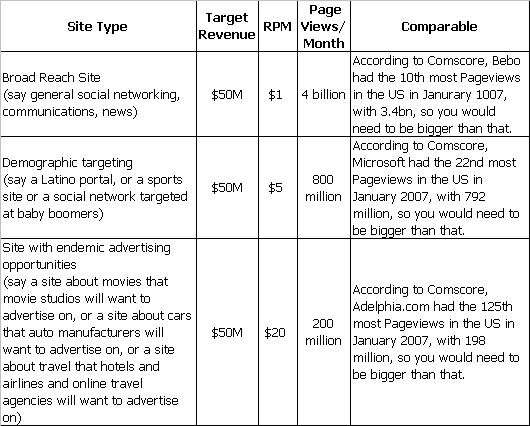
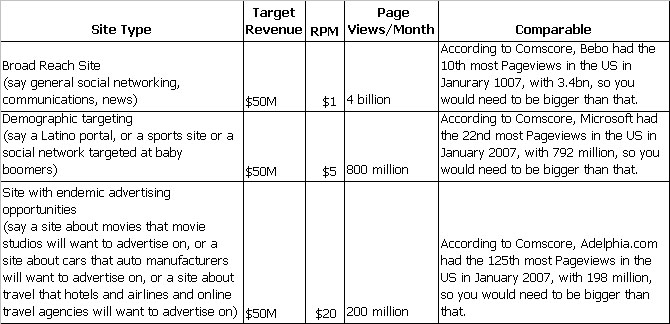
Interesting post over the weekend by Dan Mitchell at the NYT. He took the cue from Jeremy Liew of Lightspeed, who pointed out a few weeks ago the scale a business has to achieve to get $50M in revenue. I have summarized the scenarios from Jeremy’s post in the table below:
jliew2.jpg

(RPM – Revenue per thousand impressions, including CPM, CPC, and CPA models)

Scott Karp of Publishing 2.0 has an interesting take on Jeremy’s piece:

Jeremy’s analysis is correct, on one level, but it also exposes a deep flaw in the way online media is currently valued and sold to advertisers.

At that rate, you could reach 1 million people for $1,000. Now, granted most thousand page views are generated by less than a thousand people (in many cases far less). And granted we’re talking about untarget advertising. A highly targeted site can earn a revenue per thousand pages of, say, $20. But still, $20 is a pretty good deal to reach as many as a thousand people with your advertising. And if you assume that $20 is from multiple ad sources on each page, then each source is paying less than $20 to reach a highly targeted audience of up to a thousand people.

Compared to other media, online publishers are pretty much giving it away. Because the reality is that EVERY page view is in viewed by someone who has some value to some advertiser. The problem is when you DON’T KNOW who your users are. This is the problem with all the focus (particularly in Web 2.0 circles) on total traffic numbers — 10 million uniques is great, but not so much if you don’t know who these people are.

I think Scott is onto something here…Google shows ads based on keyword. These keywords provides valuable context for targeting ads. But still Google doesn’t really understand the user. Let’s look at an example…Two users – one interested in football another in politics – each search for “defense strategy” will be shown same products/offers from Google. Instead, by understanding user’s interests, a system should clearly be able to do a lot better and more optimal targeting. (It looks like Google is trying to personalize the results now – see this piece from RWW about Google Search).

So by understanding the users and context a whole let better, a system will be able to generate ads that reach the level of relevancy and thereby value approaching mainstream media. Which of course would mean that businesses with a lot fewer users or page views (page views is really the wrong to look at these things) but a good understanding of those users would become viable…and all of us will be better off for it.

Some of the systems that are being developed to address this issue are based on attention data and Google personalization. I think the market could use a bit more innovation in this area.

Digital Love

Recently, I heard this fascinating youth radio program about how MySpace is changing the way kids interact/hook up with each other. It also discusses how kids deal with like commercial characters like Jack (of Jack in the box), who have a profile on MySpace and wants to be their best friends forever

Love in the Digital Age Youth Radio looks at how technology affects teen relationships: You’ll hear about how advertisers are cashing in on befriending young people through social networking sites, spying on MySpace, and why some people just shouldn’t use technology.

Interesting and enlightening…Great job Youth Radio.

Patent reform: Use social networking

First USAToday and now the US Patent office…It looks everybody is trying to leverage social networking to improve the services they deliver. In the case of US Patent office, following are the details:

The Patent and Trademark Office is starting a pilot project that will not only post patent applications on the Web and invite comments but also use a community rating system designed to push the most respected comments to the top of the file, for serious consideration by the agency’s examiners. A first for the federal government, the system resembles the one used by Wikipedia, the popular user-created online encyclopedia.

Below are the mechanics of how the system will work:

The new patent system will try to help separate experts from posers by offering extensive details about the people sending information to the site. To help others evaluate the quality of this information, called prior art, each posting will include several measures gauging the quality of his other contributions to the site. Patent examiners, for instance, will award “gold stars” to people who previously submitted the most useful information for judging earlier applications, Noveck said.

Ultimately, those registered to participate in this online forum will vote on all the nominated information, and the top 10 items will be passed on to the examiner, who will serve as the final arbiter on whether to award a patent.

Major kudos to the US Patent office for leveraging the community of interested parties to express their opinions via the Internet. This will certainly make the process better…but because of the amounts of money at stake, there will be extremely perverse incentives for participants to game the system. I would not be surprised, if big companies create a department, just to game the review process…I think a better system with checks and balances that rewards good behavior and punishes bad behavior might be better to negate some of the incentive issues here…What do you think?

I paid to get to Digg front page

Fascinating piece on the Wired web site, related to how the editors put together a nonsensical web site, and got it on the front page of Digg by paying for diggs at User/Submitter (check out our review here) site:


Ten hours after hiring U/S, I had 40 diggs. The vast majority of them had also dugg the Photoshop tutorial or the $35 offer. This was the moment when I reached a tipping point, and I began to get a lot of organic diggs and comments. The crowd on Digg is drawn to what’s popular, and many of them second-guessed themselves when they checked out my blog and saw how crappy it was. Quomen commented, “None of those photographs really appeal to me. Am I defective? or just a loner.”Despite their doubts, Diggers kept digging my blog. There’s a perverse incentive here: Diggers who vote early on stories that become wildly popular become more “reputable” in the Digg system. If you’re trying to move up the Digg ranks, it’s in your best interest to vote on anything that looks like it’s gaining popularity. And my blog, with its flurry of paid votes, fit the pattern.

Interesting crowd dynamics at the Digg and the incentive structure does not help either…I have actually seen people comment they are not sure what a particular topic means but still Digg it. In this case more than 1/2 the Diggs were unpaid…That is just unbelievable. I guess the momentum trading theory is alive and kicking.

“We find it interesting that Digg still allows anybody to view any user’s diggs,” U/S told me in an e-mail. “By way of this ‘feature,’ User/Submitter is able to verify that our users actually digg the stories they’re given. Without this feature, Digg users are given complete digging privacy, and User/Submitter cannot exist.”

This is another perverse incentive…but this is driven by Digg’s drive to build a community. To fix this one, they will need to change the business model…All in all great job by the editors for creating and publishing this interesting experiment.

Comments are important

Interesting piece on the future of communities blog (Thanks Chris for pointing it out). It talks about what bloggers can do to incentivize more and better participation in communities.

“Given limited time and resources, where do you spend your time to increase participation?”

Here are some approaches:

1. Focus your efforts on the 1% and help them by making it easier to contribute. Compelling argument: Focus on the what you do best, is an approach that many have heard from several experts. Phil Wainewright suggests that you focus on those who are motivated to contribute. Its also easier to help people that want to help you. The real challenge is metrics that matter at times tend to be skewed by this group of enthusiastic participants who might sometimes intimidate the 9 or 90%.

2. Attempt to increase participation among the 9%: Compelling argument: Any incremental uptick will get you a more engaged audience. This is the marketing person’s dream come true. I remember hearing an entrepreneur pitching me his new idea 5 years ago on mobile phone accessories. There are going to be billion phones – even if I get 5% that’s a huge market. The trouble is our experience most of the 9% is of a different mindset and profile than your 1%. Hence getting them to participate is not materially different from the sample size.

3. Get rid of as many of the 90%. Compelling argument: They are not significantly enriching the community, but just parasites, so go forth and look for the next 1% types – or the “alphas” in your user community. The disadvantage of this model is that if your target addressable community is of a low number, the lurkers are really needed to justify the investment in the community.

4. Do a little of everything aka “peanut butter approach”: Compelling argument: Try several things at the same time and keep what works. Trouble is if you have the community being Sue’s night job and David’s “part time assignment” or Anil’s “opportunity to excel”, none of them really want to do everything. Also a “controlled experiment” is a lot harder to run in this case.

5. Do nothing but understand and accept, plan accordingly. Compelling argument: Before you scoff at this consider how little we know about these things just yet and letting “things take their course” may not be a bad option. But for the MBO-driven, metrics oriented, get it done culture we have this may clearly not be acceptable in some companies.

You may ask: What does this have to do with your comments or future of communities: Your comments are valued and I thank you for them!
I have a hunch that unless we get participation to be more encompassing and device good methods and means to make it better, the future — plurality of the masses will just be an empty promise.

Lack of quality participation is a real problem in most online communities. In the blogosphere especially, for the longest time, there was a mindset that if you got something good to say, you blog. But as more and more people are realizing that blogging is pretty hard and takes a lot of time commitment and energy, there is a renewed focus on figuring out, what can be done to get better participation from ad hoc commenters, in order to improve the quality of discussion. I think, the first step in the process is to really recognizing the importance of quality comments and ad-hoc participation.

Once we accept the importance of quality participation in blogs, we gotta look at how we can get more participation. A lot of the lack of participation really has to do with the lack of incentives for users that participate. But how can sites reward their participants…A lot of these rewards can be non-monitory like Amazon.com recognition of a top raters or viral spread of user generated content on YouTube, in contrast, commenters on blogs get nothing…Heck, most people can’t even be sure who the commenters are, so the ego boost angle is hard…This is a tough nut to crack but once we figure out an equitable and just mechanism for rewarding the participants we will be well on our way to solving this tough problem.