On-line communities

There are more then 50 million active blogs and community sites like Digg and Slashdot are more popular then ever. But how do on-line communities compare to real-world communities? Is it even fair to compare real-world communities to on-line communities?

In the real world, people in a community typically interact based on geographical proximity. In the blogoshpere its easy for users to join new groups without geographical limitations, as the cost of travelling or joining a community is typically zero. This makes people of common interest to band together much more easily. But because the cost of joining a community is zero, it reduces the community spirit as people can participate without investing much of their time, their money or their reputation. Let’s look at a couple of examples to further explore these differences.

Participation inequality

As Jacob Nielsen pointed out in a recent alert box article – user participation in on-line communities often follows a 90-9-1 rule. This means that typically 90% of on-line users are lurkers, 9% of users contribute from time to time while the rest of the 1% of users participate a lot and account for most contributions.

Now some of the participation inequality is driven by lower costs associated with joining an on-line community which enables not-so-motivated users to join a community…Some of it can be explained by inherent human nature. For example even physical communities display somewhat lop-sided participation characteristics. Internet, though, I think exacerbates this problem. Following are some of the reasons:

  • No rewards for participation. Contributing to a community does not come naturally to most people unless there is a reward associated with contributing. The mechanisms for providing reward for participation are largely missing from the blogosphere at this point in time.
  • The default substrate for interactions on the Internet is anonymity. It takes an extra effort to get them to drop the cloak of anonymity and express their opinions. This happens only when they feel really-strongly about the topic of discussion.
  • Bad UI design that discourages user participation. One of the most annoying issues here is requiring users to register before they can leave a comment.

Spreading the word-of-mouth

In real-life communities, a good band or a good chef gets a fan following. Now as long as the band keeps producing good music or good dishes, those fans will spread the word about the band or the restaurant to their communities, friends and family. Over time this will result in the driving traffic to the band or to the restaurant.
Word of mouth mechanisms are vital in a community

In on-line communities, the situation is quite different. If a reader likes a particular new blog, he/she leaves a comment. This comment on the new blog is not very useful in driving traffic as it does not create any additional incoming links to the blog. Another option that a reader has is to put the new blog on their blogroll. This will create a new incoming link to the new blog. Now, as all bloggers know, getting added to blogroll of a popular blog is a big deal…It only happens if the new blogger is well known or is writing on the same subject as the reader or has established enough credibility in the space. This makes for a fairly high threshold for a new and unknown blogger to get on the blogroll. This lack of a good word-of-mouth propagation mechanism in blogosphere, makes it hard for a new blogger to build a successful blog despite creating great content.

Conclusion

What we need really is an effective word-on-mouth propagation system based on users reading and interacting with a blog. MyBlogLog (rumored to be in talks to be acquired by Yahoo!) did a great job of creating a community of readers. With MyBlogLog, readers could add other blogs that they visit to their profile and thereby create a bit of the word-of-mouth effect. Also the explicit identification of users with MyBlogLog visitor widget humanized the users. This helped in creating trust and more interactions in the community. We need more ideas like MyBlogLog that help community of readers connect, generate trust and share better with each other.

Overall I think on-line groups are indeed communities joining together based on a shared interest. Still we need to address some of the issues – propagating word of mouth, better networking for readers and incentivizing participation – to make these communities a lot more vibrant and participatory.
CopyBot

Great article by Jennifer Granick, on the issues facing Linden labs, the creators of Second life, due to the bursting on the scene of CopyBot. For those not familiar with the havoc a new program called CopyBot, is causing to the economy of second life, below is the summary of the issue from the article:

Businesses in Second Life are in an uproar over a rogue software program that duplicates “in world” items. They should be. But the havoc sewn by Copybot promises to transform the virtual word into a bold experiment in protecting creative work without the blunt instrument of copyright law.

Second Life, operated by Linden Labs, has developed differently from other virtual worlds because it allows custom content and encourages in-world enterprise. It’s a hospitable place for creators to sell virtual goods like clothing, furniture and hairstyles.

As in any economy, the value of those goods depends on their scarcity: people will pay more for a fantastic hairdo that no one else has. If Copybot can indiscriminately duplicate these items, no one has to pay the creator for them. Copying is a value killer.

As a result, Second Life merchants are understandably up in arms over the software, reportedly closing their stores until the problem is resolved.

In the short term, Linden lab is looking to allow copyright holders to sue folks using CopyBot for infringement in courts. This is unlikely to solve the problem as most people don’t have the time or the money to pursue such a case. The other longer term approach Linden Labs is looking at is building a system of norms, kinda like a reputation system, I guess, to incentivize copyright compliance without getting legal about it.

The idea that innovation can flourish in the absence of copyright enforcement is not as heretical as it might seem.

Take the fashion industry. As law professors Chris Sprigman and Kal Raustiala write in their paper on the subject, neither copyright nor patent law prohibit copying fashion designs. There is some protection for the brand associated with the apparel, but no law prohibits a knock-off Chanel suit, peasant skirt or narrow lapel. And yet fashion is highly innovative, with new styles several times a year, despite low IP protection.

Similarly, professors Emmanuelle Fauchart and Eric von Hippel write that haute French cuisine (.pdf) is another area with low IP protection, yet high levels of innovation and creativity. No law prevents copying recipes. Instead, French chefs have developed social norms, much like those Linden Labs seeks to empower, against exact copying, dissemination of tricks of the trade and adopting significant innovations without crediting the chef responsible.

Failure to follow these norms results in reputation harm, including ostracism.

Such a norms-based (rather than law-based) system might work in Second Life. Norms-based systems are context-sensitive and highly responsive to the concerns of the relevant community. They are also cheaper and quicker than litigation. But norms-based systems can only work if the people in the community value the rewards the community can bestow or withhold.

The issue is how can Linden labs expose enough information on individuals without compromising their privacy, such that the community is able to make a judgement about the individual’s compliance of established norms. This will require Linden labs to strike an interesting balance between privacy and transparency.

Another issue is the one pointed out in the article. How will Linden labs make sure that the norms in the community discourage copyright violations? In some real-world communities like some places in China and India etc., it is acceptable and even considered wise, to buy a fake Gucci purse instead of the real thing despite a difference in quality. In the virtual world, the quality of the copied products would be identical to the original products and so the downside of buying copied products will be much less. Would such communities develop in the virtual world of second life?

How would CopyBot effect the pricing power of the creator of the original goods? What is to prevent other vendors from ripping off the original goods and selling them at a lower price? This kind of arrangement will also provide a “plausible deniability” to end users and make the norm-based enforcement almost impossible.

I have no idea how these things will evolve. One thing is for sure…This is going to be interesting to watch.

Some other takes on this issue:

CopyBot, Community and Controversy

Second Guessing Property Value in Second Life

Who owns your reputation?

Who owns your reputation? Apparently you, if ReputationDefender has its way…to the potential chagrin of the great Bob Blakley. In this review of the company in Wired magazine:

The mistakes you make on the internet can live forever — unless you hire somebody to clean up after you.

A new startup, ReputationDefender, will act on your behalf by contacting data hosting services and requesting the removal of any materials that threaten your good social standing. Any web citizen willing to pay ReputationDefender’s modest service fees can ask the company to seek and destroy embarrassing office party photos, blog posts detailing casual drug use or saucy comments on social networking profiles.

The company produces monthly reports on its clients’ online identities for a cost of $10 to $16 per month, depending on the length of the contract. The client can request the removal of any material on the report for a charge of $30 per instance.

The troubling thing about ReputationDefender, is the way, the company might go about fulfilling a customer request for eliminating embarrassing information.

Fertik declined to offer an exact description of his company’s means of removing content. “I can say we have codified a series of procedures that we are continually refining,” he says, “and that are specific to the source, location and nature of the content we are asked to destroy.”

If you’re a website owner and ReputationDefender knocks on your door, you are not legally bound to remove anything until a judge orders you to — a scenario that most website owners are keen to avoid.

“Most people will take materials down just to avoid the hassle of dealing with possible litigation,” says Susan Crawford, an associate professor at Cardozo Law School who specializes in cyberlaw and telecommunications law.

“If the letter is sufficiently threatening,” says Crawford, “the threaten-ee could bring his or her own lawsuit seeking a declaration that what they posted wasn’t unlawful. But, again, most people will just buckle rather than fight back.”

I am fine with the company deploying its “series of procedures” on the behalf of a teenager but I am afraid that these services would be misused to strong arm websites to remove newsworthy or to-be-newsworthy information from the web. An extreme example of a similar situation was presented in the movie Eternal Sunshine of the Spotless Mind (that was a great flick) where Clementine Kruczynski (Kate Winslet) had her memory erased of all references of her ex-boyfriend Joel Barish (Jim Carrey). In this case the memory being erased is our collective record, the web, and similar to the movie there is a huge potential for foul play here.

I tend to agree with Bob that one just controls one’s actions. After the actions have been taken one shouldn’t really be able to influence other people’s story about those actions…This is not good news for the web and social-media.

Amazon.com reviews are rigged

Amazon.com user reviews are a critical factor in increasing the sales for the giant retailer. The number of times, I have heard my wife say that she selected a particular product because of great user reviews, is far too high to count. These reviews can have significant credibility issues, though…In their great scholarly paper – Six degrees of reputation: The use and abuse of online review and recommendation systems – Shay David and Trevor Pinch point to some of the follies of user-generated reviews at Amazon.com:

Evidently, in many areas of cultural production user reviews are mushrooming as an alternative to traditional expert reviews. If there was any doubt, it has long ago been established that reviews and recommender systems play a determining role in consumer purchasing (an early review is available in Resnick and Varian, 1997) and recent qualitative research adds weight to the claim that these review systems have causal and positive effects on sales; to nobody’s surprise, books with more and better reviews are shown to sell better (Chevalier and Mayzlin, 2004). With people in the culture industries increasingly realizing this truism, many of the reviews are thus positively biased and it becomes very hard to distinguish the ‘objective’ quality of the reviews. In addition, due to the large variance in the quality of the reviews, and the varied agendas of the reviewers, user input too often becomes untrustworthy leaving the consumers with little ability to gauge an item’s actual quality. Do we live in a cultural Lake Wobegon where “all the books are above average?” (to paraphrase Keillor, 1985) Is there a way to review the reviewers, to guard the guards? As will be discussed in details below, emerging systems like the one employed on sites like Amazon.com (2005) suggest that there are ways to try to solve this bias problem by offering a tiered reputation management system which offers a set of checks and balances. But these new options also bring with them new problems as the participants adjust to what is at stake in this new economy of reputation.

They offer examples with links to amazon.com reviews:

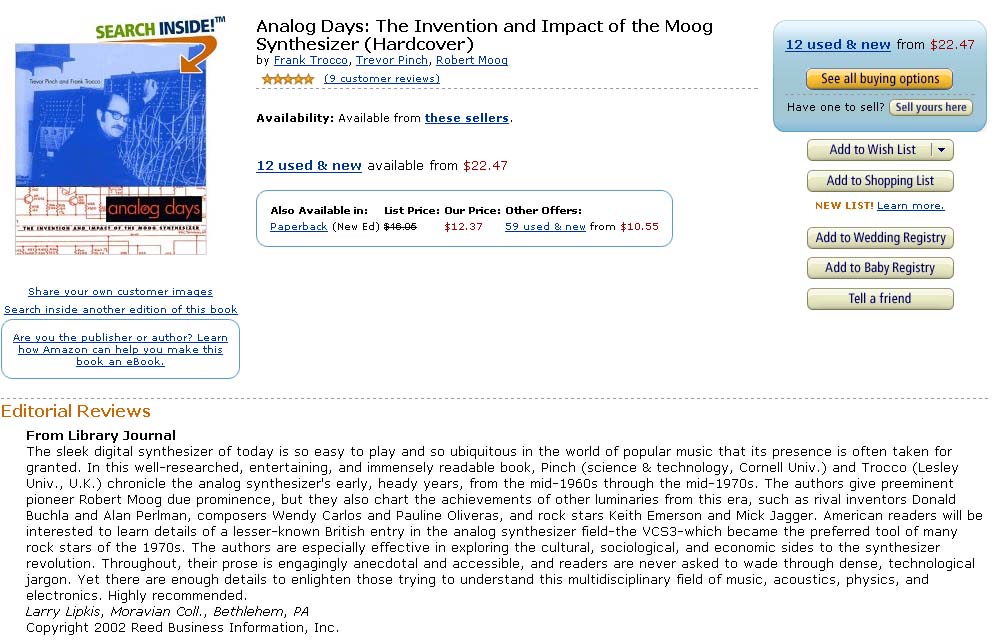
This instance concerned one of Pinch’s own books Analog Days: The Invention and Impact of the Moog Synthesizer (Pinch and Trocco, 2002). This book that chronicles the invention and early days of the electronic music synthesizer was well received by reviewers both offline and online, and the Amazon.com editors quote a review from the Library Journal that reads as follows:

… In this well–researched, entertaining, and immensely readable book, Pinch (science & technology, Cornell Univ.) and Trocco (Lesley Univ., U.K. [sic]) chronicle the synthesizer’s early, heady years, from the mid–1960s through the mid–1970s … . Throughout, their prose is engagingly anecdotal and accessible, and readers are never asked to wade through dense, technological jargon. Yet there are enough details to enlighten those trying to understand this multidisciplinary field of music, acoustics, physics, and electronics. Highly recommended. [link]

original review

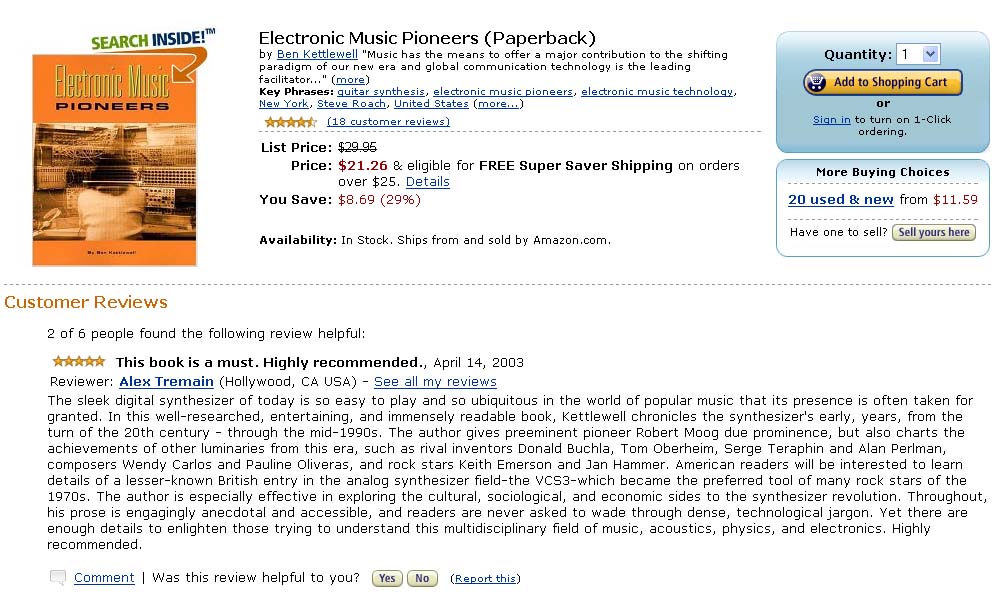
A similar (but distinctly different) book that had appeared earlier — Electronic Music Pioneers by Ben Kettlewell (Vallejo, Calif.: ProMusic Press, 2002) — received the following user review on Amazon.com on 15 April 2003:

This book is a must. Highly recommended., April 15, 2003 / Alex Tremain (Hollywood, CA USA)

… In this well–researched, entertaining, and immensely readable book, Kettlewell chronicles the synthesizer’s early, years, from the turn of the 20th century — through the mid–1990s … . Throughout, his prose is engagingly anecdotal and accessible, and readers are never asked to wade through dense, technological jargon. Yet there are enough details to enlighten those trying to understand this multidisciplinary field of music, acoustics, physics, and electronics. Highly recommended. [link]

Copied review

The ‘similarity’, of course, is striking. The second review is simply a verbatim copy of the first one, replacing only the name of the authors and the period the book covers.

In another case a user reviewed several Tom Hanks/Meg Ryan movies. The user posted the same review for the movies Sleepless in Seattle and You’ve Got Mail. He found that each of those films was “a film about human relations, hope and second chances, but most importantly about trust, love, and inner strength.” [link link]

copied review

rev4

As we know, especially with the demands for producing one blockbuster after another, Hollywood movies are sometimes strikingly similar, and yet posting the same review for two different films suggests that the reviewer is interested less in accurate representation of the movie’s content or qualities and more in the sort of reputation and identity that he or she can build as someone who posts numerous reviews.

The authors point perverse incentives for different actors to game the review mechanisms:

  • Self-plagiarize in order to write reviews quickly and to build up reviewer reputation (see examples with links above)
  • Write unusually positive reviews to butter the publisher and the author in hope of landing a job as a full-time reviewer
  • People with vested financial interest in the success of a product, take advantage of the cloak of anonymity and try to game the system by having family members etc. create positive reviews for their product and negative reviews for competing products
  • Write reviews to see your name associated with a popular product. This can work as an ego boost for adolescents or even some adults
  • Write reviews to promote other web sites or substitute products (example)

The authors find the problems mentioned above, based on their very limited analysis (due to the limitations of Amazon.com APIs), to effect about 1% of the reviews. I suspect, though, that a thorough analysis will reveal a significantly higher level of problem reviews.

So what can be done to deal with these issues? I believe that any system – both online and offline – has limitations that can be exploited by bad actors for personal benefit. Anybody remember the Armstrong Williams fiasco as an example of problems with offline systems? Still, as long as these systems are transparent and user expectations of how the systems work are properly managed, such systems can be valuable. Some of the specific things Amazon.com can do are:

  • Provide more statistics about various issues with its user generated product reviews so as to properly set user expectations. They should point to all the various kinds of problems so that users take all the reviews on their site, with a pinch of salt. This, of course will be hard because doing this might reduce their revenue and potentially their influence, but in the long term pay off in terms of higher customer satisfaction.
  • Be more receptive to user complaints and create a mechanism to penalize the people who try and game the system. At present they seem to be taking a completely hands off approach to policing the user reviews and as a result customers end up paying a price.
  • Build up a more sophisticated notion of reputation which is based on reputation of users in other communities. Such a notion should include more elements then just the number of reviews a person has entered
  • Build up a more sophisticated meta-moderation system like the one built by Slashdot.

This is not a simple problem but one Amazon.com should tackle to maintain long-term trust relationship with their users.

What is reputation?

There has been a lot of discussion about how to define and operationalize reputation for on-line communities. Bob Blakley in his beautifully written post – On the Absurdity of Owning One’s Identity – defines reputation as follows:

Your reputation is my story about you. You can’t own this by definition; as soon as you own it, it’s no longer my story about you; it instantly becomes an autobiography instead of a reputation.

James Kobielus has a different take on what reputation is:

Reputation isn’t an attribute of our identity, and it isn’t a story, really. It’s simply an assurance, confidence, or comfort level in which others regard our identity. It’s a vague, qualitative, holistic, often semi-conscious impression, calculated somewhere in the reptilian mind that has descended to us down through the ages. Quoting myself again:

“Relying parties—-the ultimate policy decision and enforcement points in any interaction—-need many levels of assurance if they’re going to do business with us. They gather assertions and data from many IdM “authorities” (authentication authorities, attribute authorities, etc.) before rendering their evaluations and opening their kimonos. They—-the relying parties—-make reputation evaluations based on information fed in from trusted authorities, from their own experiences with us, from whatever reputation-relevant data they can google across the vast field of received opinion and public record.”
Reputation is a computed halo—positive or negative–around our socially contextualized identities.

Reputation is a score computed by relying parties in order to determine whether or not to authorize the reputed party to access resources such as jobs, communities, romantic encounters, time of day, etc.
Reputation is an assurance that someone is worth our while.

This is an interesting take although it almost seems like James is defining the process of generating and evaluating trust based on reputation rather then reputation itself. Phil Windley et al in the paper “A Framework for Building Reputation Systems” have a multi-faceted definition of reputation

Reputation is one of the factors upon which trust is based. The is much confusion between trust and reputation. We consider reputation a building block for trust. We are not concerned in this paper with what other factors go into trust, how trust is built, or how trust is exchanged.

Reputation is someone else’s story about me. I can’t control what you say about me although I may be able to affect the factors you based your story on. Every person should be able to have their own story about me.

Reputation is based on identity. Reputation, as someone else’s story, isn’t part of your identity, but is based on an identity or set of identities.

Reputation exists in the context of community. Any given context will have specific factors for what is important in determining reputation. This is different than saying “communities have a reputation about someone.” Communities do not have beliefs, only people have beliefs including beliefs about what others believe.

Reputation is a currency. While you can’t change reputation directly, reputation can be used as a resource. For example, Paul Resnick et. al. has shown the value of a positive eBay reputation [Res00a].

Reputation is narrative. Put another way, reputation varies with time. Reputation is dynamic because the factors that affect it are always changing. Reputation may require weaving together plot lines from different contexts.

Reputation is based on claims (verified or not), transactions, ratings, and endorsements.. How these factors are used in determining reputation is up to each individual. Individuals may use various evidence in making claims or proposing a certain rating or endorsement. The penalty for making false claims or giving false endorsements varies from context to context.

Reputation is multi-level. A reputation isn’t just based on facts, but is also based on other’s beliefs about the target of the reputation. These beliefs are signaled to others in various ways depending on the context.

Multiple people holding the same opinion increases the weight of that opinion. Reputation systems should have some way of weighting scores. As a related issue, repeat behavior is another way of weighting reputation.

Most of these points make a lot of sense…Reputation is really a key ingredient for establishing trust…and trust really is grease to the wheels of commerce and social interactions. Reputation is more then sum total of a person’s transactions on sites like eBay, it is really more of a person’s interactions in various communities.

One of the other characteristics of reputation, which is not captured in any of the definitions, is that reputation can be transferred. E.g. if a high reputation person recommends a particular person, it improves the reputation of the recommended. It’s almost like the recommended person can bask in reflected glory of the high reputation recommender. We should know, as we are in the process of approaching a number of people for help with our startup. In this process, one of the key things we think about is, what is the best way to approach and get introduced to the target, such that we maximize our potential for success. It will be interesting to see on-line reputation systems account for this critical characteristic of reputation.

On-line Vs Real world communities

Yesterday, I went to the Silicon Valley Indian Professional’s association (SIPA) annual conference in Santa Clara.

SIPA ANNUAL EVENT 2006

It was a great event…well organized…great speakers, especially Mr. Azim Premji (CEO of Wipro) had a very refreshingly thoughtful presentation…large number of quality attendents (they were sold out)…Overall making for a very enjoyable event. My kudos to the SIPA team…I am going to keep my annual membership with them.

At the event, I was stuck by the number of motivated volunteers hustling about and making sure that everything was working as planned. Also most of the participants seemed to be engaged and interacting with other participants. This was in the stark contrast of the on-line communities where the participation levels are rather dismal. Some of reasons for this participation inequality has to do with the higher threshold for participation for real world event. In case of SIPA event, you had to pay about ~$50 for registering then wake up early (I got up at 7:00 AM which is kinda early for a Saturday), dress up and drive over to the event. These thresholds ensured that only the highly motivated participants were at the event.

Another factor driving higher level of participation was that most people were looking to meet interesting new people and exchange cards. I personally handed out close to 25 business cards and collected about the same number. In on-line virtual communities, there is no way to tell who is an interesting person as there typically don’t have a name tag with their professional credentials…Despite that, if you still manage to find somebody interesting, there is no way to exchange business cards with them as both parties are not sure each other’s credentials.

I believe this significantly limits the level of participation in on-line communities.

What do you think?

Participation Inequality on the Web

Jacob Nielsen, in his usual stellar style, has published an excellent article, on participation inequality in Internet communities:

User participation often more or less follows a 90-9-1 rule:

  • 90% of users are lurkers (i.e., read or observe, but don’t contribute).
  • 9% of users contribute from time to time, but other priorities dominate their time.
  • 1% of users participate a lot and account for most contributions: it can seem as if they don’t have lives because they often post just minutes after whatever event they’re commenting on occurs.


There are about 1.1 billion Internet users, yet only 55 million users (5%) have weblogs according to Technorati. Worse, there are only 1.6 million postings per day; because some people post multiple times per day, only 0.1% of users post daily.

Here is a shameless plug for our older post of the size of blogosphere (Jacob Nielsen’s numbers match pretty well with our numbers).

Some of the participation inequality is driven by inherent human nature. As a result even physical communities display lop-sided participation characteristics. Internet, though, I think exacerbates this problem. Following are some of the reasons:

  • People are inherently selfish. Contributing to a community does not come naturally to most people unless there is a reward associated with contributing. The mechanisms for providing reward for participation are largely missing from the web at this point in time.
  • The default substrate for interactions on the Internet is anonymity. It takes an extra effort to get them to drop the cloak of anonymity and express their opinions. This happens only when they feel really-strongly about the topic of discussion.
  • Bad UI design that discourages users from participating. One of the most annoying issues here is requiring users to register before they can leave a comment.
  • Read-only web interactions used to be the norm for most web 1.0 interactions. We are just starting to focus on the community participation and user generated content etc. and I suspect over time these statistics will change for lesser inequality.

Jacob Nielsen focuses on the effects of participation inequality on the web:

  • Customer feedback. If your company looks to Web postings for customer feedback on its products and services, you’re getting an unrepresentative sample.
  • Reviews. Similarly, if you’re a consumer trying to find out which restaurant to patronize or what books to buy, online reviews represent only a tiny minority of the people who have experiences with those products and services.
  • Politics. If a party nominates a candidate supported by the “netroots,” it will almost certainly lose because such candidates’ positions will be too extreme to appeal to mainstream voters. Postings on political blogs come from less than 0.1% of voters, most of whom are hardcore leftists (for Democrats) or rightists (for Republicans).
  • Search. Search engine results pages (SERP) are mainly sorted based on how many other sites link to each destination. When 0.1% of users do most of the linking, we risk having search relevance get ever more out of whack with what’s useful for the remaining 99.9% of users. Search engines need to rely more on behavioral data gathered across samples that better represent users, which is why they are building Internet access services.
  • Signal-to-noise ratio. Discussion groups drown in flames and low-quality postings, making it hard to identify the gems. Many users stop reading comments because they don’t have time to wade through the swamp of postings from people with little to say.

He also goes into what can be done to address the situation somewhat:

  • Make it easier to contribute. The lower the overhead, the more people will jump through the hoop. For example, Netflix lets users rate movies by clicking a star rating, which is much easier than writing a natural-language review.
  • Make participation a side effect. Even better, let users participate with zero effort by making their contributions a side effect of something else they’re doing. For example, Amazon’s “people who bought this book, bought these other books” recommendations are a side effect of people buying books. You don’t have to do anything special to have your book preferences entered into the system. Will Hill coined the term read wear for this type of effect: the simple activity of reading (or using) something will “wear” it down and thus leave its marks — just like a cookbook will automatically fall open to the recipe you prepare the most.
  • Edit, don’t create. Let users build their contributions by modifying existing templates rather than creating complete entities from scratch. Editing a template is more enticing and has a gentler learning curve than facing the horror of a blank page. In avatar-based systems like Second Life, for example, most users modify standard-issue avatars rather than create their own.
  • Reward — but don’t over-reward — participants. Rewarding people for contributing will help motivate users who have lives outside the Internet, and thus will broaden your participant base. Although money is always good, you can also give contributors preferential treatment (such as discounts or advance notice of new stuff), or even just put gold stars on their profiles. But don’t give too much to the most active participants, or you’ll simply encourage them to dominate the system even more.
  • Promote quality contributors. If you display all contributions equally, then people who post only when they have something important to say will be drowned out by the torrent of material from the hyperactive 1%. Instead, give extra prominence to good contributions and to contributions from people who’ve proven their value, as indicated by their reputation ranking.

I couldn’t agree with him more…Providing the right incentives to participants is the key to cracking this tough nut.

Social networks and the profit motive

The Blog Herald had an interesting review called Diggs for sale in organized fashion

User/Submitter is a new service that connects publishers with diggers. Have a story? Then hand over the cash and User/Submitters’ dig users will digg it for you – and you might even end up on the frontpage of Digg. That’s serious stuff, The Blog Herald knows that.

Publishers get to pay $20 and an additional $1 per dig, and digg users can get paid $0.50 for every 5 stories they digg. It seems real enough but I don’t really know, we’ll find out soon I’d reckon since the blogosphere tends to flush out the frauds.

Similarly there was another startup called PayPerPost profiled at TechCrunch.

The service is a marketplace for advertisers to pay bloggers to write about products for a fee. Commenters to our original post were polarized into those violently for and those againt the product. The key area of controversy is the fact that advertisers can mandate that posts be positive on the product, and disclosure of payment is optional for the blogger (screen shot at end of post shows sample available writing opportunities).

The main issue here is how can we incorporate the profit motive in the social networks? If a social network becomes useful enough, somebody will try to make money from it. Take comment spam as an example…No sooner did the blogs gain some popularity, spammers were creating splogs and comment spam to make money from them. So what can be done about it?

I think the answer is not a whole lot can be done to completely eliminate people from trying to make money from social networks. The issue is that in physical communities, in all interactions, users have to identify themselves. In online communities, it’s easier for users to participate without the constraint of location or without even identifying themselves. The communities pay for this ease of use and participation in terms of enabling various profit driven actors. There are still a few simple things that can be done with the design of the communities to be more effective in handling profit driven participants:

  • Community oriented monitoring of content
  • Incentivize positive participation
  • Penalize negative participation

This is not going to eliminate the profit motive from the social networks but it will help communities be more effective dealing with the issue. Slashdot did all these things and as a result is a whole lot more spam-proof than Digg. Also as expected, Slashdot pays a price for its sophisticated community design, in terms of more sophisticated user interaction model that reduces ease of use.

Pretexting and social engineering

Great summary from Kim Cameron of the NPR show on pretexting and privacy issues brought froth by HP spying scandal (originally from Craig Burton)…Pretexting is a problem that will be there as long as there is profit to be made by pretending to be somebody else. In real world communities, short of DNA profiling or a chip planted into each human being, there is not much that can done to eliminate it. And even then enterprising social engineers/pretexts will find a way to pretend to be somebody else.

As with all new technologies that facilitate communication, there is a price to be paid in terms of increase in pretexting. The advent of phones brought in a wave of new pretexting scams (Kevin Mitnick does a good job of documenting them in “The Art of Deception“) and the same is now true of Internet. So what is the solution? How do on-line communities handle rampant pretexting?

I do not believe there are any silver bullets to deal with this issue. Technologies like info-cards help in providing ease of use for managing identities (its a big problem) along with some good encryption mechanisms to make it harder for pretexters to steal identities. But anytime there is a fixed set of credentials (like name, SSN, Credit card etc.) that are used to establish identity, pretexters will be able to deploy clever techniques (albeit with a bit more difficulty) to collect these credentials. Another approach is to rely on more decentralized identity mechanism shared in a tight knit community. Establishing identity in such communities will not only require a user to have the right credentials but also have an understanding of all the old interactions including the shared context with the community members. This will not stop pretexters but will make their job a whole lot harder.

Mystery of online community

John C. Dvorak, the often controversial and flamboyant columnist at the PC magazine had an interesting post, related to the problems with virtual on-line communities.

The problem with on-line communities has been the lack of an identity infrastructure and other word-of-mouth mechanisms typically available in real-world communities. In real world communities like a church group or a professional group, word-of-mouth mechanisms provide a strong incentive to all participants to contribute positively to the shared interest of the group. In the virtual communities, where there is no physical presence required and there are no costs of joining new communities, none of these identify or word-of-mouth mechanisms that provide incentives for positive participation, exist. As a result most of the web conversation degenerate into a series of venting or spamming entries. So is it impossible to have a workable virtual community?

One of the communities John looked at in the article is Slashdot. Slashdot is a very successful community (over 100K members) that a number of my techie friends swear by. Slashdot replaces the real-world word-of-mouth mechanisms with its Karma/reputation scores in order to provide incentives to all members to contribute positively to the community. A lot of what Slashdot does is manual member-driven management of the moderation and meta-moderation system but the results are a vibrant community that provides a lot of value to its members. The takeaway then is that if one can provide the right incentives for positive participation along with a reliable identity mechanism, it is possible to have a vibrant on-line community. Now who is up to that challenge :-).