ROI of blogging

Charlene Li of Forrester has an interesting report in which she tries to calculate the ROI (return on investment) for business blogging. Unfortunately the report is only available to paying customers but she lays out the model in a blog post:

Based on the model she has a comprehensive formula (I could not see it as the link is broken) that calculates the ROI. Charlene cites the example below as the kind of calculations she has in mind:

Let’s take for example the FastLane blog. One of the key goals of that blog was “to share information about its products and to start a dialogue between GM leaders and customers”. So a key metric would be to see how many times customers wrote a comment. FastLane has about 100 people commenting on the blog each month, which is equivalent to gaining customer insight on products and brands from a traditional focus group. We estimated that the value of this was equivalent to running a focus group every month at the cost of $15,000 a month, or $180,000 a year. Voila – there’s the value of the blogging benefit laid out in black and white.

I think the model she presents is a very useful way to quantify potential benefits, although, I am not sure I buy or will be swayed by specific calculations like the one above. The reason is that blogging opens up a new channel for customer interaction, which has its own unique dynamic. Comparing it to existing business activities like focus groups is problematic. E.g. with focus groups each participant is carefully selected whereas blog commenters are self selected web-savvy individuals.

The bottom line is that a CEO has to see the value of engaging customers in a conversation. I am not sure such calculations can help sway them as there are so many ways to poke holes in any such calculation. Another, more easy to establish, thing here could be to try and establish the costs associated with blogging. If the costs associated with blogging are not very high (I don’t think they should be), then the c-level exec’s will be more willing to take the plunge. I bet, another issue holding business blogging back, is that a number of c-level execs don’t fancy themselves as writers. As such, easy tools for video/audio blogging would enable them to take the leap much more easily.

More coverage on the topic is here.

Blogging in India – Part Deux

After all the adventure setting up the network in Mysore, we moved on to Pilani – a small town in Rajasthan, where I grew up – to spend the last leg of our India trip. Needless to say, after the experience in Mysore, my expectations were a lot more modest.

As soon as we reached home, I powered up my dad’s computer and to my utter delight the connection was up and working (apparently the stolen cable had indeed been reinstalled). At home, my dad has created a nice setup for managing the spotty power situation, by installing an inverter and a generator. So all I needed to do was to connect the DSL modem to my laptop and I will be off and running. I quickly figured out the setup that required a username and password, created a broadband connection on my laptop, hooked up the Ethernet cable and I was online. That night, I slept a happy man.

In the morning, I setup up a conference call with my team and we started chatting via Skype. I was really excited as the connection was working great, and even the speed was a lot better than Mysore. Suddenly though, the whole thing came to a grinding halt. Upon further investigation, I noticed that the third light on the modem that indicates an active ADSL link with the telephone exchange was not lit anymore. After frantically trying to power cycle the modem, I was able to restore the connection and join back the conversation…Things were great but after another five minutes, no connection again. After going on and off 4 times, I decided to drop out and let the rest of the team carry on.

“Dad, what’s the story with the DSL connection?” I asked my Dad, as soon as I saw him.
“It used to work great before…I have never had this kind of issue.” Dad replied. “If you don’t believe me, talk to Rajesh ji, our neighbor.”
“Nope, never heard of any problems like you are seeing” Rajesh replied, when I called him up to check.

May be I was hitting a rare rough patch, or it might be a classic case of exaggeration, so typical in India. I looked into all sorts of possible reasons like the quality of the line, setup of the modem etc. to figure out what could be going on, but to no effect. The connection continued on and off for the next couple of days, until one morning when the ADSL link light did not turn on at all.

I called the SDOT (Superintendent of Telephone) to report the issue. Right of the bat he was upset, as I explained the situation to him:

“You should not fiddle around with the connection we setup for you”, he complained.
“Well, I needed to connect it to my laptop to get some work done…In any case, moving the Ethernet cable from our modem should not make a difference”, I retorted.
“It’s the government modem that we have leased to you…Don’t think that the modem is yours”, he countered.

After some back and froth, he agreed to investigate the issue and get back to us.

“Should I expect a response in a couple of hours?” I asked before hanging up.
“Look, these things are complicated…I can’t give you a timeline. We will get back to you”, he said and hung up.

I waited eagerly till the end of the day but got no response. The next day, again, I waited…we were told that the linesman was on his way, but again no one showed up. We called Banglore to connect to the head office but the toll free number listed for BSNL did not work. I decided to go over to the neighbor’s to at least catch up with the email. Rajesh had the DSL working so I hooked up but ran into the same on and off issue. I pointed it out to him.

“Oh, that’s what you meant…I guess we don’t browse as fast as you do, so we never have this issue”, he explained.

The next day I was getting desperate. Starting 11:00 AM (that is usually the time the government offices in Pilani start getting active), I and Dad got on the phone and started calling everybody in the exchange we could find. After a couple of hours, we got hold of the JEN (Junior Engineer).

“I checked your line and there is noting wrong with it. My guess is that your modem is shot. You need to take it to the SDOT sahib to get it checked” he said.

I and my Dad got on a scooter and went to the exchange. It was 3:00PM. SDOT sahib was nowhere to be found. We were told that he was out for lunch. Luckily, we found a JEN who hooked up our modem and splitter to test it out.

“The modem looks perfect”, he said. “These line engineers are not thorough. They must have made a mistake”.

He called the lines JEN and asked him to route our connection over to his office line, so that he could test our line. Again everything worked great. He asked the lines JEN to reconnect our line. He assured us that everything is fine, and it will work for us, when we reconnect the modem at home. We eagerly got home and hooked everything up, but again no ADSL link.

Around 6:30 PM, I decided to go over to the neighbor’s to get the emails. I was working when my Dad called me.

“The linesmen are here to check everything out. Why don’t you come back?” He said.

I sprinted back home. The linesmen were fiddling with a number of things but to no avail. Eventually, they came to the conclusion that something must be wrong at the exchange. We offered to drive them to the exchange rather than letting them bike back. When we got to the exchange, it was 7:30 PM and the power was out. The massive exchange was humming nicely in the dark. The linesman took out the torch (there is a backup power supply but for some reason it was not on) to locate our switch. They replaced our switch with the switch next to ours and we raced back. When we got back home, the most beautiful light in the world, the ADSL link light was on and the connection was working. We got the linesman to promise to replace our incoming cable with a better quality cable, the next day, in order to ensure good stable connection in the future.

This time the connection turned out to be a lot more stable. I worked till 1:00 AM but when I got up next morning again the connection was out. It turns out the switch that we have replaced the night before was the switch to the SDOT’s office, and he needed his connection back. Again we were without a connection.

In the evening, the linesman showed up and replaced the line, but again had no success establishing the connection. Eventually they called the JEN. He did something and eventually the ADSL lit up. Unfortunately, I had to leave for the US the next day so I didn’t get to enjoy the new connection. I hear, though, that the connection has been stable ever since :-).

The Tipping Point

I just finished reading Malcom Gladwell’s wonderful book – The Tipping Point. The book talks about how and why, word-of-mouth epidemics, spread. There are lot of interesting studies and data points, related to human behavior, referred to in the book. I wonder why business schools don’t teach this subject in more detail. This book is absolutely essential reading for any web 2.0 startup.

At its core, the book makes a very interesting and persuasive case for the inherent social and context dependent nature of human beings. One piece, I really found fascinating relates to the Rule of 150, which talks about the size of effective groups. For those of you who haven’t read the book, the Rule of 150 states that the size of an effective social network is limited to 150 members. It seems that the human mind is unable to maintain effective relationships with members in groups larger than 150 people. The interesting thing seems to be that if the number of people in a group increases beyond 150, the deterioration in group effectiveness is not gradual but sudden. Malcom Gladwell quotes S.l. Washburn for the rationale:

Most of human evolution took place before the advent of agriculture when men lived in small groups, on a face to face basis. As a result human biology has evolved as an adaptive mechanism to conditions that have largely ceased to exist. Man evolved to feel strongly about few people, short distances and relatively brief intervals of time; and these are still the dimensions of life that are important to him.

This is very interesting… I wonder how the rule of 150 applies to online communities. Does it mean, on-line communities, that free participants from the limitations of geography, are somehow contrary to inherent human nature? How can one apply the rule of 150 to on-line communities? My guess is that the rule of 150 very much applies to on-line communities. Still, there is an interesting tension between the technology that makes it really easy to communicate with a wider set of people, and the waning effectiveness of that communication, as one reaches a wider audience. Applying this concept to blogosphere, maybe what a blogger should do, is give up the ambition of greater reach in favor of improved richness with a few people.

Another important point in the book relates to the power of the context. Malcom Gladwell uses a number of interesting studies and examples to make a strong case that human behavior is dependent on context. This means that instead of individual behavior being predestined based on character, a change in context can make people behave differently. So, a change in context, can make can make a docile individual, violent, a non-smoker, smoke, or an angry person, commit suicide etc.

It follows, that any technology that can provide context and identity on individuals, has the potential to dramatically change the participation levels in online communities.

Problem with Trackbacks

Recently, I got a trackback from a blog that seemed to have very little in common with my blog or the specific post I had. Upon further review, I found that the blog belonged to purveyors of a nasty little program, called DigBack. This is how they pitch the idea:

So your a blogger, and you want to get more people reading your blog posts. DigBack is the tool that will help you. When you make a blog post, that’s it, your post is published for someone to read if they happen to come visit your blog. So how do you get traffic immediately to your latest posts? Easy, with DigBack. DigBack will find and locate blog posts from other bloggers, and notify those blog posts that you have a blog post with similar content. This is all done through the trackback system. Say you write a blog post titled “Donald Rumsfeld Resigns”. DigBack will find posts from other blogs that have written something about Donald Rumsfeld’s resignation, and ping their blog post using the trackback protocol. Now there is a link on that other person’s post linking back to your article. People that visit that person’s article, can click the link to see what you have to say about Donal Rumsfeld. DigBack will continually look for similar posts all around the Internet on a continual basis.

Despite the spelling mistakes, it sounds promising…I looked further to find out how they establish whether two blogs are similar…Here is the relevant section from the FAQs:

How relevant are the blog posts DigBack finds?
Currently all posts found are based on the unique keywords you use in your post titles. The new version of DigBack expected to be released soon uses artificial intelligence to determine if found blog posts are similar to blog posts you write, making the system even more accurate.

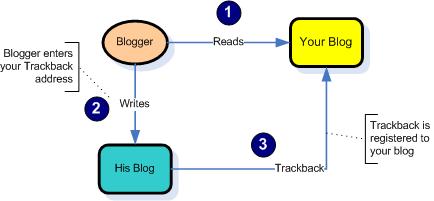
No wonder, I got trackbacks that did not make any sense…Now my intention in discussing DigBack is not to encourage its use but rather discuss the limitations and potential abuses of the underlying Trackback system. Trackbacks were originally conceived and developed by Six Apart. The idea behind it was to enable distributed discussions that can be carried out on multiple blogs, with trackback providing the mechanism to cross-reference these different threads. For those of you who want to know more about trackbacks, Douglas Karr and Wikipedia have excellent descriptions:

The Trackback mechanism used to be a great way to carry out distributed conversations, but as the size of blogosphere has increased, this mechanism has come in for a lot of abuse from a number of bad agents. Some of these abuses have been:

  1. Spam Trackback: The goal of Trackback spam is to insert an outgoing link on a blog to divert traffic to a totally unrelated URL for various financial gains. Typically, sites generating spam trackbacks don’t have a related post, or content related to the target blog.
  2. Referral spam: The spammer links to the target blog from their site, and then pings target blog through their link, thus creating a reference and link to their site on the statistics referral log of the target blog. Now many people list “referrals” on their site publicly, so by spamming referral logs, not only does the spammer get a link on referral log (which is picked up by Google) but may even get a link on the main page of the target blog.
  3. Robo Trackbacks: These are programs like DigBack, that are slightly more sophisticated than trackback spam in the sense they send out more targeted pings to a small set of blogs based on a computed criterion. This computed criterion can range from simple keyword matching, tag matching to more sophisticated natural language analysis based matching of blog content.
  4. Random Trackbacks: At times, in order to attract attention of a fellow blogger, bloggers send trackbacks. Such trackbacks can become a nuisance if the bloggers don’t take the time to read and identify a specific related post based on which to connect with the target blogger.

The underlying weakness of the trackback system is that it treats all blogs the same despite their community behavior. So there is no quick way to a blogger receiving a trackback to quickly judge the quality of an incoming trackback. Also, if a blogger spams another blog, there are no penalties for such actions. What is needed is a better carrot and stick system such that it provides appropriate incentives to all bloggers to maintain the correct linking behavior. Some blog rating services like Authorati, the good blogs might help a little bit here but they need to provide better integration with the trackback system…Anybody up for developing such a system?

Blogging in India

I am in India for a couple of weeks visiting family and wrapping up some business. Before coming here I was excited about the prospect of working in India, as most of the family we are staying with, now have broadband. In fact, while packing for India I even packed a wireless router that will enable me to be somewhat mobile with my laptop.

After the long flight to India, when we finally reached home, I turned on the family computer to check out the broadband (BSNL ADSL) connection. No Signal…Apparently the BSNL server was down. I was told, that it happens occasionally and this might even have something to do with a worker’s strike against privatizing BSNL (it’s a government owned and run organization at this point). Oh well…

The next morning, I got up and turned on the computer and lo and behold the broadband connection was working. All I needed to do now to get productive was to get broadband connection to my laptop. To address that, it was with some relish that I got into setting up the wireless network. The first thing I needed was a voltage converter to convert the 220V power supply to 120V that my router eliminator will accept. I bought an off-the-shelf step down transformer. After plugging in all the required components and the power supply, I was ready to rock and roll. Unfortunately though, I realized that after an initial indication that the router was working, the power light was no longer turned on. I fiddled around with all the combination of power strips we had, even going out and buying a new power supply that generated the requisite 7.5V and 1Amp directly from 220V power supply…still no dice. I unscrewed the router, figured out how to reset it and expectantly plugged it in again…still no light. (I later found out that the issue was that the step-down transformer I bought off-the-shelf was not working as specified and was essentially passing through the voltage unchanged. This had caused a power surge which had actually fried the router).

I was getting frustrated and I had to get some work done. So I decided to move onto plan B which was to takeover the family broadband connection. I unpacked my 40ft Ethernet cable to run the cable from the study to the living room so that I could work and still be somewhat social. Now the issue with running a long cable in India is that all walls are solid concrete and there is no way to drill a hole that goes through. I had two options…Run the cable through the window or through the doors. After a quick family consultation, we shot down the idea of running the cable through the window as it would mean that we will have the leave a couple of windows open – a huge security risk. So I ran the cable through the doors going through 3 doors in the process. After tying the cable to a few nails, to get it out the way of kids, I was ready to be productive…I turned on the laptop…It was lovely, the speed was decent, Skype was working and I could access all my email accounts. I was cruising and beginning to feel connected again when suddenly the connection stopped working…Apparently somebody had closed one of the doors and that had killed the Ethernet cable. The whole system was down again.

The only option I had now was to either work in the study or to move the DSL model to the living room. After some deliberation, I decided to move the modem over to the living room and plug it into the telephone socket there. Things worked for sometime and then boom…the power went out. I was waiting again…

After waiting for a couple of hours for the power, I finally send out an email to my dad about our travel plans in India. I called him up to ask him to look for it on his computer. He gave me a hoarse laugh.
“It won’t work” he said
“Just turn on your computer and check your mail, you should have it. Also print out a copy for reference” I said, pointing out the obvious.
“It won’t work”, he repeated.
Now my dad is no tech wiz, but he can usually read his emails without any problems.
“Why not?” I asked getting a little bit frustrated.
“Well, there was a burglar attack last night in the neighborhood and the thieves took the telephone cables outside a number of houses. They plan to extract the copper from the wires in order to make some money from selling it” he explained.
“So I guess the broadband connection won’t work”, I stated the obvious, with a calmness that even I was surprised by. I guess I was getting used to being back in India.
“It will take just a couple of days and should be ok when you get here” Dad said reassuringly.

I don’t mean to imply from this post, that things are not improving…things are improving in India in a big way – roads are better, BSNL is improving the standard broadband speed from 256Kbps to 2Mbps in the course of next couple of years and even my dad and father-in-law have both a cell phone and a computer – but there is still a long way to go.

Future of Blogging

Gartner recently came out with a new report with company’s top 10 predictions for 2007. I haven’t seen the report (it costs $995) but their press release does a good job of summarizing the predictions:

Blogging and community contributors will peak in the first half of 2007. Given the trend in the average life span of a blogger and the current growth rate of blogs, there are already more than 200 million ex-bloggers. Consequently, the peak number of bloggers will be around 100 million at some point in the first half of 2007.

By our count there are already 80 million active blogs which means that the blogging trend is just about peaking already. AP report has more background on the basis of this prediction.

Could blogging be near the peak of its popularity? The technology gurus at Gartner Inc. believe so. One of the research company’s top 10 predictions for 2007 is that the number of bloggers will level off in the first half of next year at roughly 100 million worldwide.

The reason: Most people who would ever dabble with Web journals already have. Those who love it are committed to keeping it up, while others have gotten bored and moved on, said Daryl Plummer, chief Gartner fellow.

“A lot of people have been in and out of this thing,” Plummer said. “Everyone thinks they have something to say, until they’re put on stage and asked to say it.”

That’s no knock on blogging. Plummer noted that this leveling-off dynamic plays out all the time, though it often comes as a bit of a surprise when it hits things that had achieved quick popularity.

Tony Huang of Blog Herald had the following take on the report:

I’m not sure how someone so esteemed as a Gartner fellow could be so wrong about blogging. One need not need any numbers, but only simple logic to look no further than the rest of the world to see the growth of blogging.

Even if the rate of growth were to slow down in North America, the blogosphere is exploding in places such as China and India — a country of almost a billion people, where one of the official languages is English.

In fact, as the penetration of internet access and broadband access catches up to North America and Western Europe, one cannot but fathom that like a rising tide, it will influence all manner of internet activity. Including the means to provide a voice to the potentially disenfranchised, or those whose voices may not be used to the freedom of speech.

(Yes, that was a reference to blogging).

Clearly, I expect blogging to continue to take off through 2007 and beyond; the only issue is, will professional services like Gartner, or even Technorati, be able to make enough inroads into the Non-English speaking blogosphere to measure this kind of data accurately?

This is an interesting debate…Typically I don’t get involved in futuristic predictions and debates like the ones about, but this one goes right to the core of citizen journalism and web 2.0. Overall, I tend to agree with Gartner’s prediction because Blogging is hard. It take a lot of organization to create a good blog post and most people (without meaning to sound haughty or overbearing) don’t have the skill, patience or the time to sustain the effort. As a totally unscientific example, I talked to more then 10 people about blogging, at a recent TIE event in Silicon valley. All these guys are accomplished in their areas (mostly tech) and knew what blogging was but did not blog. The main reasons they cited for not blogging was that they did not fancy themselves as writers, or did not have the time to write interesting stuff.

To me, the number of blogs peaking, does not mean an end of participative citizen media. It just means, that we are going to need better technology, to enable more ad-hoc community participation, without requiring users to blog. In practical terms this means more innovations in comments, forums and bulletin board technologies to enable non-bloggers, to participate and contribute to conversation in a fruitful way.

Another factor driving this trend is that most blogs need to focus on a particular topic, to sustain readers interest. This means, that if a bloggers wants to participate in a discussion, outside their blog topic, they will need to participate as a non-blogger. 

I suspect based on these new innovations we will see the emergence of a different community of users – the on-line citizens (as opposed to bloggers) – who participate in various online communities on an ad-hoc basis. Active participants in these communities will be grass root inflencers in their respective (local) communities. Of course, these participants will be very important to their respective communities as key sounding boards and drivers of majority opinion. What do you guys think?

Influence Scale

Check out the post at TrivialTV blog that details, via a graph, the relationship between inbound links and visitors to a site (Great data and thanks for making it public)…

In August 2006 I painstakingly harvested data to investigate the relationship between # of links and vistors/day and the effect of syndicates. I’ve only shared the data with a few friends so far, but one of them has been hounding me to share the plot with a wider audience. With Matthew Hurst’s post about Readers Or Links over at Data Mining today, I decided it’s worth going off-topic for a day. So here’s the plot:

I only included sites that used sitemeter with public data access and that were registered with technorati. Nearly 1800 different sites are represented in the figure.

In aggregate terms, the graph is a good proof that inbound links drive traffic (of course some links are more valuable then other). But it still does not answer the questions about influence…Which of the sites, listed in the graph above, have more influence. Check out this interesting post on the ebiquity blog:

Matt Hurst has a great example illustrating why measuring influence as inlinks (what Technorati does) is too simple. Here are two blogs, their inlink rank as computed by Technorati, their average daily visits as computed by Sitemeter, and the trend in visits over the past year.

As Matt pointed out, measuring readership with tools like sitemeter is problematic. As I write this I realize that I read Matt’s post through his feed in Bloglines, so his blogs will not have registered a visit.

Of course, it all depends on what you mean by influence which is mostly a function of why you are interested in it. For example, if your goal is to sell shoes, ads in “Pink” probably have more impact. If you want to push your new book “Taxes are evil” then Malkin’s blog is the way to go. So influence also has to be measured with respect to the community you want to influence.

Other factors that can determine influence are the kind of visitors that are coming to the site (meaning are these influential visitors or not), what these visitors are doing once they are on the site and how engaged are they … Check out our previous post on the subject that deals with how the engagement level of the users can be gauged using the attention data. Another measure of the influence of blogs can be the number and quality of comments. Of course without a universal measure of the quality of comments, relying on just the number of comments, could be very misleading. Bloggers can just turn off the spam filter and that will generate a huge number of bad comments and thereby game the system for judging influence. But with a common gauge of comment quality, the number of comments can be a useful measure of influence. Developing and popularizing a universal gauge for the quality of comments, is a tough nut to crack but its importance cannot be overstated. I am looking forward to more research (I am waiting for the paper that ebiquity guys mentioned) and new ideas on how best to measure influence…Indeed the future of online communities might depend on it.

De-Portalization

There is a lot of buzz of late in the blogosphere about this idea of De-Portalization. Fred Wilson got the discussion started and coined the term to discuss and suggest a strategy for Yahoo!. Edgeio explained it the best with the following pictures (Great job with the pics guys).

The following 3 graphics illustrate what we believe has happened already and is likely to continue. The first picture is a rough depiction of Internet traffic before the flattening (View image to see the full picture) 2004 and all that
The second picture is a rough depiction of today – with the mountains still evident, but much less so
The rise of the foothills
The third picture is where these trends are leading. To a flatter world of more evenly distributed traffic.
The future pattern of web traffic

I totally believe that the foothills are rising. The trend is driven by easy to use publishing tools and a thirst for more communities and authentic discussions among the populace. Still, I am not sure that rise of foothills means that the mountains are not going to as high as they used to be… I recall a similar discussion in 2000 when the product/price comparison engines were all the rage. People were debating the value of a brand and why anybody would pay a premium price for a product on Amazon.com. I suspect the mountains, that represent the well known brands on the Internet will continue to exist and even thrive. If anything, the rise of the foothills means that the mountains would become even more important, as a bearer of mass sensibility and will behave like mass media. The reason for this is really credibility…The mountains (like mass medium) bring credibility to the discussions in the foothills, and even though, there will be a lot more discussions and participation in the foothills, the denizens of one foothill will need to refer to the mountains to make sense of the discussions in other foothills. What do you guys think?

Other discussion on the subject on the web:

Kevin Burton Techmeme Mike Arrington Syntagma Keith Teare’s Weblog Dan Farber at ZDNet Mark Evans Fred Wilson Ivan Pope at Snipperoo Tech Tailrank Collaborative Thinking David Black Surfing the Chaos Ben Griffiths Dave Winer (great pics) Kosso’s Braingarden Dizzy Thinks Mark Evans

Corporate Blogging

I just finished reading the latest Scoble book – Naked Conversation. This book provides an interesting take, on how Blogs are changing the way businesses talk with customers. The driving force behind the trend, is the advent of social media and changes in consumer attitudes towards business-as-usual, that is getting companies out of “command and control” and “batten down the hatches” mentality, and forcing them to engage their customers in real conversations. San Jose Mercury News had an article with a number of examples, last week, further confirming this trend.

Perhaps best known is Mark Cuban, a billionaire who sold Broadcast.com to Yahoo in 1999 and who owns the Dallas Mavericks and co-founded HDNet, an all high-definition television network. His blog is ranked No. 105 in the Technorati blog rank. His fans read him for his idiosyncratic take on technology and sports, YouTube and the media.

At Sun Microsystems, they have gone blog crazy — 3,000 Sun employees (close to 10 percent of the workforce) are bloggers, riffing on topics light and geeky, from “techno celebrity sightings” to “how the world needs only five computers” to “what I wore at the annual shareholders meeting.” Chief among them is the chief himself: Jonathan Schwartz, the CEO. Titled “Jonathan’s blog”, it is translated into 10 languages and ranks 1,370th among all blogs on Technorati.

“The notion of the corporation as an ivory tower has just gone,” said Schwartz.

If a customer complains about a Sun product on Schwartz’s blog, “now I know before my competitors,” says Schwartz. When a commentator complained that Sun’s products are too expensive for start-up companies, Schwartz responded — and offered start-ups a new program.

Schwartz and Sun are unusual but not alone. Paul Otellini, Intel’s chief executive, writes a blog, but not for public consumption. Mark Hurd, the chief executive of Hewlett-Packard, doesn’t blog but many HP executives do at www.hp.com/blogs.

Among executive blogs, there’s some venting. Dave Hitz, co-founder and executive vice president of Network Appliance, headlined one of his recent entries “Why NetApp’s Earnings Results Last Quarter Frustrated Me” (http://blogs.netapp.com/dave/).

Alan Meckler, chief executive of Jupitermedia, an Internet media company in Darien, Conn., has used his blog (http://weblogs.jupitermedia.com/meckler/) as a sort of therapy. In one entry, he complained about a company that pulled out of a deal years ago. “I’ve been carrying that grudge for years, and when I had a chance to write about it, I did,” said Meckler.

Of course engaging customer in real conversation means that companies have to be more accountable. This forces companies in some uncomfortable positions of having to directly respond to public criticisms.

Of course, once the CEO blogs, he must blog when the company faces a public problem. Live and die by the blogging sword.

And that’s what happened in October to Richard Edelman, president and chief executive of Edelman, the public relations firm, and a blog expert. In his own blog he wrote about his firm’s work with Wal-Mart and bloggers.

When a fake blog (known as a flog) promoting Wal-Mart was exposed, Edelman was called to respond. When he initially said nothing, the blogosphere went crazy.

Finally, he posted. Took some blame, announced ethics initiatives, endured the slings and arrows. And moved on.

My take: He was better for it.

As usual, silicon valley companies are taking the lead in redefining public relations and a lot of other traditional companies have a long way to go in order to catch up. Overall this is a very promising trend for all businesses and all I can say is – Amen.

(the pic is not particularly relevant to the topic but it brought a smile to my face…)

On-line communities

There are more then 50 million active blogs and community sites like Digg and Slashdot are more popular then ever. But how do on-line communities compare to real-world communities? Is it even fair to compare real-world communities to on-line communities?

In the real world, people in a community typically interact based on geographical proximity. In the blogoshpere its easy for users to join new groups without geographical limitations, as the cost of travelling or joining a community is typically zero. This makes people of common interest to band together much more easily. But because the cost of joining a community is zero, it reduces the community spirit as people can participate without investing much of their time, their money or their reputation. Let’s look at a couple of examples to further explore these differences.

Participation inequality

As Jacob Nielsen pointed out in a recent alert box article – user participation in on-line communities often follows a 90-9-1 rule. This means that typically 90% of on-line users are lurkers, 9% of users contribute from time to time while the rest of the 1% of users participate a lot and account for most contributions.

Now some of the participation inequality is driven by lower costs associated with joining an on-line community which enables not-so-motivated users to join a community…Some of it can be explained by inherent human nature. For example even physical communities display somewhat lop-sided participation characteristics. Internet, though, I think exacerbates this problem. Following are some of the reasons:

  • No rewards for participation. Contributing to a community does not come naturally to most people unless there is a reward associated with contributing. The mechanisms for providing reward for participation are largely missing from the blogosphere at this point in time.
  • The default substrate for interactions on the Internet is anonymity. It takes an extra effort to get them to drop the cloak of anonymity and express their opinions. This happens only when they feel really-strongly about the topic of discussion.
  • Bad UI design that discourages user participation. One of the most annoying issues here is requiring users to register before they can leave a comment.

Spreading the word-of-mouth

In real-life communities, a good band or a good chef gets a fan following. Now as long as the band keeps producing good music or good dishes, those fans will spread the word about the band or the restaurant to their communities, friends and family. Over time this will result in the driving traffic to the band or to the restaurant.
Word of mouth mechanisms are vital in a community

In on-line communities, the situation is quite different. If a reader likes a particular new blog, he/she leaves a comment. This comment on the new blog is not very useful in driving traffic as it does not create any additional incoming links to the blog. Another option that a reader has is to put the new blog on their blogroll. This will create a new incoming link to the new blog. Now, as all bloggers know, getting added to blogroll of a popular blog is a big deal…It only happens if the new blogger is well known or is writing on the same subject as the reader or has established enough credibility in the space. This makes for a fairly high threshold for a new and unknown blogger to get on the blogroll. This lack of a good word-of-mouth propagation mechanism in blogosphere, makes it hard for a new blogger to build a successful blog despite creating great content.

Conclusion

What we need really is an effective word-on-mouth propagation system based on users reading and interacting with a blog. MyBlogLog (rumored to be in talks to be acquired by Yahoo!) did a great job of creating a community of readers. With MyBlogLog, readers could add other blogs that they visit to their profile and thereby create a bit of the word-of-mouth effect. Also the explicit identification of users with MyBlogLog visitor widget humanized the users. This helped in creating trust and more interactions in the community. We need more ideas like MyBlogLog that help community of readers connect, generate trust and share better with each other.

Overall I think on-line groups are indeed communities joining together based on a shared interest. Still we need to address some of the issues – propagating word of mouth, better networking for readers and incentivizing participation – to make these communities a lot more vibrant and participatory.