5 ways to get more comments on your blog

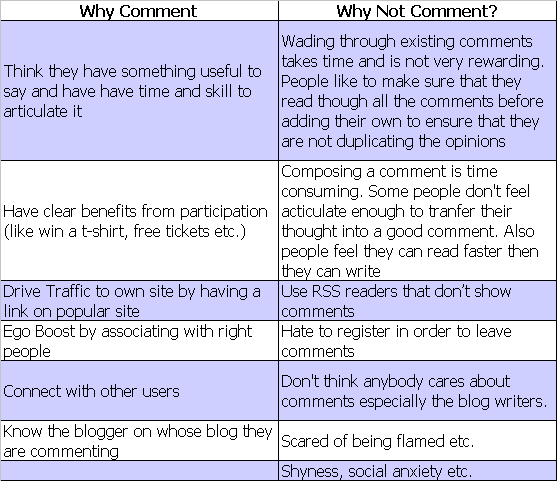
Fascinating survey post at the Freakonomics blog (Thanks Indus for pointing it out) asking users why do or why don’t they comment. (I love these guys not just because of the book or because they write intelligent/insightful stuff but also because Prof. Levitt is from my alma mater). The post generated 114 responses…Now these responses can be extrapolated to other social media as well where the participation more or less follows the same 90-9-1 kinda pattern observed on blogs. I waded through these responses and summarized them in the table below:
comment.PNG

Some of the sample comments from the article are listed below:

# Matt W

First is the fixed cost.. it just took me 3 minutes to register with WordPress and thats a long time for the internet age.

Second, usually, on a high traffic blog like this, commenters have usually taken most points of view in an hour or so.

But mostly, its just like in school where theres a class of 30 people but the same 5 or 6 are the only ones that raise their hand.

# From Deckard

I REALLY WANT OTHER PEOPLE TO READ MY BLOG AS WELL AND GET THE STATS UP – also I WANT TO LOOK IMPORTANT AND ASSOCIATE MYSELF WITH SOMEONE AS GREAT AS (INSERT NAME HERE)

Being a bit of a marketing whore with a new business to promote

# furiousball

Many bloggers comment to get comments. Many also comment to connect with people. The undying need to be loved is strong with the blogging community.

# akbal

I rarely comment on blogs because (1) written communication is a skill I have not practiced since high school (often my comments are misunderstood), (2) Ive learned that people usually ignore or attack what they dont already believe (this makes my comments seem futile), and (3) I have things I would rather be doing (it usually takes 30 minutes or more to write even a semi-coherent response to a blog.

Shyness definitely plays into my reasons.

# sbw

Commenters needed to be parsed into distinct categories. Some comment to learn to nail an idea to a page so others will refine it. Some comment to convince. Some comment for community.

Still others comment to overpower ideas with cheap rhetoric.

# jonathank

I comment on two types of blogs: people I know and where I believe the author reads the comments and might actually be looking for ideas and different takes.

I have, on rare occasion, joined in to reinforce others comments. It is fruitless to argue with people in comments – or mostly anywhere on the internet – but sometimes it can be enjoyable (and, in a rare case, even constructive) to agree with other commenters

# RobertSeattle

I actually tend to avoid blogs that dont allow comments. Not allowing for comments means the blogger really doesnt care about what their readers think. I prefer some kind of login system though because I am a firm believer in the formula:

Normal Person + Anonymity + Audience = Total Idiot

# sasha

1. I (like many readers, I suspect) read your blog through an RSS feed. So commenting involves clicking on the link to your actual site, remembering my wordpress username (which usually takes a trip to my email account where its saved), and then remembering the password Ive chosen.
2. After a while, regular commenters start to form a community. It starts to feel intrusive to insert yourself.
3. The time it takes me to formulate a comment Im happy with posting is usually not worth what Ill get out of actually posting it. Im usually picky about being concise, grammatically correct, and having fully formed ideas, so a comment can take me upwards of 30 minutes to put together. And then the comment will usually be ignored anyway.

# kentavos

Why I comment:

1. I feel passionately about the topic or I have unique insight.

2. Im in the mood and I have time.

3. I might win a t-shirt.

Why I dont comment:

1. My point of view is already represented.

2. Too many comments, Id just be lost in the sea of comments.

3. Too many passionate views, no one would really listen.

4. I dont have the time to deliver a concise and well thought out comment.

# mungojelly

Right after spending a while writing a detailed comment, I always have a nagging feeling that Ive wasted my time. If I have something important to say, why am I saying it way down at the bottom of a pile of messages, where no one will read it? If I dont have anything important to say, why am I spending time typing at all??

Heres a paradox, though: In principle I believe comments are very important, and Im offended when theyre disabled, even though I still think theyre usually a waste of space in particular. Theres some sense to that attitude, and heres my attempt to explain it: The difference between having comments and not having comments is whether you are projecting an open space or a closed space. Allowing for comments even if in practice theyre spam & junk & metooism is saying I am participating in a conversation, not a monologue; this is a two-way street.

Earlier today I saw something that was interesting but smelled like bullshit, so I glanced at the comments: Naturally the first comment was someone cutting through the bullshit & giving the real facts. Thats part of whats so nice about the internet.

5 insights for the bloggers are:

  1. People hate sites that do not allow comments
  2. Asking people explicitly for their feedback and participating in comments is a good idea if you want more comments. Also providing clear incentives or rewards for participation works. Such rewards could be vanity items like t-shirts or just an explicit recognition in blog posts
  3. Go out there and meet people. If people know you in real life, they are a lot more likely to comment on your blog then otherwise.
  4. Providing a respectable and positive environment for participation can help commenters overcome their shyness or fear of being attacked. This can be done by sanctioning personal attacks/harsh comments and ensuring that a positive environment for participation is maintained
  5. People get overwhelmed with comments so a mechanism to filter useful/unique comments can help drive more comments

Finally a haiku from the comments section of Freakonomics blog to remind you how wonderful and creative commenters can be:

# egretman

The question is not why we comment
Thats seems all too evident
Rather I want to know why you blog
Is it for the comments that you will log?
Are you a comment hog?
Do you take them home and cherish them
Read them as if each were a gem
If so then you are one sick dude
Especially if you read them in the nude
Well thats all I have to say
Heres hoping that Ive made your day.

Improving Online Communities

An online community, or for that matter any community, is built upon shared experiences of its participants. In the real world, people in a community typically interact with each other by gathering at same physical location, at the same time. In online communities, it is easy for users to interact with each other without any geographical or temporal limitations. But in return for the benefits that Internet (or even telephone to a lesser degree) provides in terms of ease of communication, it takes away from the richness, texture and context of the conversation. As such a number of startups are trying to address the problem with online communities and restore richness, texture and context to online communities. (Richard calls this market segment, meta social networking).

Who reads my blog

MyBlogLog started off with the agenda to provide blog analytics. They launched MyBlogLog Communities mid last year, to enable readers of blogs to join and share their experiences with other like-minded group of readers. The idea was that if readers like same content, they probably have plenty else in common. They built a platform where readers could trade messages with other readers and see what other sites they visit.

Power of Images

They hit the jackpot with the reader rolls that provided a picture to connect readers and writer of blogs. By just providing a static visual cue in the form of a picture, MyBlogLog provided an important visual context for online community conversations. The result, their usage took off and is not at over 50K users…In the meantime, they also got acquired by Yahoo! for a $10M.

Where there are visitors there is spam

With all the success came a number of people looking use MyBlogLog for financial gains. From R-Rated avatars to people pretending to be somebody else to other commercial avatars like Mr. Online Pharmacy, there has been a glut of stories related to how people are trying to game MyBlogLog and given their history, MyBlogLog has understandably been having a hard time coping.

Competition

In addition to all the spammers, there is new competition on the horizon for MyBlogLog. OthersOnline and Explode are two emerging players. These players have interesting new twists to the functionality provided by MyBlogLog. Let’s take a quick look at each:

Explode

Explode provides the same analytics capability as MyBlogLog but in addition to Analytics, it also allows users to build a network for friends who can be readers or writers of blogs. Bloggers can then display a friends widget on their blogs. This widget provides valuable context on the readers of the blog and the bloggers circle of friends. Another capability Explode provides is a comment wall for each user, where friends and other users can post comments. This also provides valuable context on each of the user.

OthersOnline

OthersOnline has an interesting twist on the idea of providing context. They allow people to register their profile along with their website. As part of the registration process, OthersOnline asks users to categorize their website and themselves via keywords. Now using these keywords, OthersOnline shows profile information, along with presence and email, of users via a browser plug-in (a widget is in the works as well). The idea is to make it easy for people to locate other like minded individuals or websites in the course of browsing.

Conclusion

While these companies are breaking new ground in making online conversations more useful, there is still a long way to do before we have achieved a good enough quality of online interactions. Good things, a lot of companies are working on it.

De-Portalization

There is a lot of buzz of late in the blogosphere about this idea of De-Portalization. Fred Wilson got the discussion started and coined the term to discuss and suggest a strategy for Yahoo!. Edgeio explained it the best with the following pictures (Great job with the pics guys).

The following 3 graphics illustrate what we believe has happened already and is likely to continue. The first picture is a rough depiction of Internet traffic before the flattening (View image to see the full picture) 2004 and all that
The second picture is a rough depiction of today – with the mountains still evident, but much less so
The rise of the foothills
The third picture is where these trends are leading. To a flatter world of more evenly distributed traffic.
The future pattern of web traffic

I totally believe that the foothills are rising. The trend is driven by easy to use publishing tools and a thirst for more communities and authentic discussions among the populace. Still, I am not sure that rise of foothills means that the mountains are not going to as high as they used to be… I recall a similar discussion in 2000 when the product/price comparison engines were all the rage. People were debating the value of a brand and why anybody would pay a premium price for a product on Amazon.com. I suspect the mountains, that represent the well known brands on the Internet will continue to exist and even thrive. If anything, the rise of the foothills means that the mountains would become even more important, as a bearer of mass sensibility and will behave like mass media. The reason for this is really credibility…The mountains (like mass medium) bring credibility to the discussions in the foothills, and even though, there will be a lot more discussions and participation in the foothills, the denizens of one foothill will need to refer to the mountains to make sense of the discussions in other foothills. What do you guys think?

Other discussion on the subject on the web:

Kevin Burton Techmeme Mike Arrington Syntagma Keith Teare’s Weblog Dan Farber at ZDNet Mark Evans Fred Wilson Ivan Pope at Snipperoo Tech Tailrank Collaborative Thinking David Black Surfing the Chaos Ben Griffiths Dave Winer (great pics) Kosso’s Braingarden Dizzy Thinks Mark Evans

Corporate Blogging

I just finished reading the latest Scoble book – Naked Conversation. This book provides an interesting take, on how Blogs are changing the way businesses talk with customers. The driving force behind the trend, is the advent of social media and changes in consumer attitudes towards business-as-usual, that is getting companies out of “command and control” and “batten down the hatches” mentality, and forcing them to engage their customers in real conversations. San Jose Mercury News had an article with a number of examples, last week, further confirming this trend.

Perhaps best known is Mark Cuban, a billionaire who sold Broadcast.com to Yahoo in 1999 and who owns the Dallas Mavericks and co-founded HDNet, an all high-definition television network. His blog is ranked No. 105 in the Technorati blog rank. His fans read him for his idiosyncratic take on technology and sports, YouTube and the media.

At Sun Microsystems, they have gone blog crazy — 3,000 Sun employees (close to 10 percent of the workforce) are bloggers, riffing on topics light and geeky, from “techno celebrity sightings” to “how the world needs only five computers” to “what I wore at the annual shareholders meeting.” Chief among them is the chief himself: Jonathan Schwartz, the CEO. Titled “Jonathan’s blog”, it is translated into 10 languages and ranks 1,370th among all blogs on Technorati.

“The notion of the corporation as an ivory tower has just gone,” said Schwartz.

If a customer complains about a Sun product on Schwartz’s blog, “now I know before my competitors,” says Schwartz. When a commentator complained that Sun’s products are too expensive for start-up companies, Schwartz responded — and offered start-ups a new program.

Schwartz and Sun are unusual but not alone. Paul Otellini, Intel’s chief executive, writes a blog, but not for public consumption. Mark Hurd, the chief executive of Hewlett-Packard, doesn’t blog but many HP executives do at www.hp.com/blogs.

Among executive blogs, there’s some venting. Dave Hitz, co-founder and executive vice president of Network Appliance, headlined one of his recent entries “Why NetApp’s Earnings Results Last Quarter Frustrated Me” (http://blogs.netapp.com/dave/).

Alan Meckler, chief executive of Jupitermedia, an Internet media company in Darien, Conn., has used his blog (http://weblogs.jupitermedia.com/meckler/) as a sort of therapy. In one entry, he complained about a company that pulled out of a deal years ago. “I’ve been carrying that grudge for years, and when I had a chance to write about it, I did,” said Meckler.

Of course engaging customer in real conversation means that companies have to be more accountable. This forces companies in some uncomfortable positions of having to directly respond to public criticisms.

Of course, once the CEO blogs, he must blog when the company faces a public problem. Live and die by the blogging sword.

And that’s what happened in October to Richard Edelman, president and chief executive of Edelman, the public relations firm, and a blog expert. In his own blog he wrote about his firm’s work with Wal-Mart and bloggers.

When a fake blog (known as a flog) promoting Wal-Mart was exposed, Edelman was called to respond. When he initially said nothing, the blogosphere went crazy.

Finally, he posted. Took some blame, announced ethics initiatives, endured the slings and arrows. And moved on.

My take: He was better for it.

As usual, silicon valley companies are taking the lead in redefining public relations and a lot of other traditional companies have a long way to go in order to catch up. Overall this is a very promising trend for all businesses and all I can say is – Amen.

(the pic is not particularly relevant to the topic but it brought a smile to my face…)

eBay ratings booster

I came across this fascinating piece on Auctionbyte, about how some users are gaming the eBay rating system.

Many eBay users are familiar with sellers who use a low-price/high-shipping strategy to manipulate eBay search results. But less well known is the technique of listing 1-cent eBooks with zero shipping charges. In fact, it would appear at first glance to be a money-losing strategy, since eBay charges a minimum 5-cent listing fee for Stores (and 20 cents for core listings). But sellers employing the strategy offer multiple quantities of the items in each listing.

While sellers legitimately sell digital content on eBay, many of the 1-cent eBook, no-shipping Store listings AuctionBytes examined looked suspect, including the possibility that sellers are in effect creating “feedback farms” – creating multiple User IDs that bid on these listings to quickly build up positive feedback ratings.

One such listing posted on September 20 netted the seller close to 1,000 feedback points in a 4-day period. The item for sale was a 1-cent/no shipping eBook that promised in the headline to make sellers $100/day by selling on eBay. By the evening of September 24, there were 9012 of these eBooks still available for sale through this one listing. (The listing contained photos of scantily clad women for no obvious reason.)

One UK website owner is apparently well aware of the penny eBook strategy and created a page to help users quickly overcome the restrictions eBay places on new accounts. “I know what it’s like when you have just opened your ebay account and have restrictions in place such as not being able to list “buy it now” auctions. To help with this problem I put together this short helper page which will get you 10 positive feedbacks within 100 seconds” (http://www.tradedemon.net/10EbayFeedbacks.php). The page includes links to active penny listings on eBay with instructions to buy 10 1-penny eBooks and leave positive feedback for the seller. “By the time you finish all 10, your feedback should be on 10.”

The article also talks about the struggle between the eBay policy enforcers and people trying to make a buck. Now, I don’t recommend that you do any of the things mentioned in the article, but check it out…Its an interesting case study on how it really hard for a horizontal e-business like eBay, to work effectively in the long tail economy.

Don’t trust, just verify

Francois Gossieaux, president of Corante, Inc., has an interesting post about lack of community spirit and trust in corporate cultures. He points to some interesting statistics from a study by American Management Association.

…76% of companies monitor employee web site connections and 55% retain and review email messages. The number of companies tracking telephone calls, including amount of time spent on the phone and phone numbers called has grown to 51%, up from 9% in 2001. And this does not include companies who require periodic medical checks and random drug usage tests.

This is a disturbing trend that runs quite contrary to the idea of karma capitalism (check out the BusinessWeek article that coined the phrase).

On the one hand, open source model of software development that relies on trust in the community, is gaining prominence. Google is a media and community darling based on its “don’t be evil” mantra. Wikipedia is becoming one of the most important and useful source of information on the web. Cooperation is becoming more and more important in the concept of coopetition. E.g. check out Matt Mullenweg’s take on competition in a recent interview.

On the other hand, enterprises are still looking for ways to extend their command and control influence. Remember the Walmart and Edelman PR fiasco or the lack of trust mentioned in the report above.

Best example of trust

This is going to be an interesting tussle…Already, the public opinion is changing to reflect a growing dissatisfaction with business-as-usual. I hope that overtime, this is going to force enterprises to face up to the limitation of command and control, and lead them to appreciate the power of trusting their employees and customer communities.

On-line communities

There are more then 50 million active blogs and community sites like Digg and Slashdot are more popular then ever. But how do on-line communities compare to real-world communities? Is it even fair to compare real-world communities to on-line communities?

In the real world, people in a community typically interact based on geographical proximity. In the blogoshpere its easy for users to join new groups without geographical limitations, as the cost of travelling or joining a community is typically zero. This makes people of common interest to band together much more easily. But because the cost of joining a community is zero, it reduces the community spirit as people can participate without investing much of their time, their money or their reputation. Let’s look at a couple of examples to further explore these differences.

Participation inequality

As Jacob Nielsen pointed out in a recent alert box article – user participation in on-line communities often follows a 90-9-1 rule. This means that typically 90% of on-line users are lurkers, 9% of users contribute from time to time while the rest of the 1% of users participate a lot and account for most contributions.

Now some of the participation inequality is driven by lower costs associated with joining an on-line community which enables not-so-motivated users to join a community…Some of it can be explained by inherent human nature. For example even physical communities display somewhat lop-sided participation characteristics. Internet, though, I think exacerbates this problem. Following are some of the reasons:

  • No rewards for participation. Contributing to a community does not come naturally to most people unless there is a reward associated with contributing. The mechanisms for providing reward for participation are largely missing from the blogosphere at this point in time.
  • The default substrate for interactions on the Internet is anonymity. It takes an extra effort to get them to drop the cloak of anonymity and express their opinions. This happens only when they feel really-strongly about the topic of discussion.
  • Bad UI design that discourages user participation. One of the most annoying issues here is requiring users to register before they can leave a comment.

Spreading the word-of-mouth

In real-life communities, a good band or a good chef gets a fan following. Now as long as the band keeps producing good music or good dishes, those fans will spread the word about the band or the restaurant to their communities, friends and family. Over time this will result in the driving traffic to the band or to the restaurant.
Word of mouth mechanisms are vital in a community

In on-line communities, the situation is quite different. If a reader likes a particular new blog, he/she leaves a comment. This comment on the new blog is not very useful in driving traffic as it does not create any additional incoming links to the blog. Another option that a reader has is to put the new blog on their blogroll. This will create a new incoming link to the new blog. Now, as all bloggers know, getting added to blogroll of a popular blog is a big deal…It only happens if the new blogger is well known or is writing on the same subject as the reader or has established enough credibility in the space. This makes for a fairly high threshold for a new and unknown blogger to get on the blogroll. This lack of a good word-of-mouth propagation mechanism in blogosphere, makes it hard for a new blogger to build a successful blog despite creating great content.

Conclusion

What we need really is an effective word-on-mouth propagation system based on users reading and interacting with a blog. MyBlogLog (rumored to be in talks to be acquired by Yahoo!) did a great job of creating a community of readers. With MyBlogLog, readers could add other blogs that they visit to their profile and thereby create a bit of the word-of-mouth effect. Also the explicit identification of users with MyBlogLog visitor widget humanized the users. This helped in creating trust and more interactions in the community. We need more ideas like MyBlogLog that help community of readers connect, generate trust and share better with each other.

Overall I think on-line groups are indeed communities joining together based on a shared interest. Still we need to address some of the issues – propagating word of mouth, better networking for readers and incentivizing participation – to make these communities a lot more vibrant and participatory.

Trust, or shall we say distrust, in American society

Check out the fascinating study titled – An examination of trust in contemporary American society – about what do people trust in American society. It looks like

Interestingly, respondents were loath to name a medium that they found trustworthy, and even when they did, the designated medium was not trusted nearly as well as family members or other close associates. In fact, regardless of the nature of the issue—personal, political, or professional—respondents indicated consistently high levels of trust for family members and friends. Additionally, respondents were much more willing to tell us whom they did not trust than whom they did. Interestingly, this result came not just through the survey itself, but through our attempts to advertise the survey to diverse groups. An experience with Beliefnet.org serves as a telling example:

Considering the type of medium we are using (the Internet) how can anyone be sure of anything we find here??

I guess this is another reason engagement marketing is so much in vogue these days…Also the lack of trust in the Internet is understandable especially for the non-tech savvy, older users as they are the most targeted victims of all sorts of identity, phishing and other on-line frauds.

Amazon.com reviews are rigged

Amazon.com user reviews are a critical factor in increasing the sales for the giant retailer. The number of times, I have heard my wife say that she selected a particular product because of great user reviews, is far too high to count. These reviews can have significant credibility issues, though…In their great scholarly paper – Six degrees of reputation: The use and abuse of online review and recommendation systems – Shay David and Trevor Pinch point to some of the follies of user-generated reviews at Amazon.com:

Evidently, in many areas of cultural production user reviews are mushrooming as an alternative to traditional expert reviews. If there was any doubt, it has long ago been established that reviews and recommender systems play a determining role in consumer purchasing (an early review is available in Resnick and Varian, 1997) and recent qualitative research adds weight to the claim that these review systems have causal and positive effects on sales; to nobody’s surprise, books with more and better reviews are shown to sell better (Chevalier and Mayzlin, 2004). With people in the culture industries increasingly realizing this truism, many of the reviews are thus positively biased and it becomes very hard to distinguish the ‘objective’ quality of the reviews. In addition, due to the large variance in the quality of the reviews, and the varied agendas of the reviewers, user input too often becomes untrustworthy leaving the consumers with little ability to gauge an item’s actual quality. Do we live in a cultural Lake Wobegon where “all the books are above average?” (to paraphrase Keillor, 1985) Is there a way to review the reviewers, to guard the guards? As will be discussed in details below, emerging systems like the one employed on sites like Amazon.com (2005) suggest that there are ways to try to solve this bias problem by offering a tiered reputation management system which offers a set of checks and balances. But these new options also bring with them new problems as the participants adjust to what is at stake in this new economy of reputation.

They offer examples with links to amazon.com reviews:

This instance concerned one of Pinch’s own books Analog Days: The Invention and Impact of the Moog Synthesizer (Pinch and Trocco, 2002). This book that chronicles the invention and early days of the electronic music synthesizer was well received by reviewers both offline and online, and the Amazon.com editors quote a review from the Library Journal that reads as follows:

… In this well–researched, entertaining, and immensely readable book, Pinch (science & technology, Cornell Univ.) and Trocco (Lesley Univ., U.K. [sic]) chronicle the synthesizer’s early, heady years, from the mid–1960s through the mid–1970s … . Throughout, their prose is engagingly anecdotal and accessible, and readers are never asked to wade through dense, technological jargon. Yet there are enough details to enlighten those trying to understand this multidisciplinary field of music, acoustics, physics, and electronics. Highly recommended. [link]

original review

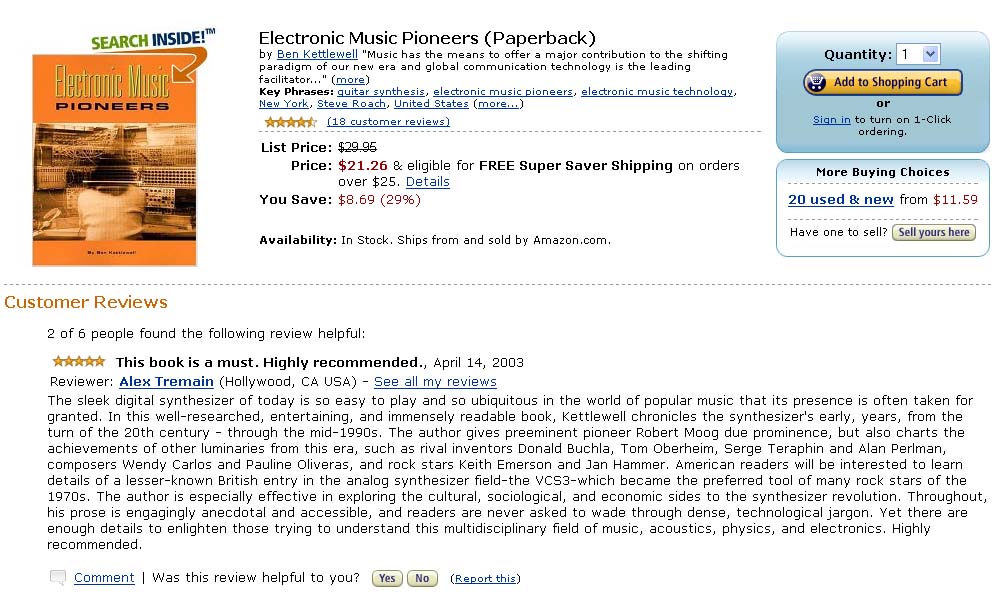
A similar (but distinctly different) book that had appeared earlier — Electronic Music Pioneers by Ben Kettlewell (Vallejo, Calif.: ProMusic Press, 2002) — received the following user review on Amazon.com on 15 April 2003:

This book is a must. Highly recommended., April 15, 2003 / Alex Tremain (Hollywood, CA USA)

… In this well–researched, entertaining, and immensely readable book, Kettlewell chronicles the synthesizer’s early, years, from the turn of the 20th century — through the mid–1990s … . Throughout, his prose is engagingly anecdotal and accessible, and readers are never asked to wade through dense, technological jargon. Yet there are enough details to enlighten those trying to understand this multidisciplinary field of music, acoustics, physics, and electronics. Highly recommended. [link]

Copied review

The ‘similarity’, of course, is striking. The second review is simply a verbatim copy of the first one, replacing only the name of the authors and the period the book covers.

In another case a user reviewed several Tom Hanks/Meg Ryan movies. The user posted the same review for the movies Sleepless in Seattle and You’ve Got Mail. He found that each of those films was “a film about human relations, hope and second chances, but most importantly about trust, love, and inner strength.” [link link]

copied review

rev4

As we know, especially with the demands for producing one blockbuster after another, Hollywood movies are sometimes strikingly similar, and yet posting the same review for two different films suggests that the reviewer is interested less in accurate representation of the movie’s content or qualities and more in the sort of reputation and identity that he or she can build as someone who posts numerous reviews.

The authors point perverse incentives for different actors to game the review mechanisms:

  • Self-plagiarize in order to write reviews quickly and to build up reviewer reputation (see examples with links above)
  • Write unusually positive reviews to butter the publisher and the author in hope of landing a job as a full-time reviewer
  • People with vested financial interest in the success of a product, take advantage of the cloak of anonymity and try to game the system by having family members etc. create positive reviews for their product and negative reviews for competing products
  • Write reviews to see your name associated with a popular product. This can work as an ego boost for adolescents or even some adults
  • Write reviews to promote other web sites or substitute products (example)

The authors find the problems mentioned above, based on their very limited analysis (due to the limitations of Amazon.com APIs), to effect about 1% of the reviews. I suspect, though, that a thorough analysis will reveal a significantly higher level of problem reviews.

So what can be done to deal with these issues? I believe that any system – both online and offline – has limitations that can be exploited by bad actors for personal benefit. Anybody remember the Armstrong Williams fiasco as an example of problems with offline systems? Still, as long as these systems are transparent and user expectations of how the systems work are properly managed, such systems can be valuable. Some of the specific things Amazon.com can do are:

  • Provide more statistics about various issues with its user generated product reviews so as to properly set user expectations. They should point to all the various kinds of problems so that users take all the reviews on their site, with a pinch of salt. This, of course will be hard because doing this might reduce their revenue and potentially their influence, but in the long term pay off in terms of higher customer satisfaction.
  • Be more receptive to user complaints and create a mechanism to penalize the people who try and game the system. At present they seem to be taking a completely hands off approach to policing the user reviews and as a result customers end up paying a price.
  • Build up a more sophisticated notion of reputation which is based on reputation of users in other communities. Such a notion should include more elements then just the number of reviews a person has entered
  • Build up a more sophisticated meta-moderation system like the one built by Slashdot.

This is not a simple problem but one Amazon.com should tackle to maintain long-term trust relationship with their users.