Sunshine for the Virtual Town Hall

Great opinion piece by Tom Grubisich at Washinton Post. It talks about the lack of transparency with user generated content.

These days we want “transparency” in all institutions, even private ones. There’s one massive exception — the Internet. It is, we are told, a giant town hall. Indeed, it has millions of people speaking out in millions of online forums. But most of them are wearing the equivalent of paper bags over their heads. We know them only by their Internet “handles” — gotalife, runningwithscissors, stoptheplanet and myriad other inventive names.

Imagine going to a meeting about school overcrowding in your community. Everybody at the meeting is wearing nametags. You approach a cluster of people where one man is loudly complaining about waste in school spending. “Get rid of the bureaucrats, and then you’ll have money to expand the school,” he says, shaking his finger at the surrounding faces.

You notice his nametag — “anticrat424.” Between his sentences, you interject, “Excuse me, who are you?”

He gives you a narrowing look. “Taking names, huh? Going to sic the superintendent’s police on me? Hah!”

In any community in America, if Mr. anticrat424 refused to identify himself, he would be ignored and frozen out of the civic problem-solving process. But on the Internet, Mr. anticrat424 is continually elevated to the podium, where he can have his angriest thoughts amplified through cyberspace as often as he wishes. He can call people the vilest names and that hate-mongering, too, will be amplified for all the world to see.

This is a real problem with the Internet (Although I am not sure about “transparency in all institution” especially with the government)…With the lack of incentives to participate and lack of tools for the community to control the conversation, the vocal and vilest few take over the conversation and bring down the quality of discourse. Tom suggests a few solutions:

Until recently, many of the site’s posters identified themselves with anonymous Internet handles — which were the site’s default ID. Now, people must enter a “user ID” that appears with their comments.

Hal Straus, washingtonpost.com’s interactivity and communities editor, says the changes “move us in the direction of transparency.” But the distinction is not quite a difference, because washingtonpost.com user IDs can be real names or fictional Internet handles. While the site prohibits comments that are libelous, abusive, obscene or otherwise inappropriate, Mr. anticrat424 could still find a well-amplified podium at washingtonpost.com.

The news and opinion site Huffingtonpost.com requires posters to register with their real names but maddeningly assures them that it will “never” use those names.

Though not foolproof, there are ways to at least raise the bar. Gordon Joseloff, a former CBS News correspondent who owns WestportNow.com, a popular grass-roots site in Westport, Conn., used to employ the standard permissive registration process. But in late 2005, turned off by the venom of anonymous posters, Joseloff instituted a policy requiring anyone who wanted to comment to use his or her real name. Joseloff also requires registrants to give their phone numbers. Numbers aren’t posted on the site, but they give him and his team an additional check against false registration.

Only the big sites like the Washington Post or Huffington Post can pull off requiring users to register…And its really painful for readers to have to remember another username and password. So what is the solution? Also there is a need to strike the right balance between the need for anonymity and identification…At times Anonymity is justified, like with whistleblowers etc. but at the same time anonymity all the times provides perverse incentives…What do you think?

Benefits of Forgetting

Interesting and scholarly study from Kennedy School of Government’s Viktor Mayer-Schönberger, titled “Useful Void: The Art of Forgetting in the Age of Ubiquitous Computing”. In the study, the author points to change in our default societal behavior, from forgetting unimportant things to remembering everything.

In March 2007, Google confirmed that since its inception it had stored every search query every user ever made and every search result she ever clicked on. Google remembers forever.

“хранить вечно“ (to be preserved forever) the KGB stamped the dossiers on its political prisoners. The Communist state would never forget the identity, believes, actions and words of those that had opposed it.

Like the Soviet state, Google does not forget. But unlike the Soviet Union that ceased to exist fifteen years ago, Google has become an indispensable tool for hundreds of millions of people around the world, who use it every day. We seem to have accepted that our digital society may forgive, but no longer forgets.

This has resulted in a drastic shift in our data retention behavior. For millennia it was difficult and costly to preserve. We would only do so in exceptional circumstances, and most frequently only for a limited period of time. For almost all of human history, most of what humans experienced was quickly forgotten. Today, however, retention of digital data is (relatively) easy and cheap. As a consequence, and absent other considerations, we keep rather than delete it. This is the central point: In our analog past, the default was to discard rather than preserve; today the default is to retain.

Credit bureaus store extensive information about hundreds of millions of U.S. citizens. Daniel Solove writes that the largest US provider of marketing information offers up to 1,000 data points for each of the 215 million individuals in its database. We also see the combination of formerly disparate data sources. Solove mentions a company that provides a consolidated view at data from 20,000 different sources across the world. It retains the data, he writes, even if individuals dispute its accuracy.

Companies keep our air travel reservations on file even when we decide not to buy the ticket, together with rich information about us and our previous travel patterns.21 Millions of cameras in public places – the UK alone is said to operate between 2 and 3 million produce records of our movements that are kept. Law enforcement agencies store biometric information about tens of millions of individuals even if these have never been charged with a crime. Search engines retain each of our search queries, and keeps archival copies of our web pages long after we have taken them offline.

This is only the beginning. With the advent of ubiquitous computing, of cheap GPS chips in our cell phones, cameras and cars, of RFID tags in everyday objects, and of tiny, networked sensors that surround us, a more comprehensive trail of our actions will be collected than ever before. Given low cost of storage, ease of retrieval and potential value in accessing information, much of the data that is being collected will be kept for months if not years, as our societal default has shifted from deletion to retention.

This has drastic consequences beyond the obvious ability to know much more about other people’s preferences, behaviors, actions and opinions than in the analog world of incremental forgetting. Living in a world in which our lives are being recorded and records are being retained, in which societal forgetting has been replaced by precise remembering, will profoundly influence how we view our world, and how we behave in it.

If whatever we do can be held against us years later, if all our impulsive comments are preserved, they can easily be combined into a composite picture of ourselves. Afraid how our words and actions may be perceived years later and taken out of context, the lack of forgetting may prompt us speak less freely and openly. This is the temporal version of a panoptic society, in which everything is being watched; it is a society in which most of what is being recorded and collected is being preserved. Regardless of other concerns we may have, it is hard to see how such an unforgetting world could offer us the open society that we are used to today.

So what is the solution? The author suggests a combination of legislative and technical approaches that restore the default of forgetting in our society. So if some entity or person wanted to remember things beyond certain time period, they would need to do some special action like writing down in digital terms…I think this makes a lot of sense and could prevent common people from becoming more and more like stage coached politicians who  plan and practice each and every one of their moves and utterances…What do you think?

Human Herd

Fascinating article in the NYT today (I am again quoting NYT…It seems they have really gotten their act together of late in the high-tech/network world space). The article talks about the theory of “Cumulative Advantage” or the “rich get richer” effect. In summary the theory suggests that our preferences/decisions are very much effected by what other people are doing. So if a technology or a singer or a movie is liked by our peers we are more likely to try it and like it. We provided another example of this phenomenon (without naming the theory) in a prior post related to behavior of users at Digg where we observed that a fake article got a number of Diggs just because a user paid of a few Diggs to get initial momentum.

istock_000002199222xsmall.jpg

Conventional marketing wisdom holds that predicting success in cultural markets is mostly a matter of anticipating the preferences of the millions of individual people who participate in them. From this common-sense observation, it follows that if the experts could only figure out what it was about, say, the music, songwriting and packaging of Norah Jones that appealed to so many fans, they ought to be able to replicate it at will. And indeed that’s pretty much what they try to do. That they fail so frequently implies either that they aren’t studying their own successes carefully enough or that they are not paying sufficiently close attention to the changing preferences of their audience.

The common-sense view, however, makes a big assumption: that when people make decisions about what they like, they do so independently of one another. But people almost never make decisions independently — in part because the world abounds with so many choices that we have little hope of ever finding what we want on our own; in part because we are never really sure what we want anyway; and in part because what we often want is not so much to experience the “best” of everything as it is to experience the same things as other people and thereby also experience the benefits of sharing.

The authors set out to test out the theory with an interesting experiment:

Because it’s not possible in the real world to test theories about events that never happened, most of what we know about cumulative advantage has been worked out using mathematical models and computer simulations — an approach that is often criticized for glossing over the richness of real human behavior. Fortunately, the explosive growth of the Internet has made it possible to study human activity in a controlled manner for thousands or even millions of people at the same time. Recently, my collaborators, Matthew Salganik and Peter Dodds, and I conducted just such a Web-based experiment. In our study, published last year in Science, more than 14,000 participants registered at our Web site, Music Lab (www.musiclab.columbia.edu), and were asked to listen to, rate and, if they chose, download songs by bands they had never heard of. Some of the participants saw only the names of the songs and bands, while others also saw how many times the songs had been downloaded by previous participants. This second group — in what we called the “social influence” condition — was further split into eight parallel “worlds” such that participants could see the prior downloads of people only in their own world. We didn’t manipulate any of these rankings — all the artists in all the worlds started out identically, with zero downloads — but because the different worlds were kept separate, they subsequently evolved independently of one another.

This setup let us test the possibility of prediction in two very direct ways. First, if people know what they like regardless of what they think other people like, the most successful songs should draw about the same amount of the total market share in both the independent and social-influence conditions — that is, hits shouldn’t be any bigger just because the people downloading them know what other people downloaded. And second, the very same songs — the “best” ones — should become hits in all social-influence worlds.

What we found, however, was exactly the opposite. In all the social-influence worlds, the most popular songs were much more popular (and the least popular songs were less popular) than in the independent condition. At the same time, however, the particular songs that became hits were different in different worlds, just as cumulative-advantage theory would predict. Introducing social influence into human decision making, in other words, didn’t just make the hits bigger; it also made them more unpredictable.

Where does this leave us with the rational choice and perfect market theory? Do you think people are more rational when it comes to money? What about making investments? How should VCs or any investor for that matter, evaluate a new consumer technology or a mass market product? This is powerful stuff.

Compete.com: first Attention based metric

You are all probably familiar with my previous posts (New audience metric, AttentionTrust) about the need for better metric to measure the engagement level of users at a particular web-site. The issue with the current metric of page-views can be best understood by comparing it with TV surfing. Consider a user Ms. X, with a remote, who surfs to a particular channel say FOX and immediately switches over to NBC where she watches a full hour of Apprentice. With page-views, which only measures the number of times a particular page loads or channel is accessed in our example, both NBC and FOX will get equal equal credit for the user. Clearly though, NBC had a better opportunity to engage the user and will likely be a more effective advertising medium for somebody looking to reach the Ms. X.

This inequality in the way the page views are measured is further exacerbated by the difference in which web sites can vary in information density per page. The use of technology like AJAX can enable web-sites to pack a whole lot of dynamic information in just one page. Check out the Noisely…I love this web-site design and the whole application is just one page (except for informational pages like FAQ etc.). All this means that we need a better way to measure the user engagement in order to better evaluate the effectiveness of web-sites.

istock_000002281507xsmall.jpg

Last week Compete.com, a web measurement company, announced the first metric to measure of this important data. From the compete.com blog:

Today we announce that you can use Compete.com to measure a site’s Attention. Attention fuses engagement (measured by time) and traffic (measured by unique visitors) into a single, more complete picture of a web site’s value.

Why is Attention Important?

  • A site’s influence can be under/over stated by traditional metrics.
  • There are only 24 hours in a day – our time is finite. Where we spend our time is where we find the most value.

Notice in the chart above how runescape.com only ranks 436th in unique visitors, yet based on Attention is the 15th most prominent site on the web. If we relied solely on traditional metrics we would overlook the real value and prominence of Runescape.

This is fantastic…I hope more companies follow suite and we can finally focus on truly important metric rather then the arbitrary page views.

If you want to follow this story further check out RWW coverage.

How to build a $50M online company?

Updated revision is also available at RWW

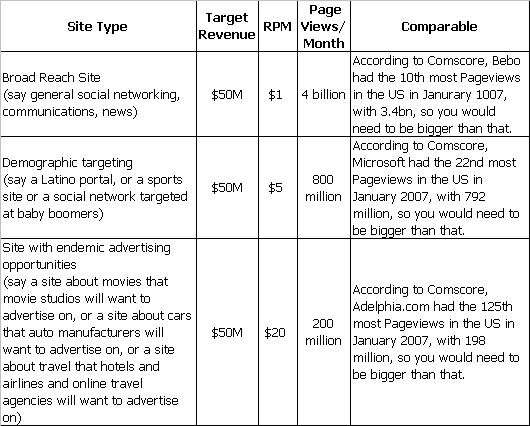
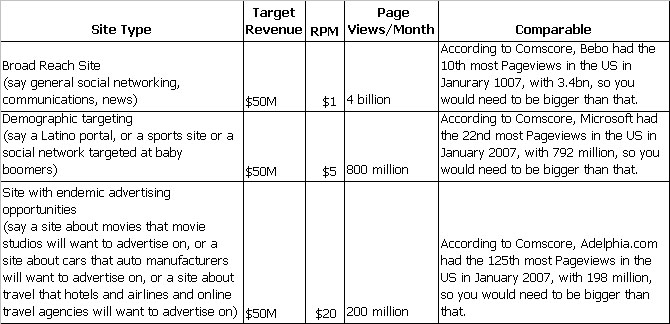
Interesting post over the weekend by Dan Mitchell at the NYT. He took the cue from Jeremy Liew of Lightspeed, who pointed out a few weeks ago the scale a business has to achieve to get $50M in revenue. I have summarized the scenarios from Jeremy’s post in the table below:
jliew2.jpg

(RPM – Revenue per thousand impressions, including CPM, CPC, and CPA models)

Scott Karp of Publishing 2.0 has an interesting take on Jeremy’s piece:

Jeremy’s analysis is correct, on one level, but it also exposes a deep flaw in the way online media is currently valued and sold to advertisers.

At that rate, you could reach 1 million people for $1,000. Now, granted most thousand page views are generated by less than a thousand people (in many cases far less). And granted we’re talking about untarget advertising. A highly targeted site can earn a revenue per thousand pages of, say, $20. But still, $20 is a pretty good deal to reach as many as a thousand people with your advertising. And if you assume that $20 is from multiple ad sources on each page, then each source is paying less than $20 to reach a highly targeted audience of up to a thousand people.

Compared to other media, online publishers are pretty much giving it away. Because the reality is that EVERY page view is in viewed by someone who has some value to some advertiser. The problem is when you DON’T KNOW who your users are. This is the problem with all the focus (particularly in Web 2.0 circles) on total traffic numbers — 10 million uniques is great, but not so much if you don’t know who these people are.

I think Scott is onto something here…Google shows ads based on keyword. These keywords provides valuable context for targeting ads. But still Google doesn’t really understand the user. Let’s look at an example…Two users – one interested in football another in politics – each search for “defense strategy” will be shown same products/offers from Google. Instead, by understanding user’s interests, a system should clearly be able to do a lot better and more optimal targeting. (It looks like Google is trying to personalize the results now – see this piece from RWW about Google Search).

So by understanding the users and context a whole let better, a system will be able to generate ads that reach the level of relevancy and thereby value approaching mainstream media. Which of course would mean that businesses with a lot fewer users or page views (page views is really the wrong to look at these things) but a good understanding of those users would become viable…and all of us will be better off for it.

Some of the systems that are being developed to address this issue are based on attention data and Google personalization. I think the market could use a bit more innovation in this area.

Digital Love

Recently, I heard this fascinating youth radio program about how MySpace is changing the way kids interact/hook up with each other. It also discusses how kids deal with like commercial characters like Jack (of Jack in the box), who have a profile on MySpace and wants to be their best friends forever

Love in the Digital Age Youth Radio looks at how technology affects teen relationships: You’ll hear about how advertisers are cashing in on befriending young people through social networking sites, spying on MySpace, and why some people just shouldn’t use technology.

Interesting and enlightening…Great job Youth Radio.

Microsoft Vs Open Source Community

There was a great piece on CNet news.com about Higgins project waiting Microsoft’s approval for creating a Windows CardSpace’s open-source equivalent:

Higgins awaits Microsoft’s blessing

An open-source rival to a Microsoft identity tool has been in limbo for months, awaiting the software giant’s go-ahead on certain patent-related issues.

Developers working on the Higgins project want to create a tool equivalent to Microsoft’s Windows CardSpace, but fear the software giant’s legal wrath if they don’t receive permission on certain features. Although parts of the project continue to move forward, proponents say it may not reach its full potential without Microsoft’s help.

While CardSpace is available on Windows, one goal of the Higgins project is to cover other operating systems. Higgins wants to offer an open-source alternative that works on Windows and on alternatives such as Linux and Mac OS X. The application would work similarly to CardSpace.

“We don’t intend to duplicate CardSpace, but a user should be able to sit down in front of the open-source implementation and feel comfortable and understand how things work, like Firefox versus Internet Explorer,” said Dale Olds, who holds the title of distinguished engineer at Novell, drawing a parallel to Web-browsing software.

Also, Higgins developers want to include the capability to take identity information from Linux systems or Macs and use it with CardSpace, and vice versa, Olds said.

“This is the equivalent of the user’s wallet. You want to be able to take your cards and use them in whatever system. How to do that has now been fully documented, but we need that included under the open-specification promise,” Olds said. Without Microsof’s acquiescence, import and export will only be possible between Higgins systems, he said.

I really like Microsoft Cardspace (see our review here) …Microsoft has done a lot of new groundbreaking work here. The issue with the Higgins project is that its gonna provide a card management client based on the Java based Eclipse platform. This would ensure that the product works for Linux and Mac and any other client that supports Java including Windows. This makes it tricky for Microsoft, as by giving up the patent rights, they will be essentially creating an open-source competitor for one of the key technologies in Vista. Not only will Higgins based CardSpace product take away one of the major selling points of Vista, it might even provide a web client implementation, which challenges the raison d’etre for an expensive desktop OS like Windows. On the other hand, an open source implementation of CardSpace functionality might generate a lot of free buzz and user education for a fairly new and unknown CardSpace functionality.

Overall, I can see the reasons for Microsoft’s reluctance in granting a license to Higgins. This is a complex decision…I won’t even be surprised if Microsoft rejected the request altogether, although I do think the right course of action would be to work with Higgins and try and advance this crucial technology together with open-source community.

Blogging in India – Part Deux

After all the adventure setting up the network in Mysore, we moved on to Pilani – a small town in Rajasthan, where I grew up – to spend the last leg of our India trip. Needless to say, after the experience in Mysore, my expectations were a lot more modest.

As soon as we reached home, I powered up my dad’s computer and to my utter delight the connection was up and working (apparently the stolen cable had indeed been reinstalled). At home, my dad has created a nice setup for managing the spotty power situation, by installing an inverter and a generator. So all I needed to do was to connect the DSL modem to my laptop and I will be off and running. I quickly figured out the setup that required a username and password, created a broadband connection on my laptop, hooked up the Ethernet cable and I was online. That night, I slept a happy man.

In the morning, I setup up a conference call with my team and we started chatting via Skype. I was really excited as the connection was working great, and even the speed was a lot better than Mysore. Suddenly though, the whole thing came to a grinding halt. Upon further investigation, I noticed that the third light on the modem that indicates an active ADSL link with the telephone exchange was not lit anymore. After frantically trying to power cycle the modem, I was able to restore the connection and join back the conversation…Things were great but after another five minutes, no connection again. After going on and off 4 times, I decided to drop out and let the rest of the team carry on.

“Dad, what’s the story with the DSL connection?” I asked my Dad, as soon as I saw him.
“It used to work great before…I have never had this kind of issue.” Dad replied. “If you don’t believe me, talk to Rajesh ji, our neighbor.”
“Nope, never heard of any problems like you are seeing” Rajesh replied, when I called him up to check.

May be I was hitting a rare rough patch, or it might be a classic case of exaggeration, so typical in India. I looked into all sorts of possible reasons like the quality of the line, setup of the modem etc. to figure out what could be going on, but to no effect. The connection continued on and off for the next couple of days, until one morning when the ADSL link light did not turn on at all.

I called the SDOT (Superintendent of Telephone) to report the issue. Right of the bat he was upset, as I explained the situation to him:

“You should not fiddle around with the connection we setup for you”, he complained.
“Well, I needed to connect it to my laptop to get some work done…In any case, moving the Ethernet cable from our modem should not make a difference”, I retorted.
“It’s the government modem that we have leased to you…Don’t think that the modem is yours”, he countered.

After some back and froth, he agreed to investigate the issue and get back to us.

“Should I expect a response in a couple of hours?” I asked before hanging up.
“Look, these things are complicated…I can’t give you a timeline. We will get back to you”, he said and hung up.

I waited eagerly till the end of the day but got no response. The next day, again, I waited…we were told that the linesman was on his way, but again no one showed up. We called Banglore to connect to the head office but the toll free number listed for BSNL did not work. I decided to go over to the neighbor’s to at least catch up with the email. Rajesh had the DSL working so I hooked up but ran into the same on and off issue. I pointed it out to him.

“Oh, that’s what you meant…I guess we don’t browse as fast as you do, so we never have this issue”, he explained.

The next day I was getting desperate. Starting 11:00 AM (that is usually the time the government offices in Pilani start getting active), I and Dad got on the phone and started calling everybody in the exchange we could find. After a couple of hours, we got hold of the JEN (Junior Engineer).

“I checked your line and there is noting wrong with it. My guess is that your modem is shot. You need to take it to the SDOT sahib to get it checked” he said.

I and my Dad got on a scooter and went to the exchange. It was 3:00PM. SDOT sahib was nowhere to be found. We were told that he was out for lunch. Luckily, we found a JEN who hooked up our modem and splitter to test it out.

“The modem looks perfect”, he said. “These line engineers are not thorough. They must have made a mistake”.

He called the lines JEN and asked him to route our connection over to his office line, so that he could test our line. Again everything worked great. He asked the lines JEN to reconnect our line. He assured us that everything is fine, and it will work for us, when we reconnect the modem at home. We eagerly got home and hooked everything up, but again no ADSL link.

Around 6:30 PM, I decided to go over to the neighbor’s to get the emails. I was working when my Dad called me.

“The linesmen are here to check everything out. Why don’t you come back?” He said.

I sprinted back home. The linesmen were fiddling with a number of things but to no avail. Eventually, they came to the conclusion that something must be wrong at the exchange. We offered to drive them to the exchange rather than letting them bike back. When we got to the exchange, it was 7:30 PM and the power was out. The massive exchange was humming nicely in the dark. The linesman took out the torch (there is a backup power supply but for some reason it was not on) to locate our switch. They replaced our switch with the switch next to ours and we raced back. When we got back home, the most beautiful light in the world, the ADSL link light was on and the connection was working. We got the linesman to promise to replace our incoming cable with a better quality cable, the next day, in order to ensure good stable connection in the future.

This time the connection turned out to be a lot more stable. I worked till 1:00 AM but when I got up next morning again the connection was out. It turns out the switch that we have replaced the night before was the switch to the SDOT’s office, and he needed his connection back. Again we were without a connection.

In the evening, the linesman showed up and replaced the line, but again had no success establishing the connection. Eventually they called the JEN. He did something and eventually the ADSL lit up. Unfortunately, I had to leave for the US the next day so I didn’t get to enjoy the new connection. I hear, though, that the connection has been stable ever since :-).

Blogging in India

I am in India for a couple of weeks visiting family and wrapping up some business. Before coming here I was excited about the prospect of working in India, as most of the family we are staying with, now have broadband. In fact, while packing for India I even packed a wireless router that will enable me to be somewhat mobile with my laptop.

After the long flight to India, when we finally reached home, I turned on the family computer to check out the broadband (BSNL ADSL) connection. No Signal…Apparently the BSNL server was down. I was told, that it happens occasionally and this might even have something to do with a worker’s strike against privatizing BSNL (it’s a government owned and run organization at this point). Oh well…

The next morning, I got up and turned on the computer and lo and behold the broadband connection was working. All I needed to do now to get productive was to get broadband connection to my laptop. To address that, it was with some relish that I got into setting up the wireless network. The first thing I needed was a voltage converter to convert the 220V power supply to 120V that my router eliminator will accept. I bought an off-the-shelf step down transformer. After plugging in all the required components and the power supply, I was ready to rock and roll. Unfortunately though, I realized that after an initial indication that the router was working, the power light was no longer turned on. I fiddled around with all the combination of power strips we had, even going out and buying a new power supply that generated the requisite 7.5V and 1Amp directly from 220V power supply…still no dice. I unscrewed the router, figured out how to reset it and expectantly plugged it in again…still no light. (I later found out that the issue was that the step-down transformer I bought off-the-shelf was not working as specified and was essentially passing through the voltage unchanged. This had caused a power surge which had actually fried the router).

I was getting frustrated and I had to get some work done. So I decided to move onto plan B which was to takeover the family broadband connection. I unpacked my 40ft Ethernet cable to run the cable from the study to the living room so that I could work and still be somewhat social. Now the issue with running a long cable in India is that all walls are solid concrete and there is no way to drill a hole that goes through. I had two options…Run the cable through the window or through the doors. After a quick family consultation, we shot down the idea of running the cable through the window as it would mean that we will have the leave a couple of windows open – a huge security risk. So I ran the cable through the doors going through 3 doors in the process. After tying the cable to a few nails, to get it out the way of kids, I was ready to be productive…I turned on the laptop…It was lovely, the speed was decent, Skype was working and I could access all my email accounts. I was cruising and beginning to feel connected again when suddenly the connection stopped working…Apparently somebody had closed one of the doors and that had killed the Ethernet cable. The whole system was down again.

The only option I had now was to either work in the study or to move the DSL model to the living room. After some deliberation, I decided to move the modem over to the living room and plug it into the telephone socket there. Things worked for sometime and then boom…the power went out. I was waiting again…

After waiting for a couple of hours for the power, I finally send out an email to my dad about our travel plans in India. I called him up to ask him to look for it on his computer. He gave me a hoarse laugh.
“It won’t work” he said
“Just turn on your computer and check your mail, you should have it. Also print out a copy for reference” I said, pointing out the obvious.
“It won’t work”, he repeated.
Now my dad is no tech wiz, but he can usually read his emails without any problems.
“Why not?” I asked getting a little bit frustrated.
“Well, there was a burglar attack last night in the neighborhood and the thieves took the telephone cables outside a number of houses. They plan to extract the copper from the wires in order to make some money from selling it” he explained.
“So I guess the broadband connection won’t work”, I stated the obvious, with a calmness that even I was surprised by. I guess I was getting used to being back in India.
“It will take just a couple of days and should be ok when you get here” Dad said reassuringly.

I don’t mean to imply from this post, that things are not improving…things are improving in India in a big way – roads are better, BSNL is improving the standard broadband speed from 256Kbps to 2Mbps in the course of next couple of years and even my dad and father-in-law have both a cell phone and a computer – but there is still a long way to go.