Repost from Mashable: Putting Social Media Monetization in “Context”

Reposting an old article that I wrote for Mashable…Reposting it here for context 🙂

—–

In his post on why the traditional CPM model doesn’t work anymore, Dave McClure breaks the CPM denial balloon, noting that the popular content-centric, keyword-based Google Adword model delivers a click-through rate of less than 1%. Dave posits that the problem is not Google-specific, but reflects the problem with the CPM model in the new world of social networks and distributed conversations.

As an answer to the problem with lackluster clicks, especially within social networks like Facebook, Dave looks to widgets to serve up content based on the interests of individuals:

“The Revolution Will Not Be Televised. It will be Widgetized. Fortunately, that revolution is already happening… it’s called widgets. and Facebook apps. it’s about engaging users via application workflow, and discovering intent. then you don’t have to advertise anymore, you just serve up the stuff that users find interesting.”

Social Networks

What’s clear is that while the appeal of social networks is growing — with 44.3% of U.S. Internet users expected to participate by year’s end according to eMarketer — the CPM model as a means to evoke a response from consumers is not just flailing, but failing.

Ad networks like Lookery, which target Facebook users, have cut ad rates nearly in half. It’s a move that has worked for Lookery in the short term—at least in providing relief to frustrated application developers.

However, cutting ad rates is not exactly the hallmark of a solid revenue model. These guarantees are more like a Band-Aid than the full-scale surgery that is required of online advertising.

Why CPMs Don’t Work

The reason CPMs don’t work in social networks is that they are trying to target new media users using old media technology and thinking. The CPM model asks, “What is the content on the page?” But social media conversations aren’t ON any one page anymore. They jump from one site to another, they take place on a variety of platforms and media types, across blogs and Twitter and FriendFeed and Facebook and MySpace.

In this AdAge article, Steve Rubel talks about the role of social search in the changing role of online advertising:

“Social-network advertising to date… has been a mixed bag. Everyone is innovating, but the draw on social networks is your group of friends. That makes it harder to be distracted by ads. Enter search. Watch for contextual advertising and programs such as Facebook’s social ads. New models will emerge where social algorithms and keywords trigger contextual ads.”

Finding a Solution

It’s clear that a solution to the social media monetization puzzle cannot be solved by content alone. Tools that track the context within which the social media participant engages within various communities are important. Context-based discovery and social search play a role in bringing relevant content to receptive audiences. Interest-based user engagement — based on user context, not content -– tracks interest across various conversations and among the plethora of social media sites.

Knowing – based on her participation across social sites – that a social media participant is a New England Patriots fan who vacations frequently in Hawaii and loves water sports and high-tech gadgets is invaluable to creating a tailored interaction between that participant and companies with offers that are relevant to her.

Universal Profiles

Universal user profiles can inform and strengthen the relationship between social media users, third-party application developers, and advertisers. In contrast to the fragmented identities we maintain in all of the social sites we participate on, universal profiles present a hyperlinked record of users’ participation across sites.

Universal profiles have supercharged the idea of “context” as it relates to the distributed Web, offering the best of both worlds. These profiles track and present the activity of users across communities, while leaving control of the data in the hands of the community or site owner. They are proving to increase traffic for site owners while providing the community with non-intrusive ways to monetize content and build reputation.

This context-based approach to social media advertising offers a creative, secure way to breathe new life into an old model. With a new way to seamlessly present meaningful offers, and even customized environments, to users, advertisers can now understand and appeal to an individual’s online and offline interests based on the fullness of their participation across social media sites. Greeting users on their own terms –- rather than force-feeding them ads based on key words and content — can, over time, transform Internet users from “mouse clicks” and “targets” to fully engaged participants and willing customers.

As founder and CEO of SezWho, Jitendra Gupta brings 13 years of experience in developing and managing software solutions. He holds an MBA from the University of and a B.Tech in EE from IIT Kanpur, India. Jitendra speaks frequently on the topic of context-based search, distributed conversations, and the changing nature of the social web. He has been blogging for nearly two years and occasionally contributes to ReadWriteWeb.com. Jitendra can be reached at jitendra [at] jitendragupta [dot] com.
Is a brand a person?

Interesting take from Tom Foremski that illustrates the issues marketers are grappling with in social media.

Corporate Social Media Marketing: I Don’t Want A Social Relationship With My Hard Drive 

It highlights some of the difficulty with making money in social media. We will explore some more related issues in the next few posts.

Open Source Economics

Also available on RWW

Since we are talking about open source, a definition of the subject from Wikipedia is in order:

“Open source is a set of principles and practices that promote access to the production and design process for various goods, products, resources and technical conclusions or advice. The term is most commonly applied to the source code of software that is made available to the general public with relaxed or non-existent intellectual property restrictions. This allows users to create user-generated software content through incremental individual effort or through collaboration.”

In the area of computers and Internet, open source movement is almost as old as computers themselves. In the beginning there was Multics, Unix, BSD, Minix etc. Than came Richard Stallman’s GPL, GNU and FSF. That was followed by Linux, Apache and many more projects. Over time open source movement has begun extending to things beyond software and technology to include media (video, pics and blogs etc.), creative content (creative commons) and communities.

Since open source movement affects our lives in more and more ways, let’s take a look at how the open source model is interacting with our market driven economic system.

Open Source Business Models

The heightened level of interest in open source model has lead companies to start looking for ways to add value to the process of open source development and distribution in order to make money from it. Some of the models/approaches that have emerged are:

  • Develop the product and open it up to the community: The main goals for the businesses here are two fold:
    • Generate marketing buzz
    • Leverage the skills/people in the community to enhance the product.

Businesses make money by selling add on software modules or services to customers using the open source technology. Some of the examples of this model are Eclipse (IBM), Netscape, Linux, and recently Solaris (Sun) etc. While this model sounds attractive as a way to reduce development costs, there are plenty of other expenses for the businesses. Businesses need to create and participate in boards (Sometime controlled by the business, sometimes not) to chart a sensible product direction, to manage licensing issues and to put together a well tested base distribution bundle. Working on a board staffed with community members and sometimes even competitors can be an expensive and time consuming process.

  • Take an Open Source product and provide support and services to enterprises: There are a number of companies like MySQL, Zmanda, RedHat etc. that provide such services. The business model is all about building up the volume and driving up the percentage of paying customers (typically less than 2% of the customers pay) for customer support or other services.
  • Provide open source platforms: There are a number of sites/projects like sourceforge.net, google code and even YouTube or FaceBook that provide platforms for open source like collaboration. The business model typically is to provide the basic services for free and make money via ads by driving the page views.

The value of the open source is pretty clear to customers as they get the product and services they want without having to pay for the underlying product…But who else is extracting the rents in open source related economic activity? Let’s look at the value accruing to three important stakeholders – Businesses, Customers and Contributors.

Value to open source businesses

Some have argued that businesses are capturing the lion share of the value of open source at the expense of contributors and customers. This point of view is expressed by Dirk Riehle (leads the open source research group at SAP Research) in his recent paper on the topic. Dirk argues that businesses derive the maximum benefit because:

  • Customers want a deployed solution, so service companies (like IBM) that use the open source software, just make up for the free open source software by increasing the price of the service. This increase directly goes to their bottom line.
  • Businesses benefit as employers, because larger talent pool due to non-proprietary nature of open source, enables businesses to have a stronger negotiating position compared to the individual developers.

Besides the obvious conflict on interests (Dirk works for SAP which isn’t big on open source and competes with IBM which is), Dirk makes the first point without pointing to any data. I find it hard to believe that customers don’t see a lowered bill when open source software is used compared to proprietary software.

For his point #2, Dirk again, provides no facts but makes a general assertion. I believe that the people who contribute to open source are self motivated people who enjoy programming and as such get a higher salary compared to people who do not participate in open source.

Also from the open source businesses point of view, if we consider the costs associated with managing, engaging and participating with the community, I am not sure the open source businesses will come out with lower costs, compared to non-open source businesses.

Overall it seems to me that open source businesses have significant costs and barriers to profitability and are certainly not capturing the majority of value in open source transactions.

Value to Customers

Customers using open source benefit a great deal.

  • Free software makes it easy to get started.
  • Using open source enables customers to avoid the dreaded vendor lock-in. So if customers are using open source they are able to change providers if they are not particularly happy with the service provided by the vendor. Open source provides them with huge leverage with service providers.
  • The customers benefit as they have a larger talent pool to hire from and they don’t have to pay proprietary vendors for all sorts of “certifications” etc.

Overall the customers come out well ahead by using open source technology. In fact, were it not for the LAMP (Linux, Apache, MySQL and Php, Python, Perl etc.) stack, startups costs would have been a lot higher then they are today and we would not be seeing the amount of innovation we are seeing in the field of Internet and Technology.

Value to Contributors

Contributors to open source also benefit from participating:

  • It used to be the case that contributors did not get paid for their contributions and had to work on their own time, but things are changing. With the popularity of the open source projects, more companies are paying contributors to support the community or are even contributing proprietary modules to the community. This provides direct incentives to contributors to work with the community.
  • Open source participation is a great way to establish creadibility of you are a programmer…Have you seen ads like these?“With your resume, please include some php and javascript code snippets or refer us to an open source project you’ve worked on.”
  • Most good open source developers have an opportunity to become public voice of the project. This extended role for engineers not only means an ego boost but also translates to higher salaries etc.

Overall developers working on open source come out ahead by participating in the open source projects.

Conclusion

Open source movement has become a powerful value creator. In addition it has created an interesting and somewhat egalitarian wealth distribution mechanism, where on one hand it has made it hard for one stakeholder to extract inordinate rent, on the other hand it has created right incentives for a lot of people to participate and have a stake in its success. No wonder it is becoming a popular model for more and more businesses and social activities.

Social Genes

Fascinating piece in the post today, related to how scientists are finding evolutionary basis for human morality.

Pic via MrFarber on Flickr

Grafman and others are using brain imaging and psychological experiments to study whether the brain has a built-in moral compass. The results — many of them published just in recent months — are showing, unexpectedly, that many aspects of morality appear to be hard-wired in the brain, most likely the result of evolutionary processes that began in other species.

No one can say whether giraffes and lions experience moral qualms in the same way people do because no one has been inside a giraffe’s head, but it is known that animals can sacrifice their own interests: One experiment found that if each time a rat is given food, its neighbor receives an electric shock, the first rat will eventually forgo eating.

Joshua D. Greene, a Harvard neuroscientist and philosopher, said multiple experiments suggest that morality arises from basic brain activities. Morality, he said, is not a brain function elevated above our baser impulses. Greene said it is not “handed down” by philosophers and clergy, but “handed up,” an outgrowth of the brain’s basic propensities.

In one 2004 brain-imaging experiment, Greene asked volunteers to imagine that they were hiding in a cellar of a village as enemy soldiers came looking to kill all the inhabitants. If a baby was crying in the cellar, Greene asked, was it right to smother the child to keep the soldiers from discovering the cellar and killing everyone?

The reason people are slow to answer such an awful question, the study indicated, is that emotion-linked circuits automatically signaling that killing a baby is wrong clash with areas of the brain that involve cooler aspects of cognition. One brain region activated when people process such difficult choices is the inferior parietal lobe, which has been shown to be active in more impersonal decision-making. This part of the brain, in essence, was “arguing” with brain networks that reacted with visceral horror.

Such studies point to a pattern, Greene said, showing “competing forces that may have come online at different points in our evolutionary history. A basic emotional response is probably much older than the ability to evaluate costs and benefits.”

Why is it that people who are willing to help someone in front of them will ignore abstract pleas for help from those who are distant, such as a request for a charitable contribution that could save the life of a child overseas?

“We evolved in a world where people in trouble right in front of you existed, so our emotions were tuned to them, whereas we didn’t face the other kind of situation,” Greene said. “It is comforting to think your moral intuitions are reliable and you can trust them. But if my analysis is right, your intuitions are not trustworthy. Once you realize why you have the intuitions you have, it puts a burden on you” to think about morality differently.

I guess we (and other animals) are really social beings…It also means that its easy for us to empathize and interact with people in face to face settings…This really presents a dilemma for social media where the geographical or even chronological proximity is not required for most interactions…I am pretty sure our genes provide no direction on what to do there? What do you think?

User Generated Ads

Interesting article in the Times today (NYT guys have really gotten their act together and are producing some good content about social media of late) about the high price of creating free ads.

Pic via NYT

From an advertiser’s perspective, it sounds so easy: invite the public to create commercials for your brand, hold a contest to pick the best one and sit back while average Americans do the creative work.

In one of them, a teenage boy rubs ketchup over his face like acne cream, then puts pickles on his eyes. One contestant chugs ketchup straight from the bottle, while another brushes his teeth, washes his hair and shaves his face with Heinz’s product. Often the ketchup looks more like blood than a condiment.

Heinz has said it will pick five of the entries and show them on television, though it has not committed itself to a channel or a time slot. One winner will get $57,000. But so far it’s safe to say that none of the entries have quite the resonance of, say, the classic Carly Simon “Anticipation” ad where the ketchup creeps oh so slowly out of the bottle.

Consumer brand companies have been busy introducing campaigns like Heinz’s that rely on user-generated content, an approach that combines the populist appeal of reality television with the old-fashioned gimmick of a sweepstakes to select a new advertising jingle. Pepsi, Jeep, Dove and Sprint have all staged promotions of this sort, as has Doritos, which proudly publicized in February that the consumers who made one of its Super Bowl ad did so on a $12 budget.

But these companies have found that inviting consumers to create their advertising is often more stressful, costly and time-consuming than just rolling up their sleeves and doing the work themselves. Many entries are mediocre, if not downright bad, and sifting through them requires full-time attention. And even the most well-known brands often spend millions of dollars upfront to get the word out to consumers.

Some people, meanwhile, have been using the contests as an opportunity to scrawl digital graffiti on the sponsor and its brand. Rejected Heinz submissions have been showing up on YouTube anyway, and visitors to Heinz’s page on the site have written that the ketchup maker is clearly looking for “cheap labor” and that Heinz is “lazy” to ask consumers to do its marketing work.

“That’s kind of a popular misnomer that, somehow, it’s cheaper to do this,” said David Ciesinski, vice president for Heinz Ketchup. “On the contrary, it’s at least as expensive, if not more.”

I am not surprised that the Heinz Ketchup folks ended up not having a good experience with what they were trying to do. Their approach does not make any sense on so many different levels:

  1. They are trying to take community content to put it on mass media outlet like TV. The content created by the community is not going to be polished or suitable for mass media. Its like taking square shaped, rough edged user generated content and trying to fit in in a round hole of mass media outlet. No wonder they are not happy…
  2. Its kinda cynical approach to engaging the community to just do your Ads…if they were really interested in working with the community they should have empowered them more…and allowed them to have real influence in the direction of what they are doing. I am not sure what they are trying to achieve here.
  3. If they are interested in really having a conversation with their user they should build up a process for interacting and really listening to them..it would also mean giving up some of the control…its really a tall order and not many companies are up for the challenge…

What do you think?

Sunshine for the Virtual Town Hall

Great opinion piece by Tom Grubisich at Washinton Post. It talks about the lack of transparency with user generated content.

These days we want “transparency” in all institutions, even private ones. There’s one massive exception — the Internet. It is, we are told, a giant town hall. Indeed, it has millions of people speaking out in millions of online forums. But most of them are wearing the equivalent of paper bags over their heads. We know them only by their Internet “handles” — gotalife, runningwithscissors, stoptheplanet and myriad other inventive names.

Imagine going to a meeting about school overcrowding in your community. Everybody at the meeting is wearing nametags. You approach a cluster of people where one man is loudly complaining about waste in school spending. “Get rid of the bureaucrats, and then you’ll have money to expand the school,” he says, shaking his finger at the surrounding faces.

You notice his nametag — “anticrat424.” Between his sentences, you interject, “Excuse me, who are you?”

He gives you a narrowing look. “Taking names, huh? Going to sic the superintendent’s police on me? Hah!”

In any community in America, if Mr. anticrat424 refused to identify himself, he would be ignored and frozen out of the civic problem-solving process. But on the Internet, Mr. anticrat424 is continually elevated to the podium, where he can have his angriest thoughts amplified through cyberspace as often as he wishes. He can call people the vilest names and that hate-mongering, too, will be amplified for all the world to see.

This is a real problem with the Internet (Although I am not sure about “transparency in all institution” especially with the government)…With the lack of incentives to participate and lack of tools for the community to control the conversation, the vocal and vilest few take over the conversation and bring down the quality of discourse. Tom suggests a few solutions:

Until recently, many of the site’s posters identified themselves with anonymous Internet handles — which were the site’s default ID. Now, people must enter a “user ID” that appears with their comments.

Hal Straus, washingtonpost.com’s interactivity and communities editor, says the changes “move us in the direction of transparency.” But the distinction is not quite a difference, because washingtonpost.com user IDs can be real names or fictional Internet handles. While the site prohibits comments that are libelous, abusive, obscene or otherwise inappropriate, Mr. anticrat424 could still find a well-amplified podium at washingtonpost.com.

The news and opinion site Huffingtonpost.com requires posters to register with their real names but maddeningly assures them that it will “never” use those names.

Though not foolproof, there are ways to at least raise the bar. Gordon Joseloff, a former CBS News correspondent who owns WestportNow.com, a popular grass-roots site in Westport, Conn., used to employ the standard permissive registration process. But in late 2005, turned off by the venom of anonymous posters, Joseloff instituted a policy requiring anyone who wanted to comment to use his or her real name. Joseloff also requires registrants to give their phone numbers. Numbers aren’t posted on the site, but they give him and his team an additional check against false registration.

Only the big sites like the Washington Post or Huffington Post can pull off requiring users to register…And its really painful for readers to have to remember another username and password. So what is the solution? Also there is a need to strike the right balance between the need for anonymity and identification…At times Anonymity is justified, like with whistleblowers etc. but at the same time anonymity all the times provides perverse incentives…What do you think?

Social Media Research

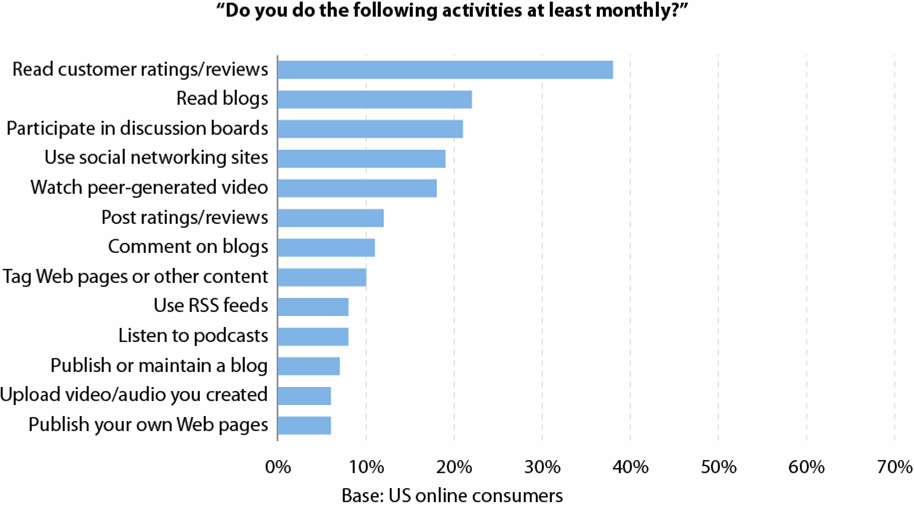
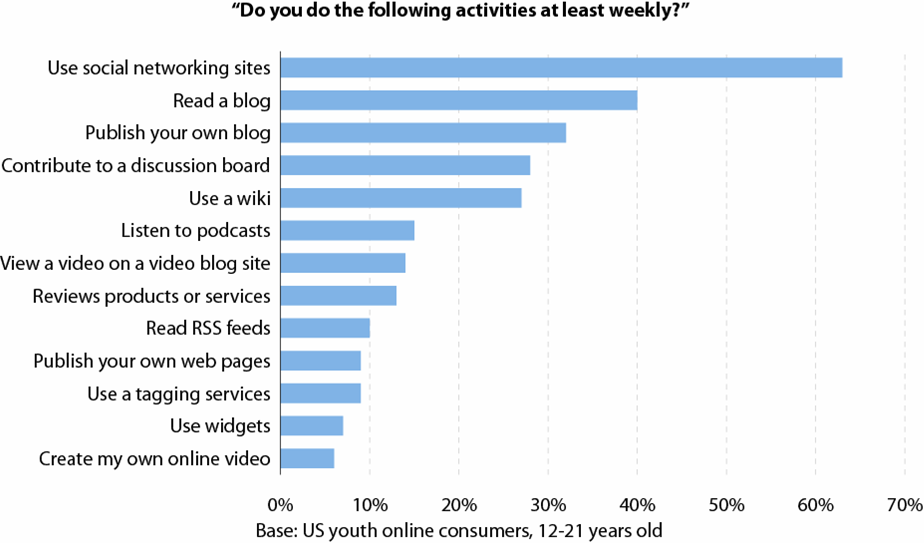
New research out from Forrester, called Social Technographics (whatever that means) – Slides here – that talks about who uses social media etc. I wouldn’t read too much into the numbers as its just one data point but its good for a 20 thousand feet level analysis.

Via Forrester
(All images via Forrester)

This is interesting although a bit lower then I would have thought. Its clear though that the youth is leading the charge.

Via forrester

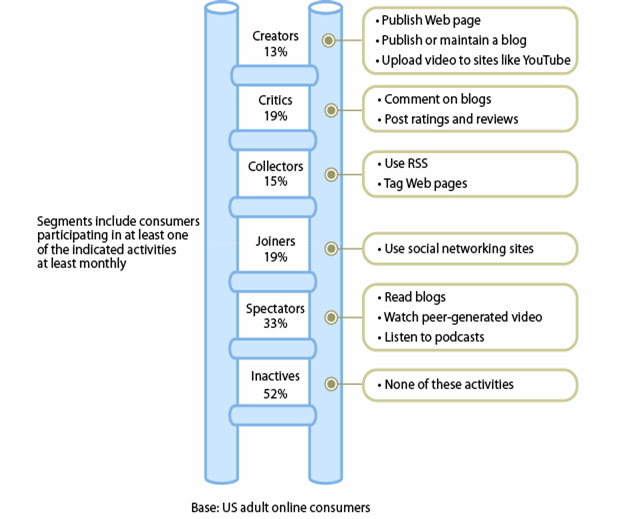
Another interesting breakdown below about further segmentation of participation. The breakdown below does not square with the 90-9-1 rule as its looking at the data related to participation at least once/per month, rather than aggregate number of visits.

via forrester

Some interesting data here…nothing earth shattering though (slides have some additional details on each of the type of users)…somewhat surprisingly critics show up as the highest earners…In a way it makes sense as critics are too busy to be full-time creators but articulate enough to be good critics.

What do you think?

Who participates in social media?

An interesting post from Bruce Nussbaum at his blog on BusinessWeek. I am summarzing the main data points below (the data is based on a study by Bill Tancer, an analyst with Hitwise, which measures Web 2.0 audiences):

istock_000002047538xsmall.jpg

  • Only a tiny fraction of people using social media actively participate.
  • 0.16 percent of visits to YouTube actually involve people putting a video up on it, according to his online surfing data. All the rest are visits by people watching the videos of that tiny fraction.
  • 0.2% of visits to Flickr are to upload new photos. Again, everyone else is watching.
  • Wikipedia shows much higher active partipation–4.6% of all visits are for editing. But think a moment–that is still a very small fraction of the total number of people using Wikipedia.
  • Visits to Web 2.0 sites constitute 12% of all web activity, according to Tancer, up from 2% two years ago. It’s soaring.

From Bruce’s blog:

So, the question is–who is shaping the conversation? These numbers suggest that only a very, very small number of people actively create content in social media. Nearly everyone watches.

So are we really just reinventing TV, with folks pretty much sitting back passively (like couch potatoes)? Is YouTube just another NBC or Fox TV network?

Could be. These YouTube and Flickr numbers are even worse than the 1% Rule–for every 100 users of social media, only ten actively participate, and only 1 actually creates something. Back in July, 2006, the ratio of creators to consumers on YouTube was 0.5%. Now it is 0.16%. Many more people are drawn to YouTube to watch than to create.

To be honest, the biggest surprise for me in these numbers is the Wikipedia number…4.6% users edit…Wow!!!. I am not sure its fair to use these numbers to discount the 90-9-1 rule of participation in social media. I think some of the specific participation numbers are skewed because of the type of media we are talking about(I think 90-9-1 rule writers had text content in mind)…Video is a lot harder to produce then to watch…same thing for pictures but probably to a lesser extent.

At the end of the day, the lack of participation reflects the lack of incentives to participate. While the ego benefits of creating a popular video are huge, the changes of doing so are fairly minimal and the skills/time required are pretty significant. For the text based context, like comments, social bookmarks or bulletin boards, its hard to prove ones identity and because of that its really hard to establish the benefits of participation. The result…90-9-1 rule.

What do you think?