Bad behavior in the blogosphere

Great piece in the SF chronicle today by Dan Fost about the recent firestorm related to vitriolic comments against Kathy Sierra (BTW she is great and I love her blog).

The threats against Kathy Sierra, an author who promotes the notion of emphasizing the needs of the user in Web site design, have sparked a Webwide debate on the nature of online discourse.

The incident and its aftermath have drawn back the curtain on a computer culture in which the more outrageous the comment, the more attention it gets. It’s a world that many women in particular see as still dominated by men and where personal attacks often are defended on grounds of free speech.

In addition, many of the newest tools of the Internet are coming into play. Blogs and online communities were supposed to herald an era in which “the wisdom of crowds” guided online behavior to a higher plane. Instead, instances of mob rule appear to be leading the discussion into the sewer.

Some observers believe the incident eventually could serve as a warning to Web communities to increase accountability and stamp out the vitriol that characterizes much of online conversation.

“We need to say this is not acceptable behavior,” said Tim O’Reilly, CEO of Sebastopol’s O’Reilly Media, which publishes Sierra’s books and runs the ETech conference where Sierra was scheduled to speak this week. “If you start making offensive comments, they will be deleted from a blog. Don’t give people that platform.”

This is a sad state of affairs and not completely unexpected either…As one of the commenters quipped in one of the older posts:

Normal Person + Anonymity + Audience = Total Idiot

The other issue here is really, accountability…Unlike in human communities, on the Internet, its easy to avoid facing repercussions of making nasty and unhelpful comments. We really need a system across social media that addresses the issue of accountability by providing the right incentives to all users for participating positively. Such a system will ensure that the users get rewarded for positive contributions and are held accountable for disrupting community discourse.

A powerful argument about what lack of accountability does to good people is provided by Philip Zimbardo, in his interesting book called the Lucifer Effect. Through a number of experiments, Philip demonstrates how if you put good people in accountability free lawlessness, they become fairly evil. Anybody remember Abu Ghirab? (I haven’t read it yet but heard from a number of sources that this is an interesting and powerful book).

What do you think?
5 ways to get more comments on your blog

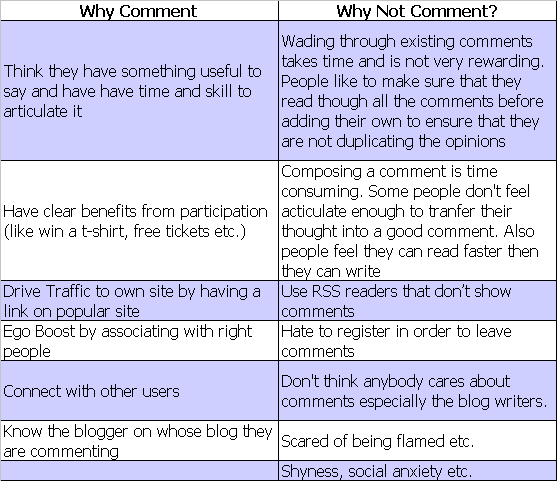
Fascinating survey post at the Freakonomics blog (Thanks Indus for pointing it out) asking users why do or why don’t they comment. (I love these guys not just because of the book or because they write intelligent/insightful stuff but also because Prof. Levitt is from my alma mater). The post generated 114 responses…Now these responses can be extrapolated to other social media as well where the participation more or less follows the same 90-9-1 kinda pattern observed on blogs. I waded through these responses and summarized them in the table below:

comment.PNG

Some of the sample comments from the article are listed below:

# Matt W

First is the fixed cost.. it just took me 3 minutes to register with WordPress and thats a long time for the internet age.

Second, usually, on a high traffic blog like this, commenters have usually taken most points of view in an hour or so.

But mostly, its just like in school where theres a class of 30 people but the same 5 or 6 are the only ones that raise their hand.

# From Deckard

I REALLY WANT OTHER PEOPLE TO READ MY BLOG AS WELL AND GET THE STATS UP – also I WANT TO LOOK IMPORTANT AND ASSOCIATE MYSELF WITH SOMEONE AS GREAT AS (INSERT NAME HERE)

Being a bit of a marketing whore with a new business to promote

# furiousball

Many bloggers comment to get comments. Many also comment to connect with people. The undying need to be loved is strong with the blogging community.

# akbal

I rarely comment on blogs because (1) written communication is a skill I have not practiced since high school (often my comments are misunderstood), (2) Ive learned that people usually ignore or attack what they dont already believe (this makes my comments seem futile), and (3) I have things I would rather be doing (it usually takes 30 minutes or more to write even a semi-coherent response to a blog.

Shyness definitely plays into my reasons.

# sbw

Commenters needed to be parsed into distinct categories. Some comment to learn to nail an idea to a page so others will refine it. Some comment to convince. Some comment for community.

Still others comment to overpower ideas with cheap rhetoric.

# jonathank

I comment on two types of blogs: people I know and where I believe the author reads the comments and might actually be looking for ideas and different takes.

I have, on rare occasion, joined in to reinforce others comments. It is fruitless to argue with people in comments – or mostly anywhere on the internet – but sometimes it can be enjoyable (and, in a rare case, even constructive) to agree with other commenters

# RobertSeattle

I actually tend to avoid blogs that dont allow comments. Not allowing for comments means the blogger really doesnt care about what their readers think. I prefer some kind of login system though because I am a firm believer in the formula:

Normal Person + Anonymity + Audience = Total Idiot

# sasha

1. I (like many readers, I suspect) read your blog through an RSS feed. So commenting involves clicking on the link to your actual site, remembering my wordpress username (which usually takes a trip to my email account where its saved), and then remembering the password Ive chosen.
2. After a while, regular commenters start to form a community. It starts to feel intrusive to insert yourself.
3. The time it takes me to formulate a comment Im happy with posting is usually not worth what Ill get out of actually posting it. Im usually picky about being concise, grammatically correct, and having fully formed ideas, so a comment can take me upwards of 30 minutes to put together. And then the comment will usually be ignored anyway.

# kentavos

Why I comment:

1. I feel passionately about the topic or I have unique insight.

2. Im in the mood and I have time.

3. I might win a t-shirt.

Why I dont comment:

1. My point of view is already represented.

2. Too many comments, Id just be lost in the sea of comments.

3. Too many passionate views, no one would really listen.

4. I dont have the time to deliver a concise and well thought out comment.

# mungojelly

Right after spending a while writing a detailed comment, I always have a nagging feeling that Ive wasted my time. If I have something important to say, why am I saying it way down at the bottom of a pile of messages, where no one will read it? If I dont have anything important to say, why am I spending time typing at all??

Heres a paradox, though: In principle I believe comments are very important, and Im offended when theyre disabled, even though I still think theyre usually a waste of space in particular. Theres some sense to that attitude, and heres my attempt to explain it: The difference between having comments and not having comments is whether you are projecting an open space or a closed space. Allowing for comments even if in practice theyre spam & junk & metooism is saying I am participating in a conversation, not a monologue; this is a two-way street.

Earlier today I saw something that was interesting but smelled like bullshit, so I glanced at the comments: Naturally the first comment was someone cutting through the bullshit & giving the real facts. Thats part of whats so nice about the internet.

5 insights for the bloggers are:

  1. People hate sites that do not allow comments
  2. Asking people explicitly for their feedback and participating in comments is a good idea if you want more comments. Also providing clear incentives or rewards for participation works. Such rewards could be vanity items like t-shirts or just an explicit recognition in blog posts
  3. Go out there and meet people. If people know you in real life, they are a lot more likely to comment on your blog then otherwise.
  4. Providing a respectable and positive environment for participation can help commenters overcome their shyness or fear of being attacked. This can be done by sanctioning personal attacks/harsh comments and ensuring that a positive environment for participation is maintained
  5. People get overwhelmed with comments so a mechanism to filter useful/unique comments can help drive more comments

Finally a haiku from the comments section of Freakonomics blog to remind you how wonderful and creative commenters can be:

# egretman

The question is not why we comment
Thats seems all too evident
Rather I want to know why you blog
Is it for the comments that you will log?
Are you a comment hog?
Do you take them home and cherish them
Read them as if each were a gem
If so then you are one sick dude
Especially if you read them in the nude
Well thats all I have to say
Heres hoping that Ive made your day.

How to build a $50M online company?

Updated revision is also available at RWW

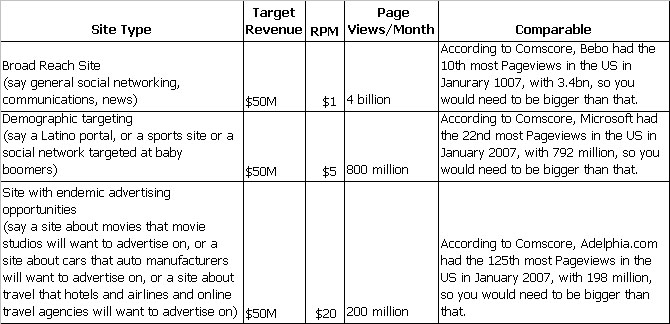
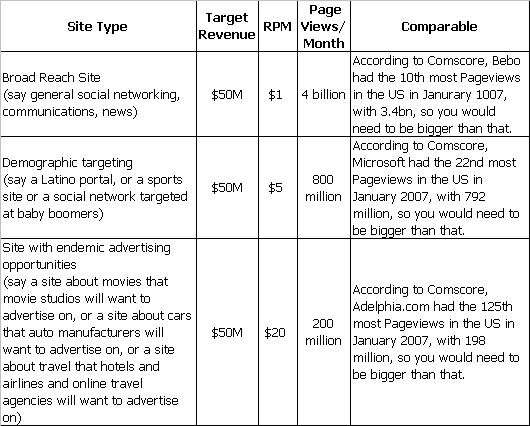
Interesting post over the weekend by Dan Mitchell at the NYT. He took the cue from Jeremy Liew of Lightspeed, who pointed out a few weeks ago the scale a business has to achieve to get $50M in revenue. I have summarized the scenarios from Jeremy’s post in the table below:
jliew2.jpg

(RPM – Revenue per thousand impressions, including CPM, CPC, and CPA models)

Scott Karp of Publishing 2.0 has an interesting take on Jeremy’s piece:

Jeremy’s analysis is correct, on one level, but it also exposes a deep flaw in the way online media is currently valued and sold to advertisers.

At that rate, you could reach 1 million people for $1,000. Now, granted most thousand page views are generated by less than a thousand people (in many cases far less). And granted we’re talking about untarget advertising. A highly targeted site can earn a revenue per thousand pages of, say, $20. But still, $20 is a pretty good deal to reach as many as a thousand people with your advertising. And if you assume that $20 is from multiple ad sources on each page, then each source is paying less than $20 to reach a highly targeted audience of up to a thousand people.

Compared to other media, online publishers are pretty much giving it away. Because the reality is that EVERY page view is in viewed by someone who has some value to some advertiser. The problem is when you DON’T KNOW who your users are. This is the problem with all the focus (particularly in Web 2.0 circles) on total traffic numbers — 10 million uniques is great, but not so much if you don’t know who these people are.

I think Scott is onto something here…Google shows ads based on keyword. These keywords provides valuable context for targeting ads. But still Google doesn’t really understand the user. Let’s look at an example…Two users – one interested in football another in politics – each search for “defense strategy” will be shown same products/offers from Google. Instead, by understanding user’s interests, a system should clearly be able to do a lot better and more optimal targeting. (It looks like Google is trying to personalize the results now – see this piece from RWW about Google Search).

So by understanding the users and context a whole let better, a system will be able to generate ads that reach the level of relevancy and thereby value approaching mainstream media. Which of course would mean that businesses with a lot fewer users or page views (page views is really the wrong to look at these things) but a good understanding of those users would become viable…and all of us will be better off for it.

Some of the systems that are being developed to address this issue are based on attention data and Google personalization. I think the market could use a bit more innovation in this area.

A-List Bloggers Vs Blue Collor Blogger

There an interesting argument going on in the blogosphere. Its captured nicely in the exchange between Tony Huang (deep Jive Interest) and Jason Calacanis:

Blogging is damn hard work, and harder still when you have kids to feed and are working lousy hours at work — and you don’t have the connections, notoriety or credentials to fuel your blogs success.

And let’s not discount it. When you have the ability to meet people most people don’t; when you have the inside track before most people do; and when you are actually *creating* news as most of us *can’t*, that’s what really separates “A-listers” from the rest of us.

I’ve come a long way in blogging, but I’m not blind to the fact that the vast majority of bloggers — even those who bring something new, refreshing, and regular to the table — may find barriers to blogging success in spite of hard work or their talent. I’d like to believe in the democracy of blogging, but the fact is that there are certain advantages that some bloggers have that others don’t. Not having them doesn’t mean you can’t be an A-lister, but I have yet to find one that didn’t have any.

I agree with Tony to a large extent although I am not sure blogging being hard etc. has anything to do with A-List bloggers trying to keep other blue collar bloggers down. Jason’s take on the A-List controversy:

What a joke… a couple of years ago Scoble, Jarvis, and I were the blue collar bloggers! We were hustling trying to get our vocies heard and a couple of years later–after blogging daily/hourly–the supposed “A List” got some traction and attention.

Here is a tip: THEY EARNED IT!!! They busted their butts for years blogging in an intelligent way. They were not given their seats at the table–they took them!

There is no “A List” — it’s a myth.

I think the basic issue really is that blogging is hard, and its getting harder to build the traffic with the proliferation of blogs. I guess it was easier when there were far fewer blogs. I this is just a manifestation of a lot of people feeling frustrated with the difficulty of blogging and building traffic. The other question is that do the A-List bloggers owe anything to the community in terms of helping deserving bloggers get more traffic? I am just not sure if the popular bloggers really owe anybody anything although it would be nice if they were more helpful and behave less as prima donnas.

But really, how could an A-list blogger help drive consistent traffic to another up and coming blog? Sure they could link to a particular blog to share the page-rank juice, do a hat-tip to another blog or even have guest writers…but if A-List bloggers did it consistently would it really work? Wouldn’t people start ignoring some of these links and guest writers? Given that some of the A-List bloggers are really busy, would having a guest writer on a blog even mean that the A-List blogger supports the writers views or even finds them interesting? I am just not sure that give the technology landscape right now, its possible for any blogger to really prop-up another outside and independent blog in a consistent fashion.

What do you think? Am I onto something or just high on something :-)?

Digital Love

Recently, I heard this fascinating youth radio program about how MySpace is changing the way kids interact/hook up with each other. It also discusses how kids deal with like commercial characters like Jack (of Jack in the box), who have a profile on MySpace and wants to be their best friends forever

Love in the Digital Age Youth Radio looks at how technology affects teen relationships: You’ll hear about how advertisers are cashing in on befriending young people through social networking sites, spying on MySpace, and why some people just shouldn’t use technology.

Interesting and enlightening…Great job Youth Radio.

Improving Online Communities

An online community, or for that matter any community, is built upon shared experiences of its participants. In the real world, people in a community typically interact with each other by gathering at same physical location, at the same time. In online communities, it is easy for users to interact with each other without any geographical or temporal limitations. But in return for the benefits that Internet (or even telephone to a lesser degree) provides in terms of ease of communication, it takes away from the richness, texture and context of the conversation. As such a number of startups are trying to address the problem with online communities and restore richness, texture and context to online communities. (Richard calls this market segment, meta social networking).

Who reads my blog

MyBlogLog started off with the agenda to provide blog analytics. They launched MyBlogLog Communities mid last year, to enable readers of blogs to join and share their experiences with other like-minded group of readers. The idea was that if readers like same content, they probably have plenty else in common. They built a platform where readers could trade messages with other readers and see what other sites they visit.

Power of Images

They hit the jackpot with the reader rolls that provided a picture to connect readers and writer of blogs. By just providing a static visual cue in the form of a picture, MyBlogLog provided an important visual context for online community conversations. The result, their usage took off and is not at over 50K users…In the meantime, they also got acquired by Yahoo! for a $10M.

Where there are visitors there is spam

With all the success came a number of people looking use MyBlogLog for financial gains. From R-Rated avatars to people pretending to be somebody else to other commercial avatars like Mr. Online Pharmacy, there has been a glut of stories related to how people are trying to game MyBlogLog and given their history, MyBlogLog has understandably been having a hard time coping.

Competition

In addition to all the spammers, there is new competition on the horizon for MyBlogLog. OthersOnline and Explode are two emerging players. These players have interesting new twists to the functionality provided by MyBlogLog. Let’s take a quick look at each:

Explode

Explode provides the same analytics capability as MyBlogLog but in addition to Analytics, it also allows users to build a network for friends who can be readers or writers of blogs. Bloggers can then display a friends widget on their blogs. This widget provides valuable context on the readers of the blog and the bloggers circle of friends. Another capability Explode provides is a comment wall for each user, where friends and other users can post comments. This also provides valuable context on each of the user.

OthersOnline

OthersOnline has an interesting twist on the idea of providing context. They allow people to register their profile along with their website. As part of the registration process, OthersOnline asks users to categorize their website and themselves via keywords. Now using these keywords, OthersOnline shows profile information, along with presence and email, of users via a browser plug-in (a widget is in the works as well). The idea is to make it easy for people to locate other like minded individuals or websites in the course of browsing.

Conclusion

While these companies are breaking new ground in making online conversations more useful, there is still a long way to do before we have achieved a good enough quality of online interactions. Good things, a lot of companies are working on it.

Patent reform: Use social networking

First USAToday and now the US Patent office…It looks everybody is trying to leverage social networking to improve the services they deliver. In the case of US Patent office, following are the details:

The Patent and Trademark Office is starting a pilot project that will not only post patent applications on the Web and invite comments but also use a community rating system designed to push the most respected comments to the top of the file, for serious consideration by the agency’s examiners. A first for the federal government, the system resembles the one used by Wikipedia, the popular user-created online encyclopedia.

Below are the mechanics of how the system will work:

The new patent system will try to help separate experts from posers by offering extensive details about the people sending information to the site. To help others evaluate the quality of this information, called prior art, each posting will include several measures gauging the quality of his other contributions to the site. Patent examiners, for instance, will award “gold stars” to people who previously submitted the most useful information for judging earlier applications, Noveck said.

Ultimately, those registered to participate in this online forum will vote on all the nominated information, and the top 10 items will be passed on to the examiner, who will serve as the final arbiter on whether to award a patent.

Major kudos to the US Patent office for leveraging the community of interested parties to express their opinions via the Internet. This will certainly make the process better…but because of the amounts of money at stake, there will be extremely perverse incentives for participants to game the system. I would not be surprised, if big companies create a department, just to game the review process…I think a better system with checks and balances that rewards good behavior and punishes bad behavior might be better to negate some of the incentive issues here…What do you think?

Google: Click Fraud at 0.02%

Interesting post on inside Adwords blog about the extent of click fraud. The upshot is that Google is claiming that they are only seeing 0.02% of all clicks as being invalid clicks but initially recorded by Google as valid clicks. Here is the interesting bit:

Our Click Quality team investigates every inquiry we receive from advertisers who believe they may have been affected by undetected click fraud. Many of these cases are misunderstandings, but in most cases where malicious activity is found, the clicks have already been filtered out (and not charged for) by our real-time filters. Because of the broad operation of our proactive detection, the relatively rare cases we find of advertisers being affected by undetected click fraud constitute less than 0.02% of all clicks.

Put another way, for every ten thousand clicks on Google AdWords ads, fewer than two are reactively detected cases of possible click fraud. This proportion has stayed within this range every quarter since we launched AdWords, even as the issue of click fraud has received more widespread media attention. In the cases of reactively detected invalid clicks, a refund or credit is provided to the advertiser, and we utilize the discovery as a feedback mechanism to improve our proactive detection systems.

They explain it with a diagram as follows:

The interesting question though is how many of these clicks are invalid that even the Google Click Quality Team is not able to detect? I just don’t know its possible with filtering or with humans to detect all kinds of click fraud scenarios. The is especially troublesome because Google does not allow its advertisers to control where there ads will be shown. This makes it really hard for customers and Google to detect the fraud based on more controllable set of conditions thereby making it a more manageable problem. Apparently some advertisers are getting frustrated with Google and switch to one of their upcoming competitors, profiled recently by NYT:

Google and Yahoo have been fighting it out over which company will dominate the online advertising business, with Google maintaining the upper hand so far.

But in the competition for contextual text ads — those small sponsored links that run adjacent to related articles online — both companies are facing a challenge from a tiny but growing adversary named Quigo Technologies, a New York-based ad service that bills itself as an alternative to the giants.

In the last year and a half, a trickle of large media sites like ESPN.com, FoxNews.com and Cox Newspapers’ 17 sites have stopped using Google and Yahoo and instead signed up with Quigo.

What Quigo offers is transparency and control in what can often be an opaque business: advertisers pay Yahoo and Google for contextual ad placement on a wide variety of Web pages, but get little say over where those ads run or even a list of sites where they do appear.

Quigo, by contrast, gives advertisers not only the list of specific sites where their ads have appeared but also the opportunity to buy only on specific Web sites or particular pages on those sites. It also allows media company sites like ESPN.com and FoxNews.com a chance to manage their own relationships with advertisers.

Although Quigo remains a small competitor, with less than 10 percent of the contextual ad business, its growing success has apparently persuaded Google, which is accustomed to calling the shots in all aspects of its business, that it has to change the way it sells the sponsored link ads in the future.

Quigo still has a long way to go, but its nice to see some of the advertisers and web-sites getting a little bit more say in their ad placements. This can only lead to good things for the overall online ad market.

Getting Rich off Those Who Work for Free

Fascinating piece in the Time Magazine, titled “Getting Rich off Those Who Work for Free” by Justin Fox, about how the new wave of open-source kind of projects are creating real riches for some:

It might seem very odd to look to a long-dead Russian anarchist for business advice. But Peter Kropotkin’s big idea–that there are important human motivations beyond what he called “reckless individualism”–is very relevant these days. That’s because one of the most interesting questions in business has become how much work people will do for free.

Open-source, volunteer-created computer software like the Linux operating system and the Firefox Web browser have also established themselves as significant and lasting economic realities. That’s not true yet in the worlds of science, news and entertainment: we’re still figuring out what the role of volunteers will be, but that it will be much bigger than in the past seems obvious.

“The question for the past decade was, Is this real?” says Yale law professor Yochai Benkler. “The question for the next half-decade is, How do you make this damned thing work?” Benkler is a leading prophet of today’s gift economy, and he fits the part:

What might those things be? Take the case Benkler makes in his 2006 book, The Wealth of Networks (available, free, at www.benkler.org) for the economic benefits of “peer production” of software and other information products–from journalism to scientific research to videos of people mixing Mentos and Diet Coke. Peer production by people who donate small or large quantities of their time and expertise isn’t necessarily great at generating the original and the unique, but it’s very good for improving existing products (like software) and bringing together dispersed information (Wikipedia). Often better, in Benkler’s telling, than corporations armed with copyright and patent laws.

Clever entrepreneurs and even established companies can profit from this volunteerism–but only if they don’t get too greedy. The key, Benkler says, is “managing the marriage of money and nonmoney without making nonmoney feel like a sucker.” In software, where IBM and other companies charge billions of dollars to install and run otherwise free Linux systems, this seems to be working–in part because Linux volunteers can make money from their expertise and there’s a clear understanding of what one can charge for.

In other fields, it’s not so clear. In a critique of Benkler’s work last summer, business writer Nicholas Carr speculated that Web 2.0 media sites like Digg, Flickr and YouTube are able to rely on volunteer contributions simply because a market has yet to emerge to price this “new kind of labor.” He and Benkler then entered into what has come to be widely known in Web circles as the “Carr-Benkler wager”: a bet on whether, by 2011, such sites will be driven primarily by volunteers or by professionals.

I usually love Nick Carr’s blog, but on this one I tend to agree with Benkler…People who set up open source systems do setup schemes to reward the participants in a number of non-monitory ways. Some of these rewards are recognition as a leader in the community, or enabling users to connect with other members or to enable user to share their content (youTube) with their family and friends. Most of the users find these to be suitable reward for their efforts and don’t worry about the owners of such establishments getting huge chunks of money.

I think a good parallel for the community sites on the web is hot night clubs…These clubs (like club 52 in NYC) attract a lot of people and charge substantial cover charges in addition to obscene amounts for beverages etc. and still typically have a line of people wanting to go participate. Going by Nick Analysis, such popular establishment are just exploiting their visitors (much like youTube etc.) and don’t really deserve the profits they get. I tend to think that instead of disparaging such businesses, we should be appreciating and learning from them as they are able to create an environment where community members want to participate. I think they fully deserve their riches and their rock-star statuses.

I think at the bottom of it, we need to recognize that non-monitory rewards can just be as effective as financial incentives. Human beings are really social creatures, and social interaction and recognition can be a powerful motivators for most people. Its no wonder solitary confinement is considered a punishment…I know its a hard think for most efficient market advocates to admit(full disclosure, I actually studied at U of Chicago) but I think the facts are stacked against them…

What do you think?

Public Connections

Great piece from Danah Boyd on her blog about the way Internet and social media makes it easy for people to document and publish their thoughts and feelings…and the effect it has on people’s behavior and relationships.

“The presence of others who see what we see and hear what we hear assures us of the reality of the world and ourselves.” — Hannah Arendt

Have you ever found yourself not saying something that is on your mind because you’re afraid that if you say it, it will become real? This is a really interesting conundrum in the context of blogging because it has to do with the ways in which public performances make ideas real. Arendt argues that one of the primary roles of the public is to make things real. People seek out witnesses to validate their emotions, ideas, actions, or mere existence. Our stories become real when we have other people to share them with, when other people saw and experienced what we experienced. Having no access to public life can be maddening (literally) because everything might as well be a fable with no witnesses to validate what took place.

The Internet has allowed us to take the most “intimate” thoughts and ideas and perform them in a public before witnesses. This makes real every neurosis and stupid act – stuff that might simply have slipped away before. It makes it possible to be heard.

Of course once you make public a bunch of private things like your relationship, you need to undo them publicly as well if things don’t work out…Check out this youtube video of a UNC Pit student who decided to have a public breakup on valentine’s day:


I suspect, the ease with which the Internet enables people to go public, even changes dynamics of relationships…Anybody remember the speed dial episode on Sienfeld…now imagine kids, who are dealing with growing up and building up a more mature public persona, having a rich and public equivalent of the speed dial list. It isn’t hard to imagine, how kids will use the web to communicate various transitory feelings and crushes and regret some of those public communications later. No wonder their are companies like ReputationDefender that just focus on cleaning up online histories of kids.

Now the effect of public nature of connections might not just be limited to kids either. LinkedIn provides a good example of public connections that more and more adults are using. Using LinkedIn people can browse people’s professional networks. Now there are people on LinkedIn who have a huge number of connections. Some of these people build up these connections without really even meeting the person (I am sure you get such connection requests as well). I suspect its the public nature of the linked in connections that compels people to establish these useless connections…What do you guys think?