Social Genes

Fascinating piece in the post today, related to how scientists are finding evolutionary basis for human morality.

Pic via MrFarber on Flickr

Grafman and others are using brain imaging and psychological experiments to study whether the brain has a built-in moral compass. The results — many of them published just in recent months — are showing, unexpectedly, that many aspects of morality appear to be hard-wired in the brain, most likely the result of evolutionary processes that began in other species.

No one can say whether giraffes and lions experience moral qualms in the same way people do because no one has been inside a giraffe’s head, but it is known that animals can sacrifice their own interests: One experiment found that if each time a rat is given food, its neighbor receives an electric shock, the first rat will eventually forgo eating.

Joshua D. Greene, a Harvard neuroscientist and philosopher, said multiple experiments suggest that morality arises from basic brain activities. Morality, he said, is not a brain function elevated above our baser impulses. Greene said it is not “handed down” by philosophers and clergy, but “handed up,” an outgrowth of the brain’s basic propensities.

In one 2004 brain-imaging experiment, Greene asked volunteers to imagine that they were hiding in a cellar of a village as enemy soldiers came looking to kill all the inhabitants. If a baby was crying in the cellar, Greene asked, was it right to smother the child to keep the soldiers from discovering the cellar and killing everyone?

The reason people are slow to answer such an awful question, the study indicated, is that emotion-linked circuits automatically signaling that killing a baby is wrong clash with areas of the brain that involve cooler aspects of cognition. One brain region activated when people process such difficult choices is the inferior parietal lobe, which has been shown to be active in more impersonal decision-making. This part of the brain, in essence, was “arguing” with brain networks that reacted with visceral horror.

Such studies point to a pattern, Greene said, showing “competing forces that may have come online at different points in our evolutionary history. A basic emotional response is probably much older than the ability to evaluate costs and benefits.”

Why is it that people who are willing to help someone in front of them will ignore abstract pleas for help from those who are distant, such as a request for a charitable contribution that could save the life of a child overseas?

“We evolved in a world where people in trouble right in front of you existed, so our emotions were tuned to them, whereas we didn’t face the other kind of situation,” Greene said. “It is comforting to think your moral intuitions are reliable and you can trust them. But if my analysis is right, your intuitions are not trustworthy. Once you realize why you have the intuitions you have, it puts a burden on you” to think about morality differently.

I guess we (and other animals) are really social beings…It also means that its easy for us to empathize and interact with people in face to face settings…This really presents a dilemma for social media where the geographical or even chronological proximity is not required for most interactions…I am pretty sure our genes provide no direction on what to do there? What do you think?

User Generated Ads

Interesting article in the Times today (NYT guys have really gotten their act together and are producing some good content about social media of late) about the high price of creating free ads.

Pic via NYT

From an advertiser’s perspective, it sounds so easy: invite the public to create commercials for your brand, hold a contest to pick the best one and sit back while average Americans do the creative work.

In one of them, a teenage boy rubs ketchup over his face like acne cream, then puts pickles on his eyes. One contestant chugs ketchup straight from the bottle, while another brushes his teeth, washes his hair and shaves his face with Heinz’s product. Often the ketchup looks more like blood than a condiment.

Heinz has said it will pick five of the entries and show them on television, though it has not committed itself to a channel or a time slot. One winner will get $57,000. But so far it’s safe to say that none of the entries have quite the resonance of, say, the classic Carly Simon “Anticipation” ad where the ketchup creeps oh so slowly out of the bottle.

Consumer brand companies have been busy introducing campaigns like Heinz’s that rely on user-generated content, an approach that combines the populist appeal of reality television with the old-fashioned gimmick of a sweepstakes to select a new advertising jingle. Pepsi, Jeep, Dove and Sprint have all staged promotions of this sort, as has Doritos, which proudly publicized in February that the consumers who made one of its Super Bowl ad did so on a $12 budget.

But these companies have found that inviting consumers to create their advertising is often more stressful, costly and time-consuming than just rolling up their sleeves and doing the work themselves. Many entries are mediocre, if not downright bad, and sifting through them requires full-time attention. And even the most well-known brands often spend millions of dollars upfront to get the word out to consumers.

Some people, meanwhile, have been using the contests as an opportunity to scrawl digital graffiti on the sponsor and its brand. Rejected Heinz submissions have been showing up on YouTube anyway, and visitors to Heinz’s page on the site have written that the ketchup maker is clearly looking for “cheap labor” and that Heinz is “lazy” to ask consumers to do its marketing work.

“That’s kind of a popular misnomer that, somehow, it’s cheaper to do this,” said David Ciesinski, vice president for Heinz Ketchup. “On the contrary, it’s at least as expensive, if not more.”

I am not surprised that the Heinz Ketchup folks ended up not having a good experience with what they were trying to do. Their approach does not make any sense on so many different levels:

  1. They are trying to take community content to put it on mass media outlet like TV. The content created by the community is not going to be polished or suitable for mass media. Its like taking square shaped, rough edged user generated content and trying to fit in in a round hole of mass media outlet. No wonder they are not happy…
  2. Its kinda cynical approach to engaging the community to just do your Ads…if they were really interested in working with the community they should have empowered them more…and allowed them to have real influence in the direction of what they are doing. I am not sure what they are trying to achieve here.
  3. If they are interested in really having a conversation with their user they should build up a process for interacting and really listening to them..it would also mean giving up some of the control…its really a tall order and not many companies are up for the challenge…

What do you think?

Branding on the web

New York Times had an interesting piece a few days back about the advances in ad targeting and measurement technologies that are enabling companies to use the web effectively to build a brand.

Peter and Maria Hoey (via NYT)

THE Internet search engine is an indispensable tool of modern life and an advertising gold mine for Google, the favorite first stop on the Web.

But searching accounts for only about 5 percent of the time people spend online; the other 95 percent is spent on the wider Web, where a different advertising landscape looms. Instead of the short text ads that appear on a Google results page after a search, visitors often find display ads that are the Internet’s equivalents of glossy magazine ads or television commercials. These are typically the province of brand advertisers like Cadillac and Coke.

Until recently, however, it was impossible to tell whether these ads were in fact reaching their target audiences because no one had applied the computing tools and powerful mathematical analytics that were needed to link online display ads to specific markets. But that is changing, and a number of small companies are standing at the forefront of this transformation.

Indeed, many in the industry regard display advertising that can reach specific audiences as the next big online opportunity — the postsearch wave, the Internet ad market 2.0.

The result…lousy RPM (revenue per 100 impressions for the site owners that provide great branding opportunities) and a lot of viable content and sites go under because of lack of monetization…

“The promise is to be able to measure the reach and effectiveness of brand advertising as never before,” said Rich LeFurgy, a principal at Archer Advisors, a digital-advertising consultant. “If that happens, it will really accelerate the migration of brand advertisers online.”

The big Web portals like Yahoo, AOL and Microsoft are working on it, trying to tease out which display ads should be shown and to whom. Last month, when Google paid $3.1 billion for DoubleClick, which specializes in software for display ads and has close relationships with Web publishers and advertisers, it declared that display ads would be crucial to its future strategy.

But besides the giant portals, there are scores of small, innovative companies — typically venture-backed start-ups — that are behind the revolution on Madison Avenue.

Industry analysts estimate that there are about 200 such companies. Many call themselves ad networks, while others are referred to as ad exchanges or optimization services. The roster includes Revenue Science, Tacoda, Tribal Fusion, Rapt, AdECN and x+1. In one way or another, they are all trying to bring more effectiveness to the online display ad market.

The ideal, Mr. Gabriner said, is to advertise only to prime customers. “Imagine an environment where the company that makes dentures and denture products only advertises to people who don’t have teeth,” he said.

The most common technique for identifying an audience is called behavioral targeting, which tracks, analyzes and predicts online behavior based on where you (actually your browser software) have gone before on the Internet. The ad targeters cull vast quantities of Web-viewing behavior and other data, like the speed of your Internet connection, the time of day you visited a site, whether it was done from work or home and even associated ZIP codes.

These defined audience clusters consist of people who share characteristics based on their behavior on the Internet, not personal information like names, ages, home addresses or telephone numbers. So, for example, a person who recently visited sports and auto Web sites and read global warming articles on news sites would most likely turn out to be an 18- to 45-year-old male. An algorithm would then determine that he would be a good candidate for an ad about Toyota’s hybrid-electric Prius. Advertisers are willing to pay much higher rates to reach such screened audiences.

Most of these companies are working on using the available context to target the ads better and then measure their effectiveness…While there is a lot of work going on in the area of targeting the ads based on available information, not enough work is going on figuring out how to understand the user better…This is another area that is likely to be big and will benefit users, site owners, and the advertisers…One idea has been the user controlled attention data, that users can share with any site they go to, in order to provide their context to the sites…in return they get better ads and service…This is really an interesting and exciting area that bears watching out.

Sex, Drugs and Updating Your Blog

Check out this fascinating piece from NYT magazine by Clive Thompson about the new dynamics/business models in the entertainment industry…I have to warn you that it is kinda long but its really well written…Also be sure to look at this video about “Code Monkey”, which seems like an anthem for computer programmers everywhere…

(Pic via NYT as well)

The Hold Steady’s online audience has grown so huge that Kubler, like Jonathan Coulton, is struggling to bear the load. It is the central paradox of online networking: if you’re really good at it, your audience quickly grows so big that you can no longer network with them. The Internet makes fame more quickly achievable — and more quickly unmanageable.

To cope with the flood, the Hold Steady has programmed a software robot to automatically approve the 100-plus “friend” requests it receives on MySpace every day. Other artists I spoke to were testing out similar tricks, including automatic e-mail macros that generate instant “thank you very much” replies to fan messages. Virtually everyone bemoaned the relentless and often boring slog of keyboarding. It is, of course, precisely the sort of administrative toil that people join rock bands to avoid.

Things sure are a changing.

Sunshine for the Virtual Town Hall

Great opinion piece by Tom Grubisich at Washinton Post. It talks about the lack of transparency with user generated content.

These days we want “transparency” in all institutions, even private ones. There’s one massive exception — the Internet. It is, we are told, a giant town hall. Indeed, it has millions of people speaking out in millions of online forums. But most of them are wearing the equivalent of paper bags over their heads. We know them only by their Internet “handles” — gotalife, runningwithscissors, stoptheplanet and myriad other inventive names.

Imagine going to a meeting about school overcrowding in your community. Everybody at the meeting is wearing nametags. You approach a cluster of people where one man is loudly complaining about waste in school spending. “Get rid of the bureaucrats, and then you’ll have money to expand the school,” he says, shaking his finger at the surrounding faces.

You notice his nametag — “anticrat424.” Between his sentences, you interject, “Excuse me, who are you?”

He gives you a narrowing look. “Taking names, huh? Going to sic the superintendent’s police on me? Hah!”

In any community in America, if Mr. anticrat424 refused to identify himself, he would be ignored and frozen out of the civic problem-solving process. But on the Internet, Mr. anticrat424 is continually elevated to the podium, where he can have his angriest thoughts amplified through cyberspace as often as he wishes. He can call people the vilest names and that hate-mongering, too, will be amplified for all the world to see.

This is a real problem with the Internet (Although I am not sure about “transparency in all institution” especially with the government)…With the lack of incentives to participate and lack of tools for the community to control the conversation, the vocal and vilest few take over the conversation and bring down the quality of discourse. Tom suggests a few solutions:

Until recently, many of the site’s posters identified themselves with anonymous Internet handles — which were the site’s default ID. Now, people must enter a “user ID” that appears with their comments.

Hal Straus, washingtonpost.com’s interactivity and communities editor, says the changes “move us in the direction of transparency.” But the distinction is not quite a difference, because washingtonpost.com user IDs can be real names or fictional Internet handles. While the site prohibits comments that are libelous, abusive, obscene or otherwise inappropriate, Mr. anticrat424 could still find a well-amplified podium at washingtonpost.com.

The news and opinion site Huffingtonpost.com requires posters to register with their real names but maddeningly assures them that it will “never” use those names.

Though not foolproof, there are ways to at least raise the bar. Gordon Joseloff, a former CBS News correspondent who owns WestportNow.com, a popular grass-roots site in Westport, Conn., used to employ the standard permissive registration process. But in late 2005, turned off by the venom of anonymous posters, Joseloff instituted a policy requiring anyone who wanted to comment to use his or her real name. Joseloff also requires registrants to give their phone numbers. Numbers aren’t posted on the site, but they give him and his team an additional check against false registration.

Only the big sites like the Washington Post or Huffington Post can pull off requiring users to register…And its really painful for readers to have to remember another username and password. So what is the solution? Also there is a need to strike the right balance between the need for anonymity and identification…At times Anonymity is justified, like with whistleblowers etc. but at the same time anonymity all the times provides perverse incentives…What do you think?

Benefits of Forgetting

Interesting and scholarly study from Kennedy School of Government’s Viktor Mayer-Schönberger, titled “Useful Void: The Art of Forgetting in the Age of Ubiquitous Computing”. In the study, the author points to change in our default societal behavior, from forgetting unimportant things to remembering everything.

In March 2007, Google confirmed that since its inception it had stored every search query every user ever made and every search result she ever clicked on. Google remembers forever.

“хранить вечно“ (to be preserved forever) the KGB stamped the dossiers on its political prisoners. The Communist state would never forget the identity, believes, actions and words of those that had opposed it.

Like the Soviet state, Google does not forget. But unlike the Soviet Union that ceased to exist fifteen years ago, Google has become an indispensable tool for hundreds of millions of people around the world, who use it every day. We seem to have accepted that our digital society may forgive, but no longer forgets.

This has resulted in a drastic shift in our data retention behavior. For millennia it was difficult and costly to preserve. We would only do so in exceptional circumstances, and most frequently only for a limited period of time. For almost all of human history, most of what humans experienced was quickly forgotten. Today, however, retention of digital data is (relatively) easy and cheap. As a consequence, and absent other considerations, we keep rather than delete it. This is the central point: In our analog past, the default was to discard rather than preserve; today the default is to retain.

Credit bureaus store extensive information about hundreds of millions of U.S. citizens. Daniel Solove writes that the largest US provider of marketing information offers up to 1,000 data points for each of the 215 million individuals in its database. We also see the combination of formerly disparate data sources. Solove mentions a company that provides a consolidated view at data from 20,000 different sources across the world. It retains the data, he writes, even if individuals dispute its accuracy.

Companies keep our air travel reservations on file even when we decide not to buy the ticket, together with rich information about us and our previous travel patterns.21 Millions of cameras in public places – the UK alone is said to operate between 2 and 3 million produce records of our movements that are kept. Law enforcement agencies store biometric information about tens of millions of individuals even if these have never been charged with a crime. Search engines retain each of our search queries, and keeps archival copies of our web pages long after we have taken them offline.

This is only the beginning. With the advent of ubiquitous computing, of cheap GPS chips in our cell phones, cameras and cars, of RFID tags in everyday objects, and of tiny, networked sensors that surround us, a more comprehensive trail of our actions will be collected than ever before. Given low cost of storage, ease of retrieval and potential value in accessing information, much of the data that is being collected will be kept for months if not years, as our societal default has shifted from deletion to retention.

This has drastic consequences beyond the obvious ability to know much more about other people’s preferences, behaviors, actions and opinions than in the analog world of incremental forgetting. Living in a world in which our lives are being recorded and records are being retained, in which societal forgetting has been replaced by precise remembering, will profoundly influence how we view our world, and how we behave in it.

If whatever we do can be held against us years later, if all our impulsive comments are preserved, they can easily be combined into a composite picture of ourselves. Afraid how our words and actions may be perceived years later and taken out of context, the lack of forgetting may prompt us speak less freely and openly. This is the temporal version of a panoptic society, in which everything is being watched; it is a society in which most of what is being recorded and collected is being preserved. Regardless of other concerns we may have, it is hard to see how such an unforgetting world could offer us the open society that we are used to today.

So what is the solution? The author suggests a combination of legislative and technical approaches that restore the default of forgetting in our society. So if some entity or person wanted to remember things beyond certain time period, they would need to do some special action like writing down in digital terms…I think this makes a lot of sense and could prevent common people from becoming more and more like stage coached politicians who  plan and practice each and every one of their moves and utterances…What do you think?

Hit job – web style

This is a familiar enough story (Via SF Gate)…And the people hit have few avenues for relief:

The first postings appeared soon after Sue Scheff, who runs a Web-based referral service for parents with troubled teenagers, advised a woman from Louisiana to withdraw her twin sons from a boarding school in 2002. Scheff is “a con artist,” “a crook” and “a fraud,” according to the messages, which peppered blogs and Internet forums for parents of troubled teens.

Soon, calls to Scheff’s Parents Universal Resource Experts dropped by half, said Scheff, 45, who lives in Weston, Fla. “People would say: ‘You know, I just read this about you online. How do I know I can trust you?’ ”

Scheff, whose 6-year-old service usually draws a lot of traffic, is a victim of an emerging phenomenon: online smear campaigns, which can wreak havoc in the victims’ professional and business lives at the touch of a few keystrokes.

We need an identity and reputation infrastructure that puts all opinions, expressed by all people, in perspective based on what they have done in the past. Such a system will help online communities maintain decorum by penalizing participants who don’t add value to the discussion (much like discussions in real community) and rewarding those who do…This is quickly emerging as an important requirement for wider adoption of social media…

Social Media Research

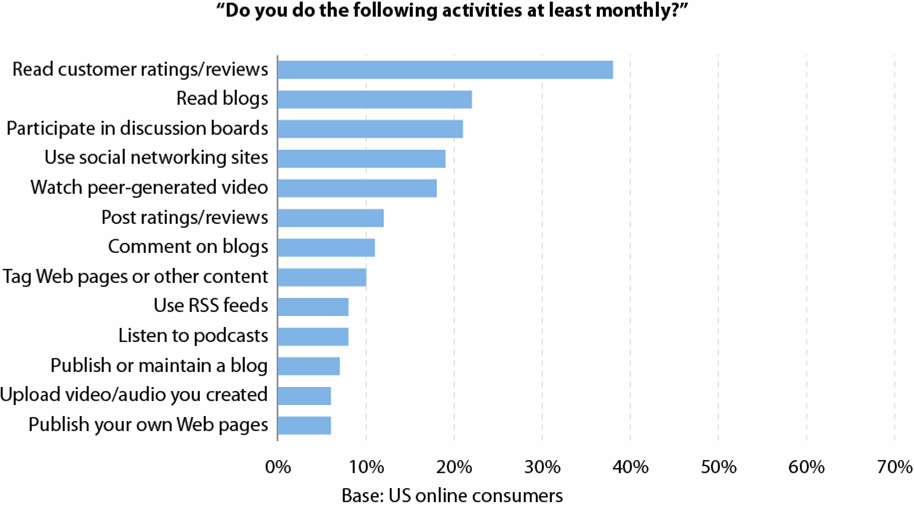
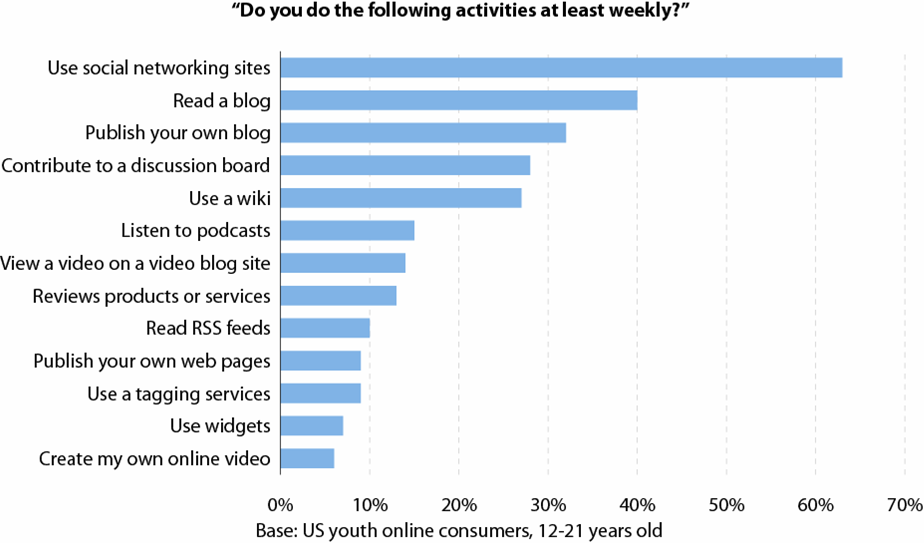
New research out from Forrester, called Social Technographics (whatever that means) – Slides here – that talks about who uses social media etc. I wouldn’t read too much into the numbers as its just one data point but its good for a 20 thousand feet level analysis.

Via Forrester
(All images via Forrester)

This is interesting although a bit lower then I would have thought. Its clear though that the youth is leading the charge.

Via forrester

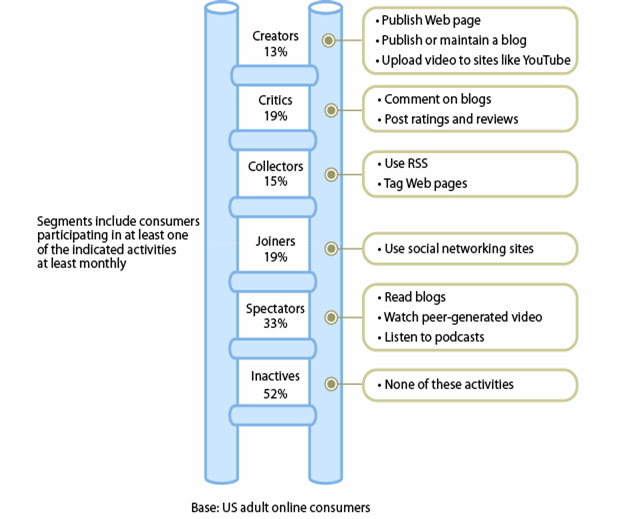
Another interesting breakdown below about further segmentation of participation. The breakdown below does not square with the 90-9-1 rule as its looking at the data related to participation at least once/per month, rather than aggregate number of visits.

via forrester

Some interesting data here…nothing earth shattering though (slides have some additional details on each of the type of users)…somewhat surprisingly critics show up as the highest earners…In a way it makes sense as critics are too busy to be full-time creators but articulate enough to be good critics.

What do you think?